

Every business relies on numbers to make decisions when to spend, when to save, and whether the business is truly profitable. But numbers only work when they can be trusted. This is where double-entry bookkeeping plays a critical role.
At Priority1 Group, this is something we see every day while managing books for growing businesses. When double entry bookkeeping is applied correctly, it removes blind spots, strengthens reporting accuracy, and gives business owners confidence in their numbers. When it isn’t, even profitable businesses can end up making decisions based on incomplete or misleading data.
At its simplest, double entry bookkeeping exists to ensure that every transaction is recorded from two perspectives creating balance, visibility, and accountability. While the term may sound technical, the logic behind it is practical and grounded in real-world business operations.
In outsourced bookkeeping environments like those managed by Priority1 Group, these blind spots often appear when businesses grow quickly but their record-keeping doesn’t evolve at the same pace. A structured double entry system ensures that growth does not come at the cost of financial clarity.
Blind spots often appear when:
A strong bookkeeping system ensures that financial data reflects reality, not assumptions. Double entry bookkeeping basics were designed specifically to eliminate these gaps by requiring every transaction to be recorded in a balanced way.
Every transaction has two sides. Something is received, and something is given up. Double entry bookkeeping records both sides so nothing exists in isolation.
For example:
This dual recording is what keeps the books balanced.
If you are asking what is double entry bookkeeping, it is a method where each transaction affects at least two accounts. One account is debited and another is credited, ensuring that totals remain equal.
The double entry bookkeeping system became the global standard because it mirrors how businesses actually operate every action has an equal and opposite effect.

Debits and credits are not indicators of profit or loss. They simply describe how values move between accounts.
A debit records one side of the transaction, and a credit records the other. Together, they tell the full story.
Thinking in terms of movementwhat increases and what decreases makes debits and credits easier to understand. These double entry bookkeeping principles help ensure that transactions are recorded logically and consistently.
For outsourced bookkeeping teams, this structured flow is essential. At Priority1 Group, maintaining this transaction discipline ensures that client reports remain reliable month after month, not just at year-end. When every transaction follows a clear path, issues are identified early rather than after decisions have already been made.
Every transaction starts with a source document, such as an invoice or receipt. That information is then entered into the bookkeeping system and posted to the relevant accounts.
This structured flow creates consistency across records.
Because every entry must balance, mistakes become visible quickly. Missing entries, duplicated transactions, or incorrect amounts disrupt the balance and signal a problem.
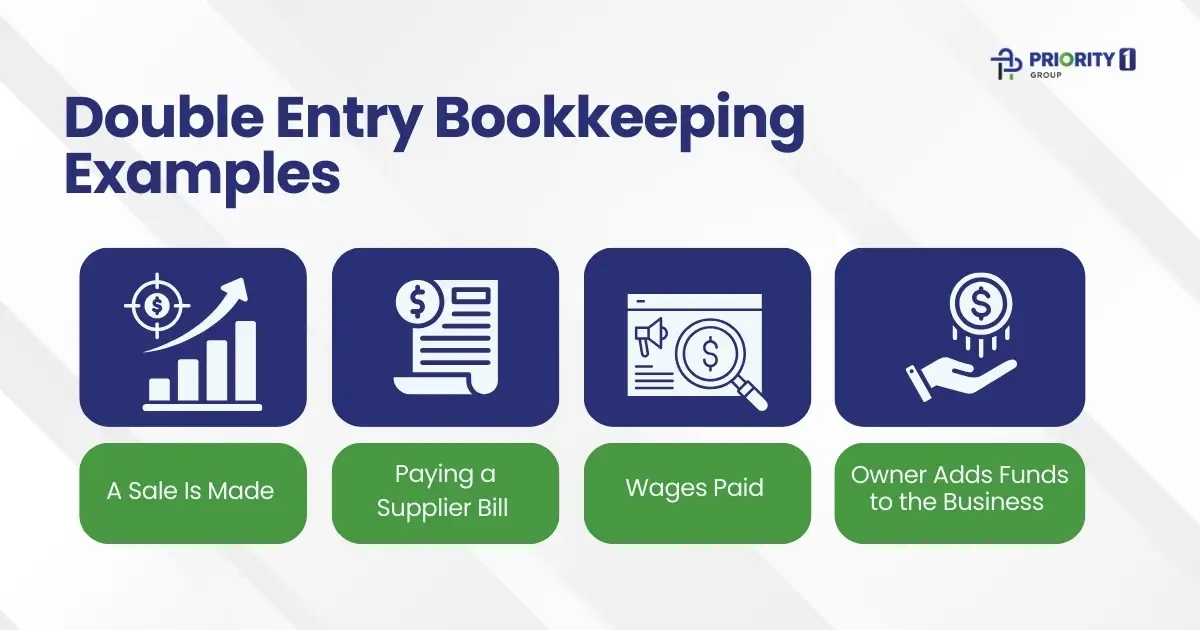
Practical examples make double entry bookkeeping examples easier to understand.
When a business makes a sale:
Two accounts change, keeping the books balanced.
When a bill is paid:
Both the cost and the cash impact are captured.
Paying wages:
This ensures true operating costs are reflected.
When an owner contributes money:
This keeps personal and business finances clearly separated.
Accounts are categories that group similar transactions together. Common account types include assets, liabilities, equity, income, and expenses. These form the foundation of accounts double entry bookkeeping.
Because every transaction affects two accounts, the system continuously cross-checks itself. Imbalances highlight issues that need attention.

Double-entry bookkeeping offers several practical advantages that help businesses maintain accurate, reliable, and decision-ready financial records. By recording every transaction from two perspectives, the system creates a strong foundation for financial clarity and long-term stability.
One of the strongest benefits of double entry bookkeeping is its built-in accuracy. Because every transaction must balance, errors such as missing entries, incorrect amounts, or one-sided recordings are easier to identify. When debits and credits do not match, it signals that something needs to be reviewed. This reduces the risk of mistakes going unnoticed and protects the integrity of the financial records.
Double entry bookkeeping provides a complete view of how money moves through the business. Each transaction shows both the source and the destination of funds, offering clarity around income, expenses, assets, and liabilities. This transparency helps business owners better understand cash flow patterns and financial health, rather than relying on fragmented or incomplete data.
Accurate profit and loss statements and balance sheets depend on balanced records. Double entry bookkeeping ensures that financial reports are built on consistent and structured data. This reliability allows business owners to trust their reports when reviewing performance, planning budgets, or assessing financial position.
As transaction volumes increase, double entry bookkeeping provides structure that scales. The system maintains order and clarity even as the business becomes more complex, preventing confusion and data gaps over time.
Every transaction must be properly considered before being recorded. This encourages careful bookkeeping practices, reduces careless errors, and creates a stronger sense of accountability across financial records.
Accurate financial reports begin with correctly recorded transactions. Profit and loss statements and balance sheets rely on every entry being complete and balanced. Double entry bookkeeping ensures that each transaction is recorded from two perspectives, creating a consistent trail from day-to-day bookkeeping through to final reports.
Because each debit is matched with a corresponding credit, inconsistencies are easier to detect before reports are generated. This reduces the risk of misleading figures, missing expenses, or overstated income. As a result, financial reports reflect the true performance and position of the business rather than estimates or partial data.
Business decisions are only as good as the information behind them. Reliable financial reports support accurate budgeting, cash flow planning, and performance analysis. When reports are built on balanced and well-structured records, business owners can identify trends, assess profitability, and plan for future growth with confidence.
Double entry bookkeeping removes guesswork from decision-making. Instead of relying on assumptions, businesses can trust their numbers, respond quickly to issues, and make informed strategic decisions that support long-term stability and success.
Despite modern accounting software and automation, the logic behind what is double entry system of bookkeeping has remained unchanged for centuries. It continues to work because it mirrors how real business transactions occur every action has an equal and measurable impact. Technology may speed up data entry, but it does not replace the need for structured, balanced records.
Understanding this system helps business owners move beyond simply “looking at numbers” to actually interpreting them. When business owners understand how transactions flow and balance, they can trust their reports, identify issues earlier, and ask smarter financial questions. This knowledge creates stronger oversight, better control, and more confident decision-making in today’s fast-moving business environment.
Double entry bookkeeping remains essential because it reflects how businesses actually operate. By recording both sides of every transaction, it prevents blind spots, exposes errors early, and creates records that can be trusted.
For business owners and for outsourced bookkeeping partners like Priority1 Group this system is the foundation of reliable financial reporting. When books are balanced and structured correctly, reports become meaningful, decisions become informed, and uncertainty is reduced. Double entry bookkeeping transforms transactions into insight, giving businesses the clarity and confidence they need to grow sustainably.