
For NDIS providers across Australia, rostering is more than just assigning shifts. A well-structured NDIS roster is a compliance document, a financial safeguard, and a service delivery blueprint.
Poorly managed NDIS rostering can result in:
Understanding how an ndis roster of care works is essential for operational stability and long-term growth.
An NDIS roster is a structured schedule that allocates support workers to participants based on approved funding, support categories, and service agreements.
Unlike general staff scheduling, an NDIS roster must:
It is both a workforce management tool and a compliance record.
An NDIS roster of care outlines:
The roster of care NDIS framework ensures that every service provided matches the participant’s approved plan.
This alignment is critical for:
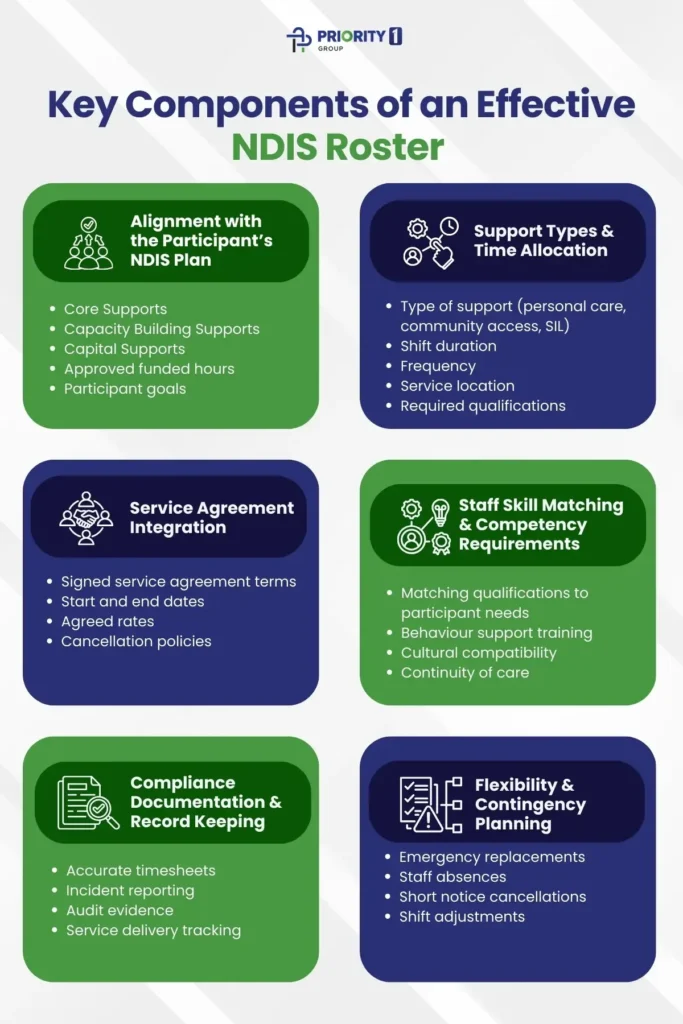
Every roster must reflect:
Rosters that exceed funded hours can lead to compliance breaches and payment issues.
A compliant roster should specify:
This protects providers during audits.
The roster must mirror:
Any variation must be documented.
Effective NDIS rostering includes:
Participant-centred scheduling improves outcomes and satisfaction.
Strong rostering systems support:
Without documentation, claims may be rejected.
Providers must plan for:
Flexibility reduces service disruptions.
The NDIS Commission requires providers to maintain accurate service records.
Rostering errors can trigger:
Compliance begins with structured rostering systems.
Australian providers frequently face:
Without streamlined systems, growth becomes unsustainable.
Modern NDIS rostering software offers:
Digital systems reduce risk significantly.
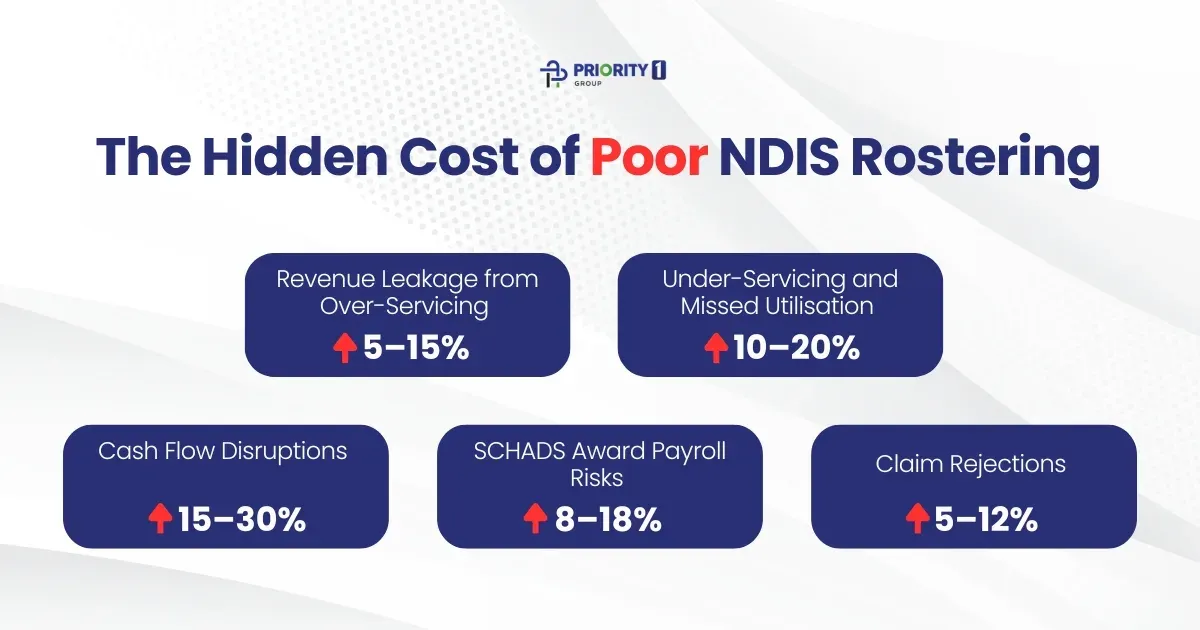
Even small rostering inefficiencies can create significant financial consequences for NDIS providers. Below is a realistic snapshot of the operational risks associated with poorly managed NDIS rostering:
Delivering support beyond approved funded hours can result in 5–15% revenue loss per participant plan, particularly in high-volume service environments. Without funding alignment, those hours cannot be claimed.
Inaccurate scheduling may cause participants to receive fewer funded hours than allocated, reducing plan utilisation by 10–20% and affecting both compliance and revenue forecasting.
Claim mismatches and incorrect line item usage can delay payments, impacting up to 15–30% of monthly cash flow cycles. Inconsistent rostering directly affects financial stability.
Improper calculation of penalty rates, overtime, or allowances may inflate payroll costs by 8–18%, while increasing exposure to Fair Work audits and back-pay liabilities.
Poor documentation and inaccurate rostering may result in 5–12% claim rejection rates, creating additional administrative workload and lost revenue opportunities.
When providers implement structured or outsourced NDIS roster of care systems, many experience:
The financial difference between reactive rostering and structured NDIS rostering can determine whether a provider struggles to maintain margins — or scales sustainably.
Forward-thinking NDIS providers are recognising that rostering is not just a scheduling function, it is a compliance and financial control system.
Outsourcing allows providers to:
Outsourcing NDIS rostering can reduce internal administrative workload by approximately 25–40%, allowing management teams to reallocate time toward strategic growth and service improvement.
Structured rostering systems and external oversight can lower documentation and audit-related errors by 30–50%, significantly reducing financial and regulatory risk.
Optimised scheduling improves staff utilisation rates by around 15–25%, minimising overtime costs and reducing under-servicing or over-servicing risks.
Providers with streamlined rostering systems often experience 20–35% operational scalability improvement, enabling them to onboard more participants without proportionally increasing overhead.
With reduced administrative strain, providers report improved service consistency and participant satisfaction levels rising by approximately 10–20%, supporting long-term retention and reputation growth.
For growing providers, outsourcing becomes a strategic advantage.
Priority1 Group partners with NDIS providers who want structure, scalability, and sustainable growth.
Our integrated approach includes:
By combining operational outsourcing with digital growth strategies, Priority1 Group helps providers streamline internal systems while expanding their market presence.
This integrated approach reduces risk while driving sustainable growth.
We don’t just manage tasks, we strengthen systems.
The result?
Providers gain clarity, control, and confidence.
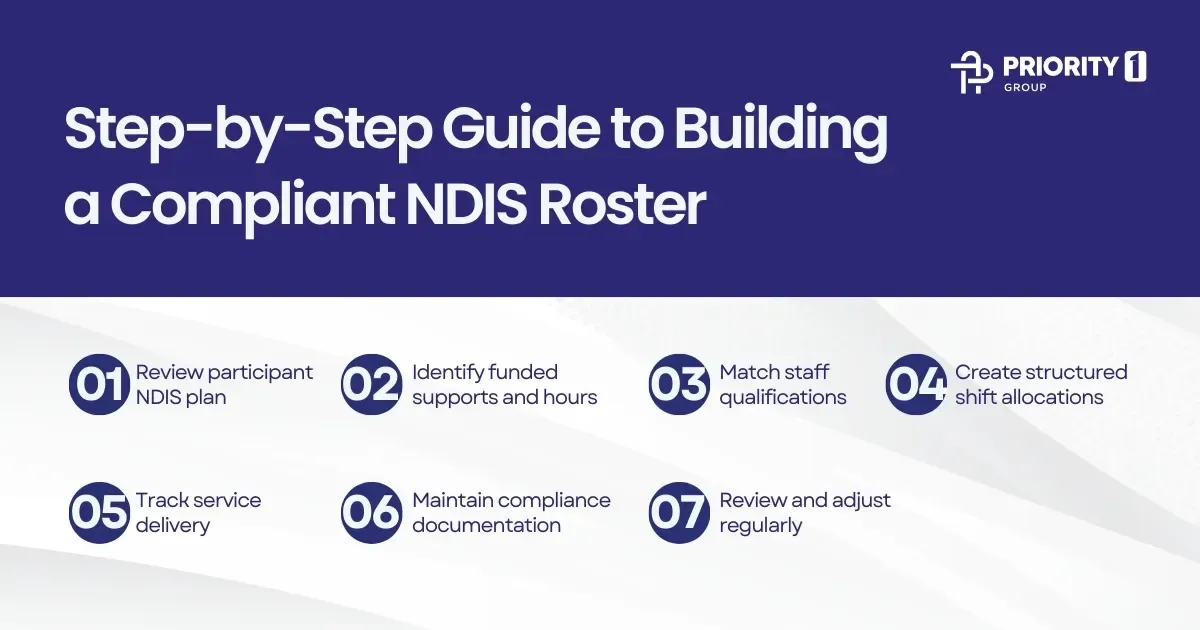
1. Review participant NDIS plan
2. Identify funded supports and hours
3. Match staff qualifications
4. Create structured shift allocations
5. Track service delivery
6. Maintain compliance documentation
7. Review and adjust regularly
Consistency is key.
A well-structured NDIS roster of care protects your organisation, strengthens compliance, and improves participant outcomes.
As the NDIS landscape becomes more regulated and competitive, providers must adopt structured systems that reduce risk and improve efficiency.
With expert outsourcing, bookkeeping, and digital growth support, Priority1 Group helps NDIS providers across Australia streamline operations and build sustainable businesses.