
Here’s a hard truth that most B2B marketers learn the expensive way: a bigger audience is not a better audience. You can pour budget into campaigns that reach tens of thousands of people, generate impressive-looking impression counts, and still watch your pipeline stay flat. Why? Because reach without relevance is just noise.
In B2B, the buying decision isn’t made by a single person scrolling through a feed. It’s made by committees, shaped by procurement processes, and stretched across sales cycles that can run months or even years. Getting in front of the right people; the ones who actually influence and authorise purchases is what separates marketing that drives revenue from marketing that drives only reports.
This guide breaks down how to identify, segment, and reach the audience that matters, with a strategic framework you can apply regardless of your industry or deal size.
Consumer marketing often works on emotion, impulse, and individual choice. A person sees an ad, wants the product, and buys it sometimes within minutes. B2B operates on entirely different mechanics.
According to research from Gartner, a typical B2B buying group for a complex solution involves six to ten decision-makers, each armed with their own information and priorities. That means your “audience” isn’t one person; it’s a network of stakeholders, each evaluating your offer through a different lens. The CFO cares about cost and ROI. The IT director worries about integration and security. The end user just wants something that makes their day easier.
If your targeting strategy treats all of these people as interchangeable, your message will resonate with none of them. The strategic approach starts by acknowledging this complexity rather than flattening it.
There’s also the matter of intent and timing. In B2B, only a small fraction of your total addressable market is actively in-market at any given moment. The challenge isn’t just reaching the right companies, it’s reaching the right people within those companies at the moment they’re solving a problem you can fix.
Most companies have an Ideal Customer Profile (ICP) document somewhere. Far fewer have one that’s grounded in evidence rather than aspiration. There’s a common failure mode here: teams describe the customers they wish they had rather than the ones who actually close, stay, and renew.
A useful ICP is built backward from your best existing accounts. Pull your customer data and look for patterns among your highest-value, longest-retained, most-referenceable clients. Examine firmographics like industry, company size, revenue, and geography, but don’t stop there. The richer signals are often behavioral and situational: What triggered their purchase? What technology stack were they running? What organisational change preceded the deal?
A practical example illustrates the difference. Imagine a software company that assumed its ICP was “mid-market manufacturers.” When the team actually analysed closed-won deals, they discovered their best customers weren’t defined by industry at all; they were companies that had recently hired a new operations leader. That hire, not the vertical, was the real buying trigger. Reorienting targeting around that signal produced dramatically more qualified leads than industry-based targeting ever had.
The lesson: your ICP should describe the conditions under which someone buys, not just the category they belong to.
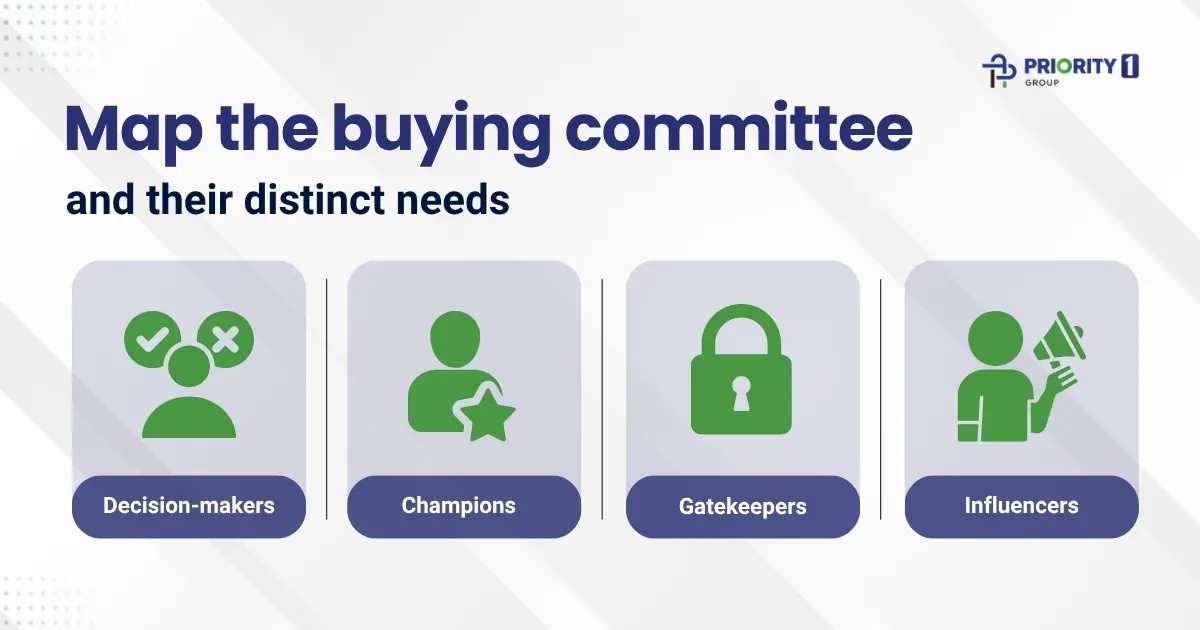
Once you know which companies to target, you need to identify the people inside them who matter. This is where many otherwise-sophisticated targeting strategies fall apart; they nail the account but miss the humans.
Within any target account, you’ll typically encounter several distinct roles:
Effective targeting means crafting differentiated messaging for each of these roles rather than blasting everyone with the same generic pitch. The champion needs an ROI calculator; the technical influencer needs a security white paper; the executive needs a one-page business case. Same account, very different conversations.
Knowing who to target gets you halfway. Knowing when gets you the rest of the way. Intent data, signals that indicate an account is actively researching solutions like yours, has transformed B2B targeting from a static exercise into a dynamic one.
These signals come from multiple sources. First-party intent includes behavior on your own properties: repeat visits to pricing pages, downloads of bottom-funnel content, demo requests. Third-party intent captures research activity happening across the broader web, a target account suddenly consuming content about the category you compete in.
When you combine firmographic fit (this account matches our ICP) with intent (and they’re showing buying behavior right now), you get the highest-probability prospects in your entire market. Prioritising outreach toward these accounts, rather than spreading effort evenly, is one of the highest-leverage decisions a B2B marketing team can make.
A word of caution from experience: intent data is directional, not definitive. A spike in research activity tells you something is happening, but it doesn’t tell you whether that account is evaluating you, a competitor, or simply educating themselves with no near-term plans. Treat intent signals as a prompt to investigate and engage thoughtfully, not as a guarantee of readiness.
A targeting strategy is only as good as your ability to reach the people it identifies. The temptation is to be everywhere; the smarter move is to be precise.
Account-based marketing (ABM) platforms let you serve tailored campaigns to specific companies and even specific roles within them. LinkedIn remains the dominant channel for reaching professional decision-makers by job title, function, and seniority. Industry publications, niche communities, and trade events often deliver far higher concentration of qualified prospects than broad digital advertising ever will.
The strategic principle here is concentration over dispersion. It is almost always better to dominate the three channels where your buyers genuinely spend their attention than to maintain a thin, forgettable presence across a dozen.
Audience targeting is never “set and forget.” Markets shift, buying behaviors evolve, and your own product and positioning change over time. The teams that win are the ones that treat targeting as a living hypothesis to be tested and refined.
Build tight feedback loops between marketing and sales. Sales conversations are the richest source of insight you have about whether you’re reaching the right people. When reps consistently report that leads are unqualified or that deals stall at a particular stage, that’s targeting feedback, use it. Conversely, when certain segments close faster and retain longer, double down on them.
Track the metrics that reflect quality, not just volume. Pipeline contribution, conversion rates by segment, deal velocity, and customer lifetime value tell you far more about targeting effectiveness than impressions or raw lead counts ever will.
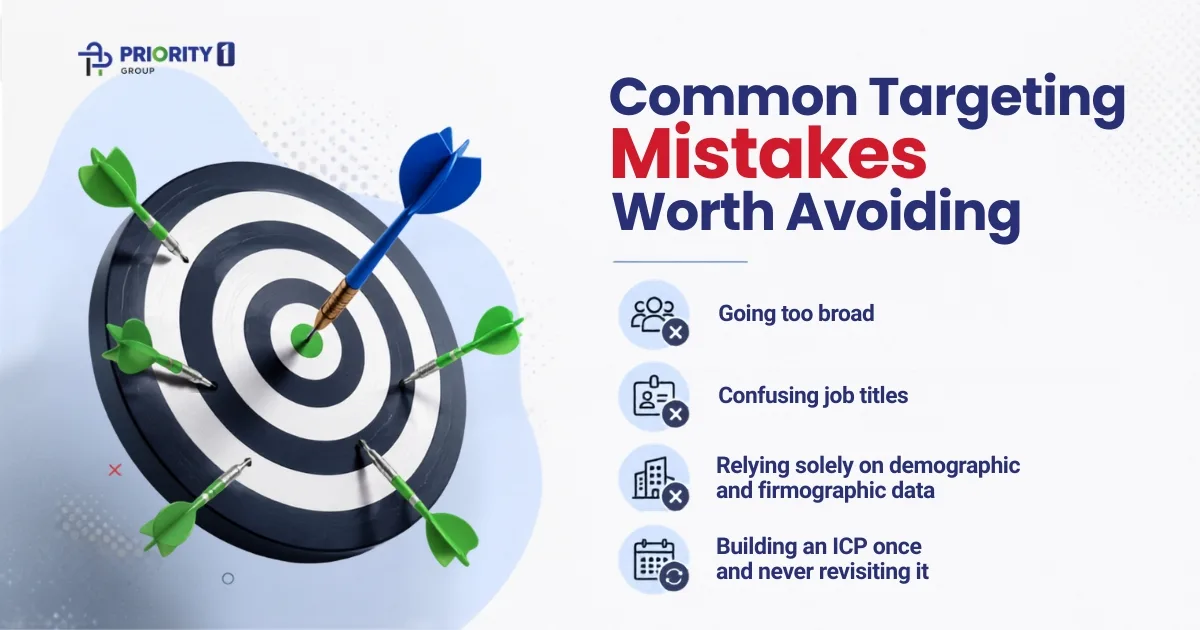
Even experienced teams stumble in predictable ways. A few worth flagging:
Going too broad out of fear of missing opportunities almost always backfires; it dilutes messaging and wastes budget. Confusing job titles with actual influence is another trap; the person with the impressive title isn’t always the one driving the decision. Relying solely on demographic and firmographic data while ignoring behavioral and intent signals leaves enormous value on the table. And perhaps most common: building an ICP once and never revisiting it, even as the business evolves underneath it.
Strategic audience targeting in B2B isn’t about reaching more people, it’s about reaching the right people with the right message at the right moment. It requires a clear-eyed ICP grounded in real data, a nuanced understanding of the buying committee, intelligent use of intent signals, disciplined channel selection, and a commitment to continuous refinement.
The companies that get this right don’t just generate more leads. They generate better one’s prospects who convert faster, spend more, and stay longer. In a discipline where waste is the default and precision is the exception, targeting is where strategic advantage is won.
At Priority1 Group, we’ve seen firsthand how transformative a disciplined targeting strategy can be for B2B organisations ready to move beyond vanity metrics and build a pipeline that actually drives growth. The fundamentals in this guide are the same ones that separate marketing programs that report activity from those that deliver revenue.
The shift from broad reach to strategic targeting is one of the most important moves a B2B marketing team can make. It demands more thinking upfront and more discipline along the way, but the payoff is a marketing engine that consistently puts your message in front of people who are positioned and motivated to buy. Start with a data-grounded ICP, map your buying committees with real care, let intent guide your timing, and never stop refining. Do that, and you’ll spend less to reach fewer people and close far more business as a result.