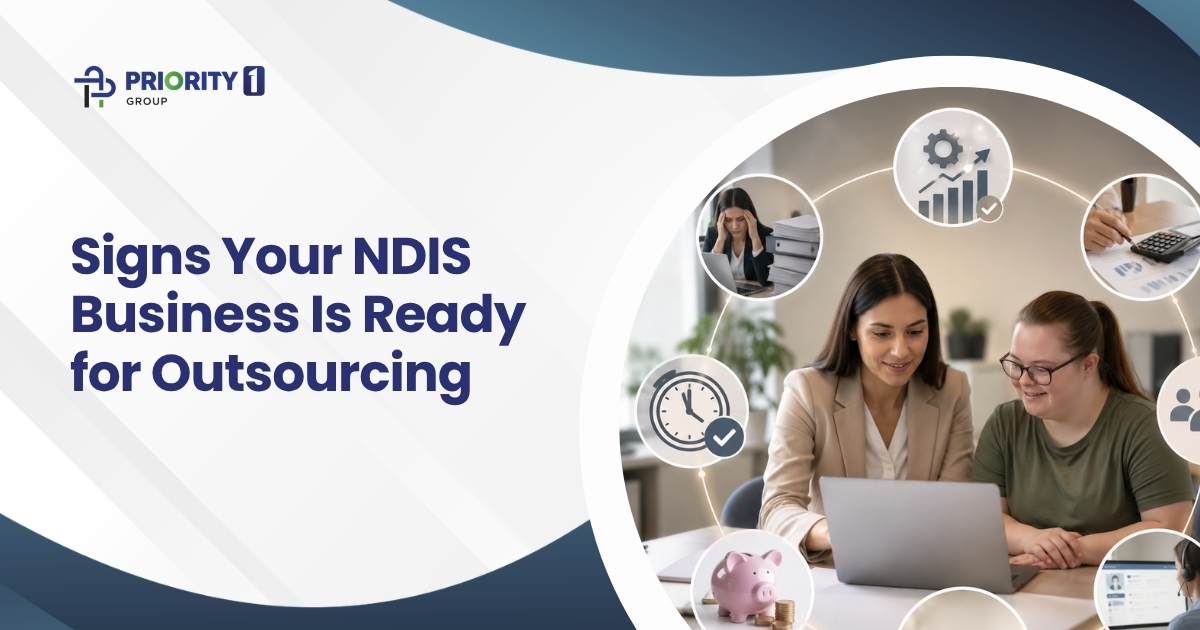
Running an NDIS business in Australia is rewarding work. You’re genuinely changing lives. But let’s be honest about the other side of it, the late nights reconciling claims, the constant scramble to keep up with PRODA portal updates, the participant who needed a callback three days ago that you only just remembered. If any of that sounds familiar, you’re not failing. You’re growing. And growth has a way of quietly outpacing the systems and people you started with.
The hard part is knowing when to bring in outside help. Outsource too early, and you’re paying for the capacity you don’t need. Leave it too late, and you risk burnout, compliance slip-ups, and participants who feel like a number instead of a person. So how do you read the signs?
At Priority1 Group, we work with NDIS providers across Australia every day, and we’ve noticed the same patterns come up again and again. Here are the clearest signals that your business is ready to outsource and what tends to happen when providers act on them.
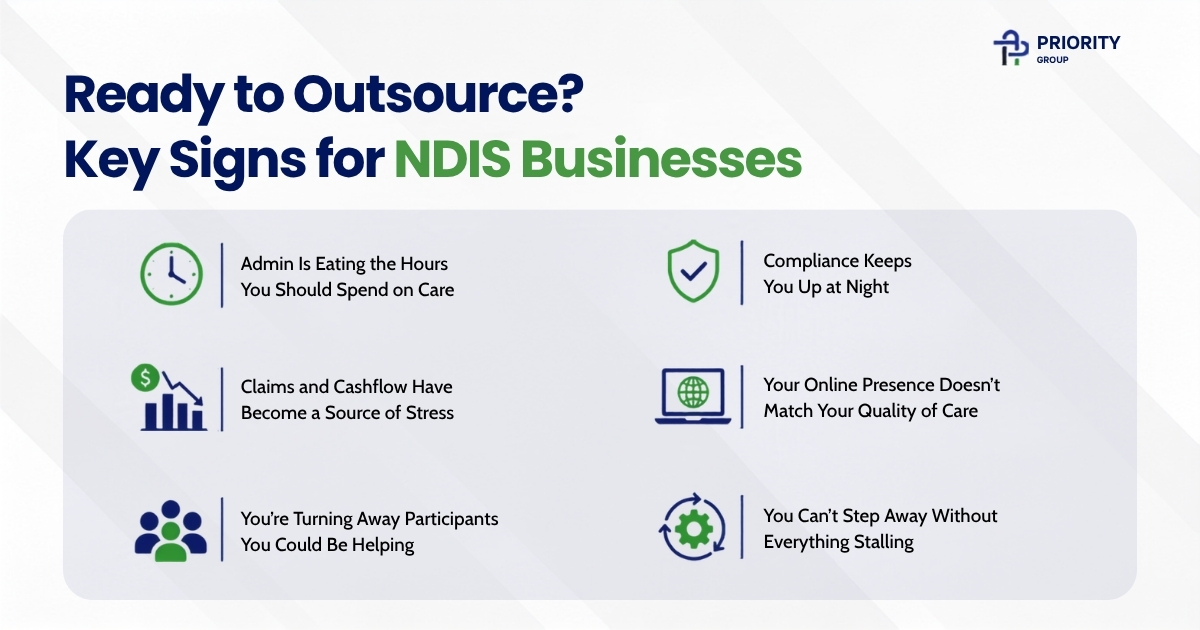
Here’s a quick gut-check. Think back over the last fortnight. How many hours did you spend on actual service delivery and relationship-building versus invoicing, rostering, claim submissions, and chasing paperwork?
If the admin column is winning, that’s your first sign.
Picture a support coordinator we’ll call Maya. She started with a handful of participants and could manage everything from her laptop after dinner. Two years on, she’s supporting forty participants, and the “after-dinner” admin has crept to 11 pm most nights. She’s brilliant at coordination, but she’s spending 60% of her week on data entry. The work that made her good at her job, sitting with people, understanding their goals, and problem-solving, keeps getting squeezed.
When your most valuable people are buried in tasks that don’t require their expertise, you’re not just losing hours. You’re losing the very thing that differentiates your business. Outsourcing the back-office load frees Maya to do what only Maya can do.
NDIS claiming is unforgiving. A misaligned service booking, an incorrect line item, or a claim submitted against the wrong support category: any of these can mean rejected payments and a cash flow hole that hits at exactly the wrong moment.
If you find yourself dreading the claiming cycle, or if you’ve had payments rejected more than once because something slipped through, your processes have outgrown your capacity to manage them manually.
Consider a small therapy provider that was carrying around $40,000 in unclaimed or rejected invoices simply because no one had time to investigate the rejections and resubmit them correctly. The money was owed. It was sitting there. They just didn’t have a dedicated person to chase it. A specialised claims and accounts function, whether in-house or outsourced, turns that leaking bucket into reliable, predictable income.
This is one of the most common reasons providers come to us, and it’s also one of the fastest wins. When claims are handled by people who do nothing but NDIS claims all day, error rates drop and cash flow steadies.
This one stings because it goes against why most providers got into this work in the first place.
When a referral comes in, and your instinct is “we don’t have the capacity,” that’s a business decision being made for you by your limitations rather than your ambitions. Every participant you can’t onboard is someone who waits longer for support and revenue that your business doesn’t capture.
The instinct is often to solve this by hiring. But recruitment in the disability sector is slow, expensive, and competitive, and onboarding a new internal team member can take months before they’re productive. Outsourcing intake coordination, scheduling, and administrative onboarding lets you say “yes” to growth without the lead time and overhead of building every function internally from scratch.
The NDIS Quality and Safeguards Commission doesn’t grade on a curve. Documentation, incident reporting, worker screening, service agreements, audit readiness, it all has to be right, and the requirements evolve.
If you’re not fully confident you’d sail through an audit tomorrow, or if compliance is something you “get to when there’s time,” you’re carrying a risk that could threaten your registration entirely.
Imagine a provider scaling quickly across multiple regions, with service agreements stored in three different formats, incident reports living in someone’s email inbox, and no consistent system tying it together. They weren’t being careless they were simply moving too fast for their systems to keep up. That’s exactly the gap where a single misstep can become a serious problem. Bringing in support that lives and breathes NDIS compliance means audit readiness becomes a steady state, not a fire drill.
Here’s a sign people often overlook. You might deliver outstanding support, but if a participant’s family searches for you and finds a slow, outdated website or no clear website at all you’ve lost them before you’ve had a chance to show what you do.
In a sector built on trust, your digital presence is frequently the first impression. A confusing site, no online enquiry form, or content that doesn’t clearly explain your services quietly sends referrals to competitors who simply look more established and reliable.
Think of two providers offering near-identical services in the same city. One has a clear, professional, mobile-friendly website that ranks when families search for support. The other relies entirely on word of mouth. Same quality of care, very different growth trajectories. This is where digital marketing and web design stop being “nice to have” and become a genuine driver of enquiries.
At Priority1 Group, we sit at the intersection of NDIS operations and digital growth, which means we understand both why the participant experience matters and how to make sure the right people find you in the first place.
Try this test. Could you take a genuine two-week holiday, phone off, and trust that claims would be submitted, participants supported, and enquiries answered?
If the honest answer is “absolutely not,” then you don’t really own a business yet. You have a job that depends entirely on you. That’s a fragile position, and it’s a clear sign you’ve outgrown a structure where everything routes through one or two people.
A business that’s ready to scale needs functions that run without the founder’s constant input. Outsourcing the right operational pieces is one of the most direct ways to build that resilience, so the business keeps serving participants whether you’re at your desk or not.
You don’t need to tick every box on this list. Even two or three of these signs showing up consistently is usually enough to know that the way you’re working now won’t carry you where you want to go.
Outsourcing isn’t about handing over control or caring less about your participants. Done well, it’s the opposite. It’s about protecting the parts of your business that matter most: the care, the relationships, the outcomes, by taking the operational weight off your shoulders and putting it in expert hands.
That’s exactly what we do at Priority1 Group. We’re a business outsourcing partner built specifically for Australian NDIS providers, combining hands-on NDIS operational support with digital marketing and web design that helps you grow. Whether it’s claims and admin draining your week, compliance keeping you anxious, or an online presence that isn’t pulling its weight, we help you turn those pressure points into a foundation for sustainable growth. Check out our completed /on going project
If a few of these signs hit close to home, it might be worth a conversation. No pressure, no obligation, just a chance to talk through where your business is feeling the strain and whether the right support could lift it.
