

Most SCHADS breaches don’t happen in the payroll office. They happen the moment a shift is created.
By the time an underpayment surfaces in a timesheet or a Fair Work back-pay claim, the mistake is already weeks old, baked in when someone dropped a one-hour visit onto a Sunday roster, split a support worker’s day around a client’s nap, or scheduled an overnight without deciding whether it was a sleepover or active night duty. The award interpretation that follows only ever repeats the decision made at the point of scheduling.
That’s the shift in thinking behind this guide. Instead of treating SCHADS as a payroll problem to reconcile after the fact, we look at compliance as a set of decisions made while the shift is being built, because that’s where the money is won or lost. If you’re an NDIS provider, coordinator, or roster manager trying to keep the Social, Community, Home Care and Disability Services Industry Award (MA000100) on your side, this is where to focus.
All rates and provisions below reflect the SCHADS Award as it stands after the 1 July 2026 Annual Wage Review (a 4.75% increase) and the sleepover and overtime changes that took effect from the first full pay period on or after 1 June 2026. Because dollar figures change every 1 July and the Fair Work Commission can vary provisions mid-year, as it did with sleepovers in 2026 always confirm against the current Fair Work Ombudsman Pay Guide before you rely on a number.
The SCHADS Award covers more than 250,000 workers across disability support, home care and community services, and it is widely regarded as one of the most complex modern awards in Australia. Multiple streams, classification levels, pay points, a penalty-rate matrix, broken-shift rules, sleepover provisions and interacting allowances all sit on top of each other.
Here’s the part that catches providers out: a SCHADS underpayment is rarely one dramatic error. It’s a small, correct-looking decision repeated across every shift, every fortnight, sometimes for years. A missing broken-shift allowance worth around twenty dollars doesn’t look like much on a single day. Multiplied across a workforce of forty support workers over three years, it becomes a six-figure liability with penalties attached.
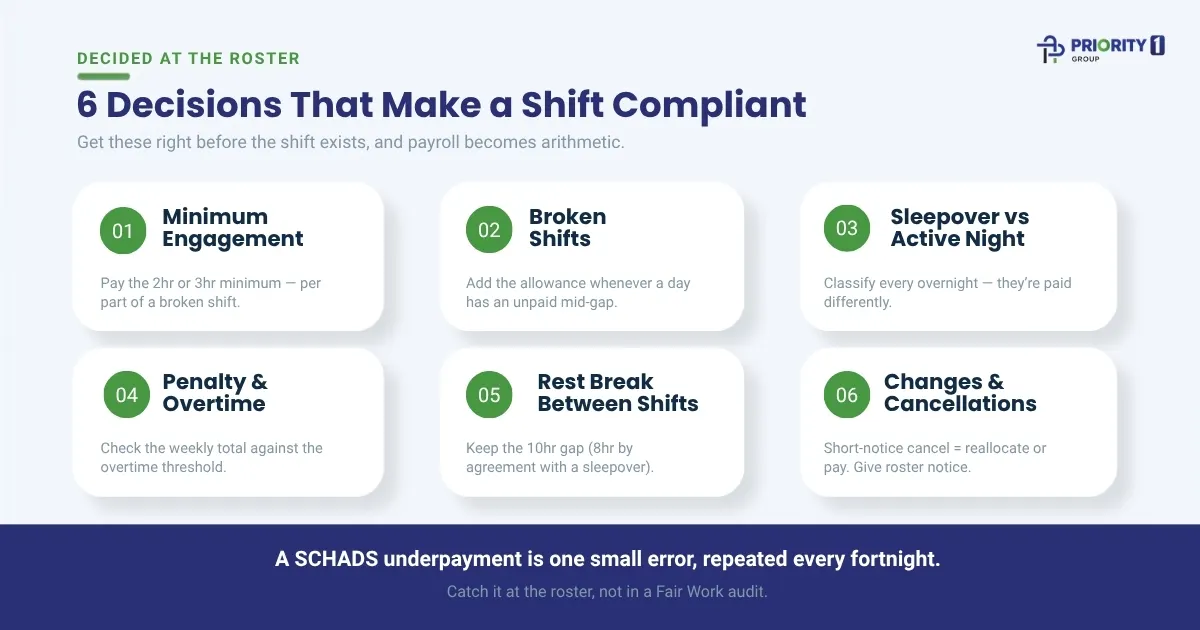
The roster is the origin point for six decisions that determine whether a shift is compliant before a single hour is worked:
Get these right on the roster, and payroll becomes arithmetic. Get them wrong, and no payroll process can fully rescue you.
The most commonly overlooked SCHADS rule is also the simplest: workers must be paid a minimum number of hours per shift, regardless of how long they actually work.
For most disability support employees, the minimum payment is two hours per shift. For social and community services employees not performing disability services work, it rises to three hours per shift, and, critically, that minimum applies to each separate part of a broken shift, not just to the day as a whole.
Where this bites: a roster built around a client’s needs often contains short, high-frequency visits. A thirty-minute medication prompt, a forty-five-minute morning routine, a one-hour community access drop-in. Each of those, in isolation, still attracts the full minimum engagement. Schedule three one-hour visits with three different clients as three separate shifts, and you may owe six paid hours, not three.
This is one of the clearest examples of why the roster, not the payslip, is where compliance is decided. Consolidation is only possible before the shift exists.
A broken shift is any arrangement where a worker performs two or more separate periods of work in a single day, with an unpaid gap between them. In the NDIS world, they’re almost unavoidable: a worker who supports a participant with a morning routine, breaks while the participant is at a day program, then returns for the evening is working a broken shift by definition.
SCHADS requires a broken-shift allowance on top of the hours worked:
The award also caps how a broken shift can be structured and interacts with minimum-engagement rules for each portion. The trap is subtle: rosters built around client availability generate broken shifts constantly, and because the individual worked hours all look correct, the missing allowance never announces itself. Payroll pays the hours, the timesheet reconciles, and the allowance quietly goes unpaid every fortnight.
Flag a broken shift at creation when a single worker’s day contains a gap that isn’t a paid meal break, and they’re expected to resume work later the same day. If your rostering tool doesn’t automatically attach the allowance when it detects that pattern, that’s a manual checkpoint you need to build in.
Overnight support is where SCHADS is most litigated, and the single most important decision is a definitional one you make on the roster: is this shift a sleepover or active night duty? They are paid completely differently, and calling one the other is a live audit and back-pay risk.
A sleepover is where the worker is required to be on the premises overnight and available if needed, but is otherwise permitted to sleep. It attracts a flat allowance of approximately $62.87 per night (set at 4.9% of the standard rate). The allowance covers being present, nothing more.
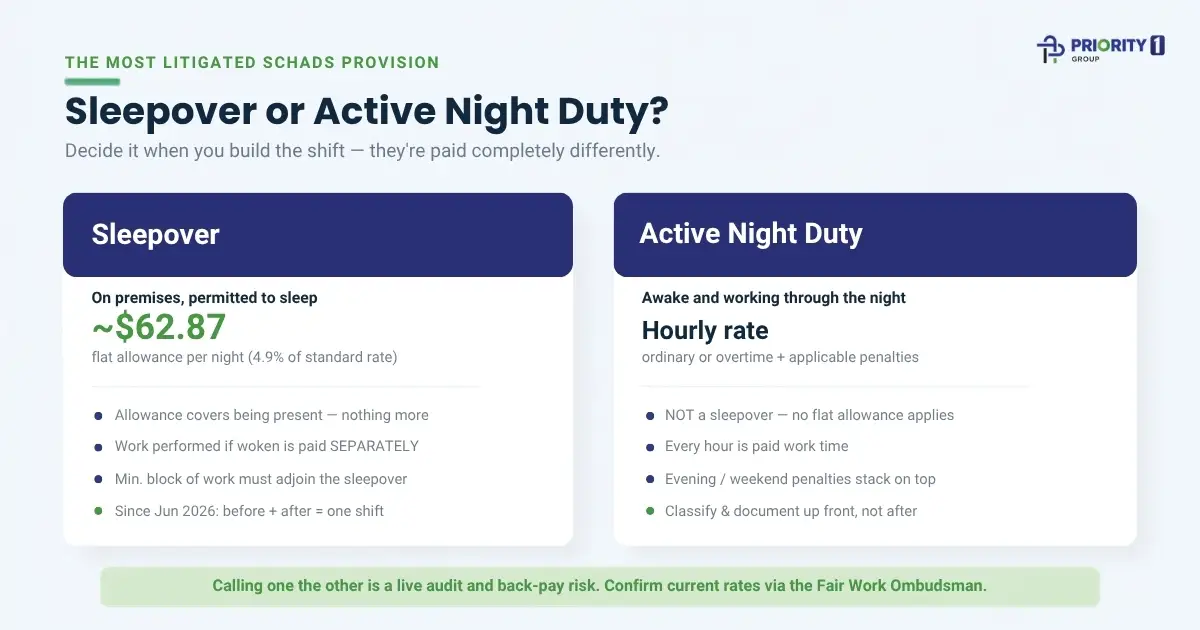
The part providers get wrong: any actual work performed during a sleepover is paid separately, at the applicable rate with a minimum payment per call-out. It is not absorbed by the allowance. If a worker is woken twice to assist a participant, those periods are paid on top of the flat rate.
Two structural rules make this even more exacting after the 2026 changes:
Active night duty is different: the worker is expected to stay awake and working through the night. That’s ordinary (or overtime) hours at the relevant rate with applicable penalties, not a sleepover allowance. The distinction has to be settled when the shift is designed, communicated to the worker, and documented. Deciding after the fact is exactly the ambiguity Fair Work scrutinises.
SCHADS penalty rates apply to evenings, Saturdays, Sundays and public holidays, and they stack differently depending on whether the worker is permanent, part-time or casual. Casuals carry a 25% loading on top of the penalty, which is why a casual Saturday shift can reach 175% of the base rate rather than the permanent Saturday figure.
Overtime is where rostering discipline matters most, because the thresholds differ by stream and the trigger is often crossed by a well-intentioned roster tweak:
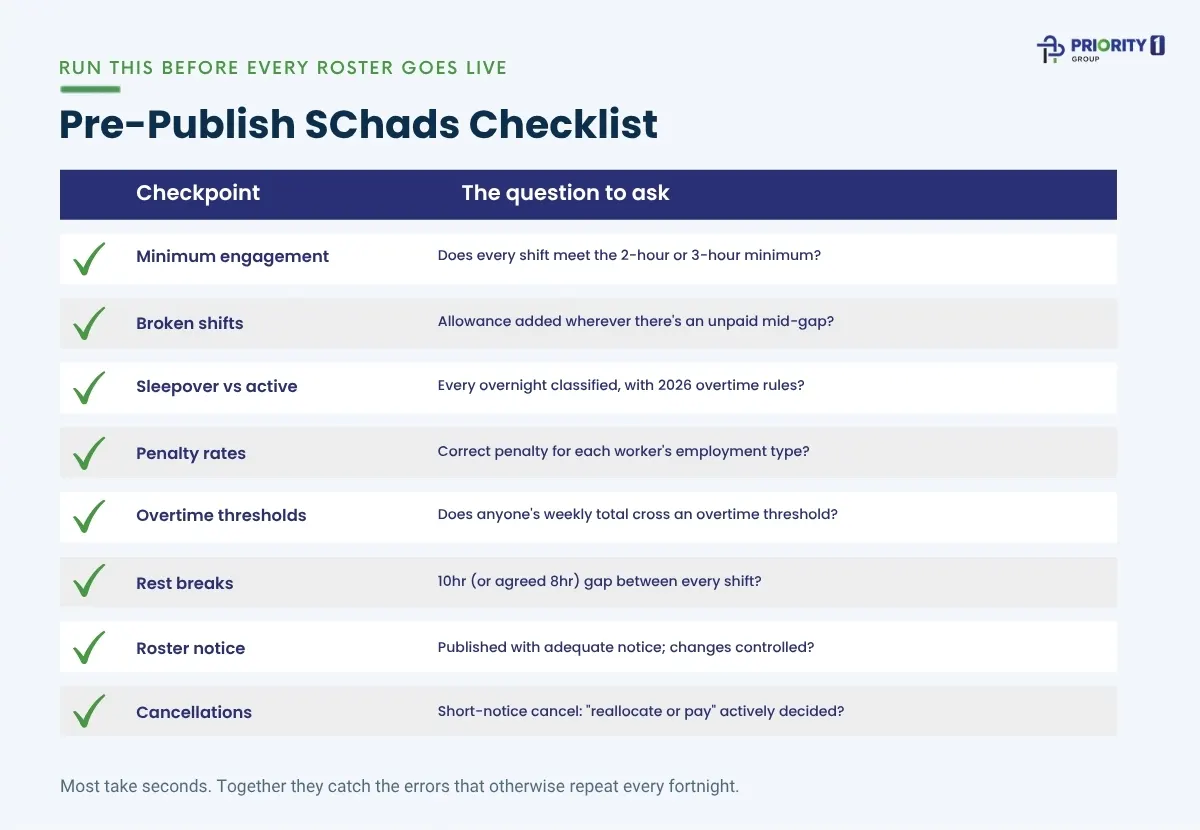
Before you publish, sanity-check: does any worker’s rostered week cross an overtime threshold once all shifts are totalled? Does a weekend or public-holiday shift carry the correct penalty for that worker’s employment type? These are five-second checks on the roster that prevent fortnightly recurring errors.
SCHADS requires a minimum break of 10 hours between rostered shifts. Where a sleepover is involved, an 8-hour break can apply by agreement (a provision clarified in the 2026 changes). Roster a worker off a late evening shift and back onto an early morning one without that gap, and you’ve created a breach and, in many cases, an obligation to pay overtime until the break is given.
This is purely a rostering decision. It never shows up as a rate error; it shows up as a pattern of tired staff, safety incidents, and, eventually, a Fair Work finding. Building a hard rule into your scheduling process- no worker rostered inside the minimum break window- closes it off entirely.
Two SCHADS provisions turn ordinary operational churn into a payment obligation, and both are decided at the roster:
a. Notice of roster changes. The award sets expectations around giving employees proper notice of their roster and of changes to it. Publishing rosters at least two weeks in advance and managing changes through a controlled process isn’t just good practice; it’s how you stay on the right side of the notice provisions and avoid disputes.
b. Short-notice client cancellations. This one surprises providers new to the sector. If a home care or disability support client cancels within a short window (commonly seven days), the provider generally must either reallocate the worker to other suitable work or still pay the worker for the cancelled shift. The participant’s cancellation does not automatically cancel your wage obligation. That means a cancelled shift needs an active decision- reallocate or pay- not a quiet deletion from the roster.
The cash-flow angle matters here too, and it’s specific to the NDIS: a cancelled shift you still have to pay for may or may not be claimable against the participant’s plan depending on the NDIS cancellation rules in force. When the wage obligation and the claim rules don’t line up, the gap comes straight out of your margin.
Before a roster goes live, run it against these questions. Most take seconds; together they catch the errors that otherwise repeat every fortnight.
SCHADS compliance is a moving target by design. Rates reset every 1 July with the Annual Wage Review, and the Fair Work Commission varies provisions between cycles; the mid-year 2026 sleepover and overtime changes are a reminder that “set and forget” is not an option. A payroll system configured correctly in 2024 and left untouched is almost certainly non-compliant today.
Three habits keep providers ahead of it:
a. Configure the award at the roster layer, not just payroll. If your scheduling tool understands minimum engagements, broken shifts, sleepovers and overtime thresholds, most breaches are prevented before they’re created rather than caught afterward.
b. Audit a sample of paid shifts each quarter. Pull a fortnight of real timesheets and check them line by line against the current award, broken-shift allowances, sleepover call-outs, penalty rates by employment type, minimum-payment top-ups. A recurring error found in a quarterly sample is a small fix; the same error found in a Fair Work audit is a back-pay claim.
c. Re-check every provision after each wage review and FWC determination. Diarise 1 July, and watch for mid-year variations.
For many growing providers, the realistic answer isn’t hiring a full-time award specialist; it’s making sure the people building rosters understand these six decisions, and that the systems behind them enforce the rules automatically.
At Priority1 Group, SCHADS-aware payroll and back-office support is a core part of how we work with NDIS providers, not an add-on. We configure payroll platforms to reflect the current award, reconcile rostered hours against what’s actually paid and claimed, and keep provisions current as rates and rules change through the year.
The advantage of working with a team that sits across bookkeeping and payroll, NDIS outsourcing, and digital marketing is that compliance stops being a fire to put out and becomes part of a system that runs quietly in the background, freeing you to focus on participants and growth.
If you’re not fully confident your rosters and payroll are holding up against the current SCHADS Award, talk to our team. We’ll review where you stand and show you exactly where the gaps are.
This article is general information, not legal or industrial-relations advice. For decisions specific to your workforce, confirm current provisions with the Fair Work Ombudsman or seek professional advice.
The rates and award provisions cited in this article were verified against the following sources (accessed August 2026). Dollar figures reflect the SCHADS Award (MA000100) effective from the first full pay period on or after 1 July 2026, plus the sleepover and overtime changes effective 1 June 2026. Always confirm current figures against the Fair Work Ombudsman before relying on them.
Note on citation practice: for a published blog, the primary sources to display to readers are the Fair Work Ombudsman and Fair Work Commission links, as they are the authoritative, legally enforceable references. The third-party guides above were used only to cross-verify figures during drafting and can be omitted from the live post if you prefer to cite official sources only.