
Your EOFY 2026 Guide_ Key Deadlines and Tax Planning Tips

Your EOFY 2026 Guide: Key Deadlines and Tax Planning Tips

As the 2025-26 financial year draws to a close, it’s crucial for Australian businesses and individuals to ensure their financial matters are in order. The end of the financial year (EOFY), falling on 30 June 2026, is a significant time for both individuals and businesses, requiring proactive preparation to meet tax obligations efficiently. Early planning can help you avoid penalties, stay compliant, and maximise your financial outcomes — and this year, with major payroll changes arriving on 1 July 2026, getting ahead matters more than ever.
Understanding EOFY 2026 – Essential Deadlines

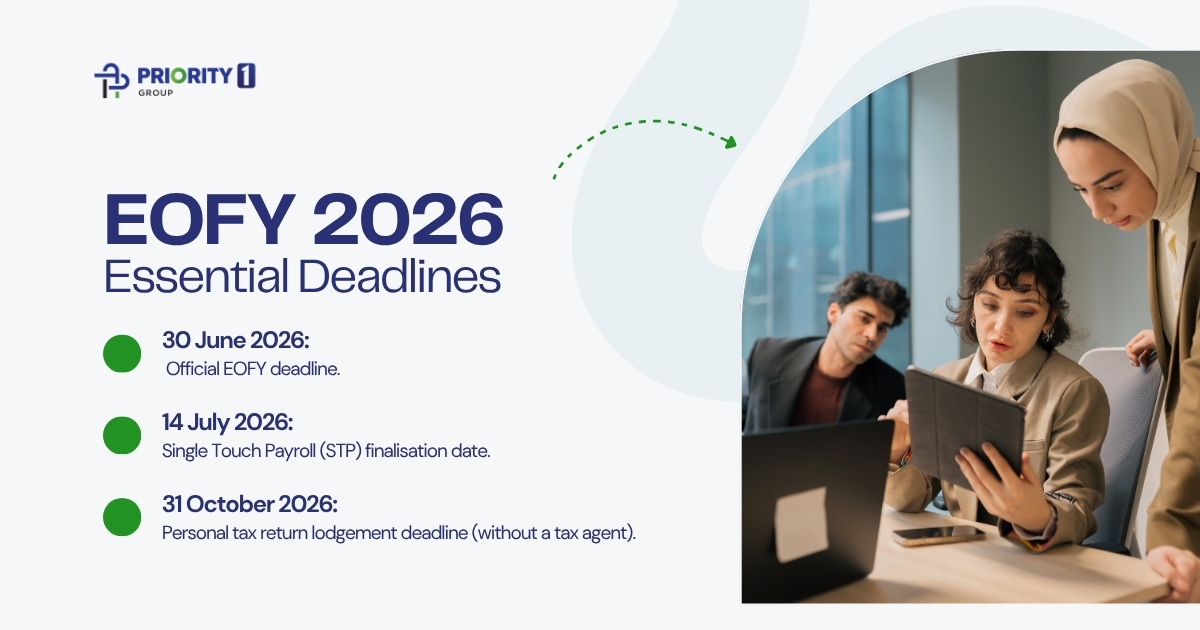
EOFY 2026 Essential Deadlines

Being aware of key EOFY dates ensures smooth tax compliance:

  • 30 June 2026: Official end of the 2025-26 financial year.
  • 14 July 2026: Single Touch Payroll (STP) finalisation deadline for most employers.
  • 28 July 2026: Due date for super guarantee contributions for the April–June 2026 quarter (the final quarterly payment before Payday Super begins).
  • 31 October 2026: Personal tax return lodgement deadline if you are lodging yourself (without a registered tax agent).

Missing these deadlines can lead to penalties and fines, including late lodgement fees and interest charges on overdue amounts. In some cases, it could also trigger audits or increased scrutiny from the Australian Taxation Office (ATO). Delayed or incorrect compliance may result in additional administrative burdens, financial costs, and stress — reinforcing the importance of proactive planning and timely compliance.

What’s Changed for EOFY 2025-26

A few important updates apply to this financial year, and being across them now will save headaches later:
  • Super Guarantee is at 12%. From 1 July 2025, the Super Guarantee (SG) rate reached its final legislated target of 12% of ordinary time earnings, up from 11.5% the previous year. If you employ staff, your payroll should already be calculating super at this rate.
  • Payday Super arrives 1 July 2026. This is the biggest payroll change in years. From 1 July 2026, employers will need to pay super guarantee contributions at the same time as wages, rather than quarterly. EOFY 2025-26 is the moment to confirm your payroll software and clearing house are ready for the switch and to model the cash-flow impact of more frequent payments.
  • The $20,000 Instant Asset Write-Off has been extended. After some uncertainty, Parliament confirmed the $20,000 instant asset write-off threshold for the 2025-26 year. From 1 July 2026, it is currently legislated to drop back to $1,000 unless the Government extends it again.

Preparing for EOFY – A Step-by-Step Guide
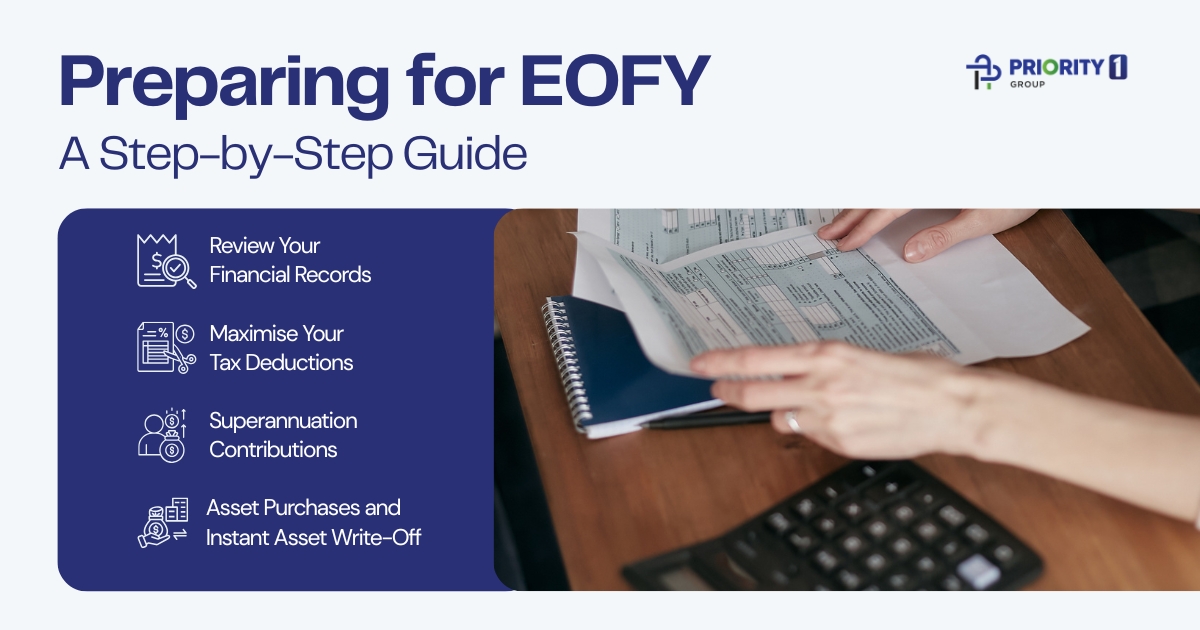
Preparing for EOFY A Step-by-Step Guide

Step 1 – Review Your Financial Records

Accurate bookkeeping is fundamental at EOFY. Ensure all financial records are up to date and correctly recorded. Reconcile your bank accounts, verify statements, and address any discrepancies. Confirm that invoices, debtors, and creditors are accurately tracked and managed, and that your payroll records reconcile before you finalise STP.

Step 2 – Maximise Your Tax Deductions

Claiming eligible deductions effectively reduces taxable income. Common deductible expenses include:

    • Work-related expenses (uniforms, tools, equipment)
    • Home office expenses
    • Travel and vehicle expenses
    • Education and training costs

Always keep clear documentation and receipts to substantiate your claims. The ATO continues to focus on work-related deductions, so the better your records, the safer your claim.

Step 3 – Superannuation Contributions

Superannuation remains one of the most tax-effective ways to build retirement savings. Contributions must stay within set limits to avoid extra taxes:

    • Concessional (before-tax) contributions cap: $30,000 for 2025-26. This includes employer SG, salary sacrifice, and personal deductible contributions.
    • Non-concessional (after-tax) contributions cap: $120,000 for 2025-26.
    • Carry-forward rule: If your total super balance was under $500,000 on 30 June 2025, you may be able to carry forward unused concessional cap amounts from the previous five years, allowing a larger deductible contribution this year.

To count toward the 2025-26 year, contributions generally need to be received by your super fund before 30 June 2026 — not just paid — so allow time for processing.

Step 4 – Asset Purchases and the Instant Asset Write-Off

Eligible small businesses with an aggregated annual turnover under $10 million can immediately deduct the full cost of qualifying assets costing less than $20,000 (excluding GST) under the instant asset write-off for 2025-26. The threshold applies on a per-asset basis, so multiple assets can each be written off provided each one falls below the limit. To qualify, assets must be first used or installed ready for use between 1 July 2025 and 30 June 2026.

A word of caution: a deduction reduces your taxable income, but it doesn’t make the asset free. If you spend $10,000, you still part with $10,000 in cash — the tax saving is only a portion of that. Buy what your business genuinely needs, and let the write-off be a bonus rather than the reason for the purchase.

Strategic Tax Planning Tips 

Proactively managing your finances can yield considerable tax advantages:
  • Income timing: Where appropriate and commercially sensible, defer receiving income until after EOFY, or bring forward deductible expenses, to manage taxable income across the two years.
  • Tax-effective investments: Consider investments such as property, shares, or managed funds with favourable tax outcomes, keeping your broader strategy in mind rather than chasing a deduction alone.
  • Small businesses and sole traders: Make the most of simplified depreciation rules and the deductions available specifically to small business entities.
  • Get ready for Payday Super: Use the lead-up to 30 June to review payroll systems, test a super run, and adjust cash-flow forecasts ahead of the 1 July 2026 changeover.

Common Mistakes to Avoid This EOFY

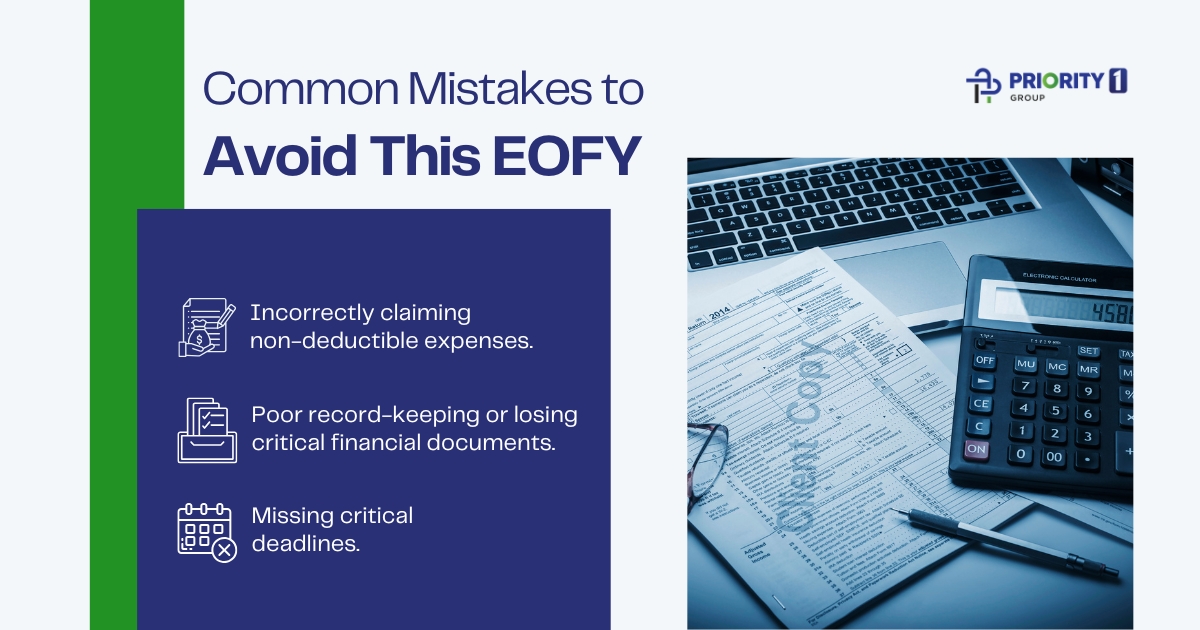
Common Mistakes to Avoid This EOFY

Avoid common pitfalls to ensure a smooth EOFY:

  • Incorrectly claiming non-deductible expenses.
  • Poor record-keeping or losing critical financial documents.
  • Missing critical deadlines, including STP finalisation and the June-quarter super payment.
  • Assuming an asset purchase is fully deductible when its cost exceeds the $20,000 threshold (in which case it goes into the small business depreciation pool instead).

Maintaining meticulous records and understanding deduction eligibility prevents many of the most common — and most expensive — issues.

Leveraging Professional Advice 

While some individuals and businesses manage EOFY tasks independently, professional guidance ensures accuracy and compliance. Qualified bookkeepers and accountants offer valuable insight and can:

  • Identify overlooked deductions and benefits.
  • Ensure accurate and compliant lodgements, including STP finalisation.
  • Help you prepare for structural changes like Payday Super.
  • Provide strategic financial planning advice tailored to your specific situation.

Conclusion 

Preparing for EOFY 2025-26 doesn’t need to be stressful. By understanding the critical deadlines, maintaining accurate financial records, maximising your deductions, staying within the current super caps, and preparing early for the Payday Super transition, you can move smoothly into the new financial year. For tailored advice and professional bookkeeping assistance, consider contacting Priority1 Group to help streamline your EOFY preparations.

FAQs

Missing key EOFY deadlines can result in fines, penalties, and interest charges. Lodge your return and finalise your obligations promptly to mitigate potential issues.

Not all expenses are deductible. To be claimable, an expense must directly relate to your income-earning activities and meet the ATO criteria.

Ensure your records are complete, reconciled with bank statements, and properly categorised, with documentation to support all transactions and payroll figures.

Yes — extra contributions can lower your taxable income and grow your retirement savings, but they must stay within the contribution caps ($30,000 concessional and $120,000 non-concessional for 2025-26) to avoid extra tax.

Payday Super begins on 1 July 2026. From that date, employers must pay super guarantee contributions at the same time as wages rather than quarterly. EOFY 2025-26 is the right time to make sure your payroll systems and cash flow are ready.

You can lodge your own return; however, engaging a registered tax agent can simplify the process, improve accuracy, and often help maximise your deductions.