
When people talk about NDIS service quality, the conversation usually centres on what happens face-to-face: support workers, coordination, communication, and outcomes. But in practice, consistent quality is often decided before anyone arrives at a participant’s home, inside the systems that manage rostering, documentation, claims, incidents, complaints, training, and continuity planning.
Back-office operations aren’t “just admin.” They are the engine room that keeps services safe, on time, compliant, and sustainable. When the back office is strong, frontline teams can focus on participants rather than paperwork and firefighting. When it’s weak, quality drops in predictable ways: missed shifts, rushed handovers, incomplete notes, billing errors, delayed incident responses, inconsistent participant communication, and audit stress.
For NDIS providers across Australia; especially those scaling quickly – back-office maturity is one of the clearest predictors of service quality.
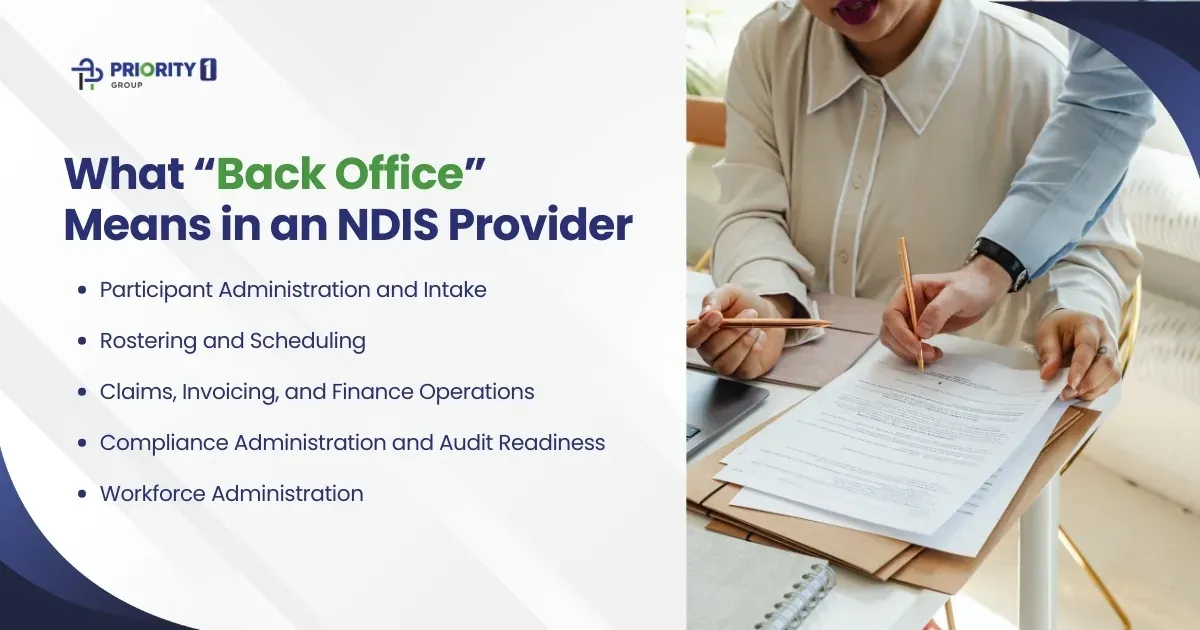
Back-office operations include the people, processes, and systems that support delivery teams and prove quality through evidence. While structures differ by provider size and model, most NDIS back offices manage:
In short: the back office is where reliability, safety, consistency, and evidence are built.
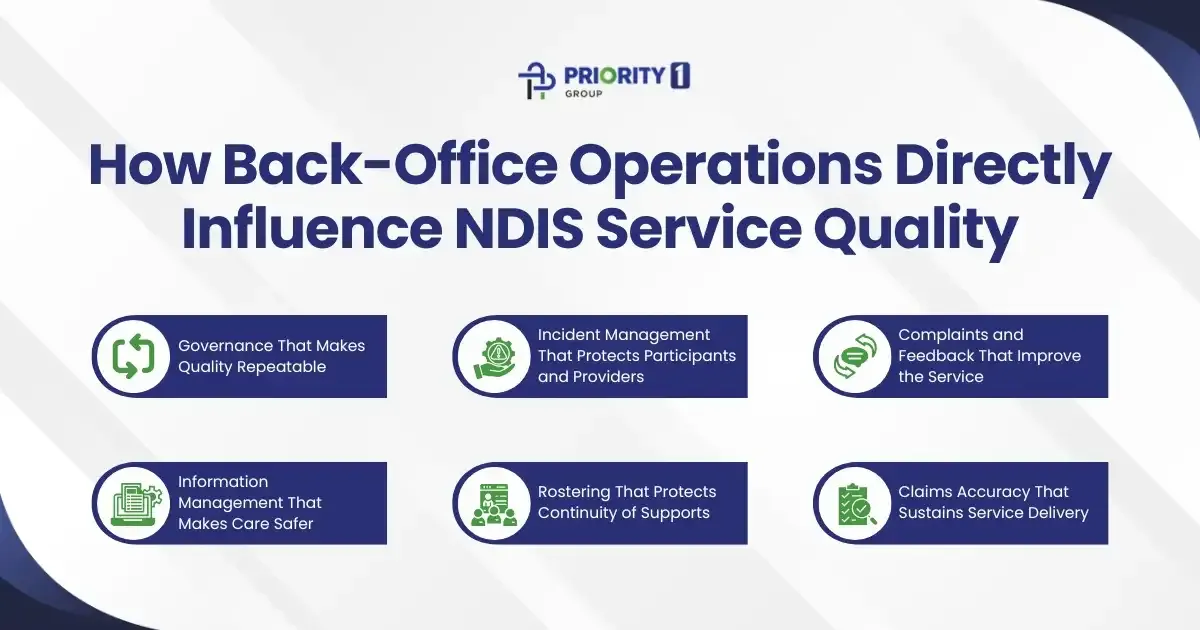
Quality is not a one-off act of goodwill; it’s a repeatable system. Governance in the back office creates:
When governance is operational (not just a binder on a shelf), providers reduce variability. Participants experience fewer surprises, fewer missed commitments, and more consistent standards of care.
A high-quality incident response is rarely improvised on the day. It depends on back-office workflows that ensure:
Without structured incident management, small problems become repeated problems, and repeated problems become reputational and regulatory risks.
Complaints are not just “issues to close.” They are quality data.
Strong back-office systems treat feedback as a signal:
Providers that operationalise feedback build trust especially in a sector where participants and families value transparency and responsiveness.
Accurate records support safer decisions. When documentation is consistent and accessible:
Poor information management creates hidden risk: incomplete notes, conflicting versions of truth, and gaps that force frontline staff to guess.
Continuity isn’t just a “nice to have.” It’s central to participant wellbeing especially for those who rely on routine, predictability, and trusted relationships.
Back-office rostering impacts:
A provider can have excellent staff and still deliver inconsistent quality if rostering is chaotic.
Even the best service model can be undermined by unstable cash flow, billing errors, or delayed claim resolution. When finance operations are strong:
Back-office finance discipline supports the stability that quality requires.
NDIS quality isn’t assessed only through what providers say, it’s assessed through what providers can demonstrate. That demonstration depends heavily on back-office evidence: policies, registers, training records, incident logs, complaint workflows, participant files, governance artefacts, and continuity planning.
This is why many providers feel the strain during audits: they may be delivering good supports, but if systems are inconsistent, evidence becomes difficult to assemble. That creates last-minute scrambles, staff burnout, and avoidable findings.
A quality-first back office reduces audit anxiety because readiness is continuous, not a once-every-few-years event.
Even well-intentioned teams fall into patterns that quietly reduce service quality over time:
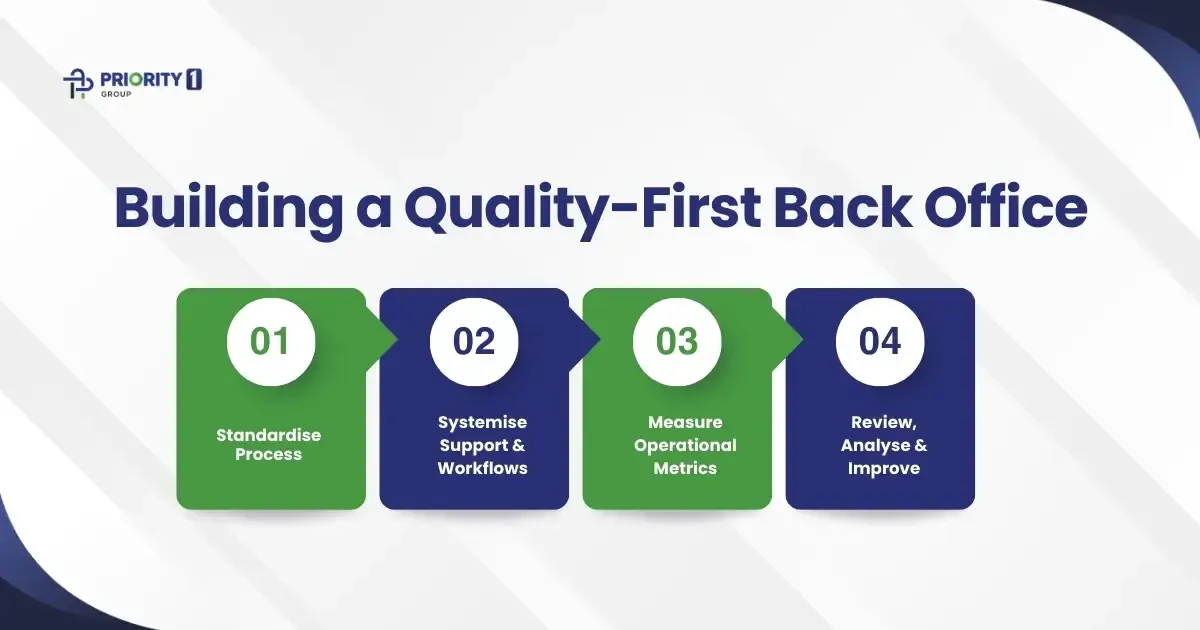
Improving back-office operations doesn’t require perfection. It requires standardisation, visibility, and continuous improvement.
Create consistent, easy-to-follow workflows for:
Standardisation reduces reliance on memory and individual habits.
Support your workflows with systems that:
Systemisation lowers error rates and makes performance measurable.
Operational metrics can directly reflect service quality. Examples include:
Quality becomes easier to improve when it becomes visible.
Run simple monthly reviews:
This turns quality into a living system, not a compliance event.
Many NDIS providers in Australia reach a tipping point: growth increases complexity, and internal admin capacity can’t keep up without affecting frontline focus.
Back-office outsourcing can improve service quality by delivering:
A dedicated operations team runs standard workflows daily; reducing delays, rework, and variability.
Specialised admin support improves:
As participant numbers increase, outsourcing enables growth without adding permanent overhead too early or overloading existing staff.
Outsourced back-office support can improve visibility through structured reporting, escalation pathways, and routine performance reviews.
Most importantly, outsourcing gives leadership time back so managers can spend less energy chasing admin and more energy improving participant outcomes.
Not everything needs to be outsourced at once. Many providers start with functions that deliver immediate quality and stability improvements:
Starting with these areas typically improves reliability, responsiveness, and internal confidence quickly.
A back-office partner should do more than “process tasks.” They should strengthen quality systems. Look for:
They should understand provider workflows, the importance of evidence, and the operational realities of service delivery.
You want agreed turnaround times, escalation steps, and regular reporting.
Checks, templates, and consistent processes should be part of delivery, not an optional extra.
Back-office teams manage sensitive participant information. Strong access controls and disciplined information management are essential.
A good partner works with your systems and helps reduce fragmentation rather than creating new silos.
NDIS service quality is shaped by what happens behind the scenes as much as what happens at the point of care. Governance, rostering, documentation, claims, incident response, and complaint handling determine whether service delivery is:
If your back office is under strain, quality becomes harder to maintain no matter how committed your frontline teams are. But with the right processes and support, back-office operations become a competitive advantage: fewer disruptions, stronger participant trust, clearer evidence, and a calmer, more sustainable organisation.
If you’re an NDIS provider looking to strengthen service quality while reducing operational pressure, Priority1 Group can support you with NDIS back-office outsourcing that helps improve consistency, compliance readiness, claims accuracy, rostering coordination, and administrative efficiency.
Partner with Priority1 Group to build a back office that scales with your organisation so, your team can spend more time delivering great supports and less time managing avoidable admin overload.