Search engines aren’t just retrieving pages anymore. They’re generating answers synthesising information from dozens of sources, delivering confident responses, and increasingly, leaving users with no reason to click anywhere at all. This isn’t a distant disruption on the horizon. It is the new reality of digital marketing in 2026.
At Priority1 Group, we help brands stay found, not just on page one, but inside the answers your customers are already receiving. This guide breaks down everything you need to understand about generative search, what it means for your visibility, and the precise steps to take right now.
Generative search refers to AI-powered search systems that produce contextual, conversational, and personalised responses rather than simply listing web links. Platforms like Google AI Overviews, Microsoft Copilot, ChatGPT Search, and Perplexity don’t just find pages they read them, synthesise them, and hand users a ready-made answer.
For two decades, SEO operated on a stable set of assumptions: users type keywords, search engines return a ranked list, and brands fight for position. That model hasn’t disappeared, but it now shares the stage with an entirely different mode of discovery one where answers are generated, not retrieved, and where visibility depends on whether intelligent systems understand, trust, and cite your expertise.
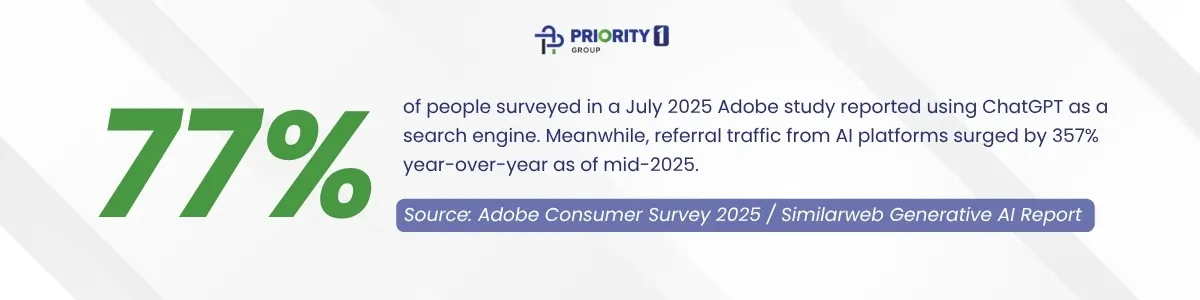
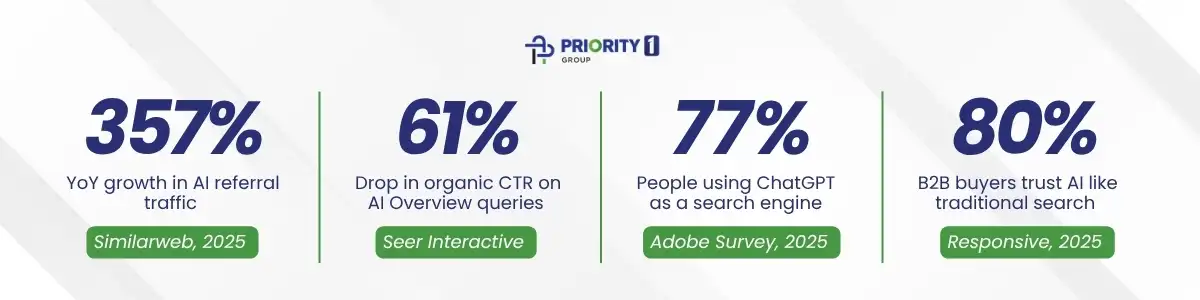
These numbers aren’t a trend to watch. They’re a shift to respond to. AI-driven referral traffic has become a primary discovery channel, and brands without a generative search strategy are already invisible in a significant portion of their audience’s search journey.
Google’s AI Overviews the AI-generated summaries that appear above traditional organic results have had a measurable, immediate impact on traffic. Organic CTR on informational queries where AI Overviews are triggered has dropped by as much as 61%. Fewer people click through when the answer is served to them directly.
But here’s the nuance most marketers miss: fewer clicks doesn’t mean less value. Being cited within an AI Overview drives brand visibility, voice-search authority, and assisted conversions even without a direct visit. The value exchange has changed. The opportunity has not.
For a generation of marketers, the finish line was clear: rank on page one. The higher, the better. That metric still matters, but it no longer tells the full story of your digital visibility.
In the world of generative search, the real question is: does AI cite you as a trusted source? Visibility is now determined by an AI model’s internal understanding of your brand, not merely your position in a ranked list of results. You can rank #1 on Google and still be completely absent from the AI-generated answers your customers are reading.
PRIORITY1 GROUP INSIGHT
“At Priority1 Group, we no longer build strategies for one search engine. We build them for every place your next customer might be asking a question and right now, they’re asking AI.”
AI systems don’t award citations arbitrarily. They draw from sources that demonstrate consistent expertise, clear structure, and signals of trust. The concept of E-E-A-T (Experience, Expertise, Authoritativeness, Trustworthiness) has become even more central in the generative era, because AI models actively evaluate whether your content reflects genuine authority.
Authority is now the primary currency of search. AI filters for trust, credibility, and consistency before deciding to surface a brand. Generic content built around keyword volume won’t pass that filter. Original insights, proprietary frameworks, original research, and expert perspectives will.
Perhaps the most important structural shift: optimising for a single search engine is no longer sufficient. In 2026, successful discovery requires a multi-platform approach. Your audience is searching on Google, yes, but also on ChatGPT, Perplexity, TikTok, YouTube, Amazon, and Gemini. Each system surfaces information differently; weights trust signals differently and serves a different moment in the customer journey.
KEY TERMS EVERY MARKETER NEEDS TO KNOW | ||
GEO | Generative Engine Optimisation | Strategies designed to ensure your content is understood by LLMs, perceived as trustworthy, and cited as a primary source in AI-generated responses. |
AEO | Answer Engine Optimisation | A subset of GEO focused on structuring content to earn direct AI-generated mentions. Involves Q&A formats, snippet-friendly formatting, and deep topical authority. |
SGE | Search Generative Experience | Google’s umbrella term for its AI-powered search features, including AI Overviews that appear above traditional organic results. |
AIO | AI Overviews | The AI-generated summaries Google displays at the top of search results pages, synthesising content from multiple sources into a single direct answer. |
Before mapping out your strategy, it’s worth being precise about what has changed and what hasn’t. Traditional SEO is not dead; it’s the foundation everything else is built on. But its scope has expanded significantly.
Dimension | Traditional SEO | Generative SEO (2026) |
Primary Goal | Rank on page one for target keywords | Be cited as a trusted source in AI answers |
Success Metric | Rankings, organic traffic, CTR | AI citation frequency, brand mention accuracy, LLM referral traffic |
Content Strategy | Keyword optimisation, meta data, volume | Topical authority, structured data, E-E-A-T signals, original research |
Technical Priority | Page speed, mobile-friendliness, crawlability | All of the above + schema markup, machine-readable architecture |
Discovery Platforms | Primarily Google | Google, ChatGPT, Perplexity, Gemini, Bing, TikTok, YouTube & more |
Link Strategy | Backlinks for domain authority | Backlinks + being referenced by sites AI models trust |
The key insight: generative and answer-based AI optimisation is not a replacement for SEO. It’s an evolution layered on top of it. Technical SEO: crawlability, strong information architecture, Core Web Vitals, structured data; is what makes your content machine-readable for LLM crawlers. Without those foundations in place, no GEO or AEO strategy has anything reliable to work with.
Strategy is only as useful as its execution. Here is the practical framework Priority1 Group uses to help brands adapt to the generative search era; built around five core pillars.
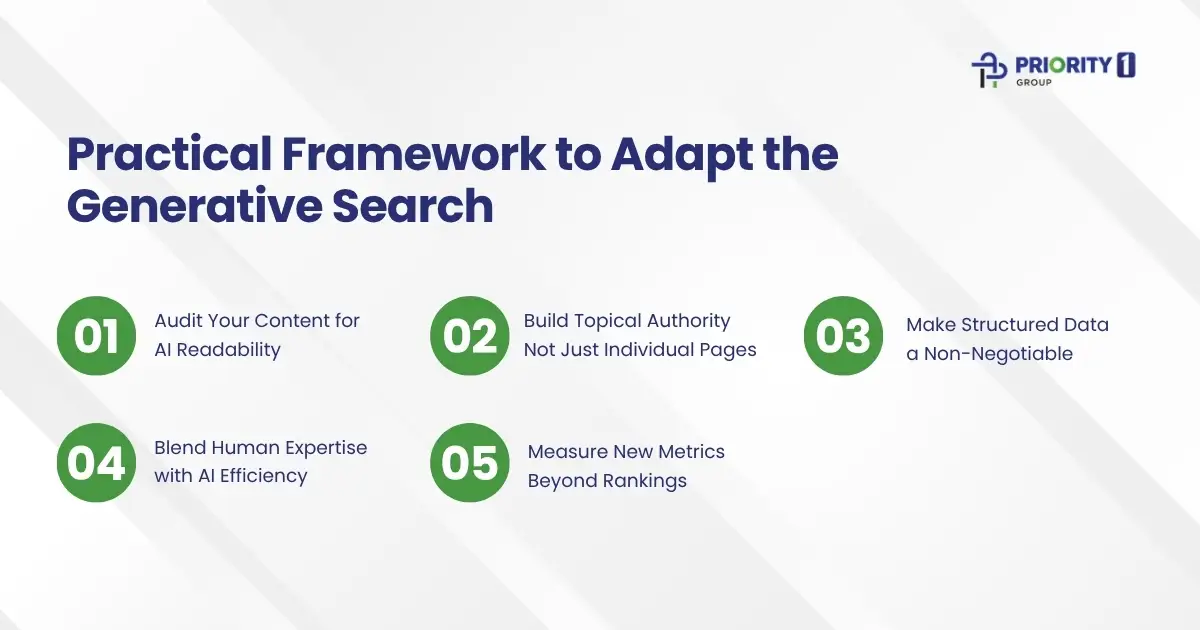
Your existing content library is likely built for human readers and legacy search algorithms. Before creating anything new, assess what you already have through the lens of AI interpretability. Ask: does this content have clear headings and subheadings? Does it answer specific questions directly? Is it structured with Q&A blocks, concise definitions, and logical flow?
Content that is vague, meandering, or padded for word count will not be cited by AI systems. Content that is precise, well-organised, and demonstrably expert will be. The standard has shifted from ‘does this rank?’ to ‘would an AI trust this enough to cite it?’
Ranking for a single keyword no longer signals expertise to AI. To be selected as a trusted source, brands must demonstrate breadth across related sub-questions and depth across the nuances of a topic. Authority now comes from completeness, not content length.
This means moving from isolated optimised pages to interconnected content clusters a structured network of articles that collectively cover the full terrain of your subject matter. When an AI model encounters your site, it should be able to map a comprehensive, consistent body of knowledge, not a collection of disconnected posts.
Schema markup acts as a translation layer between your content and AI systems. It provides generative engines with a clear roadmap to understand your expertise, your products, your customer Q&As, and the qualifications behind your content. Without it, even excellent content may be misinterpreted, or overlooked entirely.
Priority areas for schema implementation include FAQ and HowTo schema, Article and Author schema (to signal E-E-A-T), Product and Review schema for e-commerce, and Organisation schema for establishing brand authority.
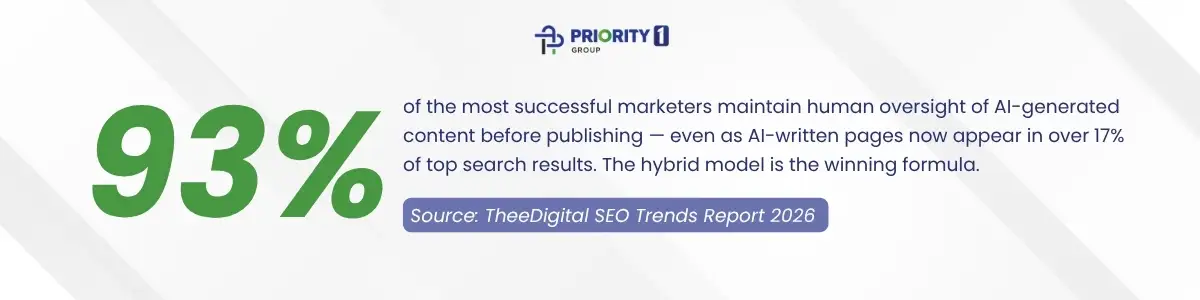
AI can dramatically accelerate content production generating outlines, summarising research, drafting first versions, and identifying semantic gaps. But it cannot replace the human ability to interpret context, add genuine expertise, or write with the authentic voice that builds brand trust over time.
The brands winning in generative search are those combining AI’s analytical scale with human judgment and storytelling. AI-generated content alone will not earn citations. The hybrid approach will.
Your reporting dashboard needs to evolve. If you’re still measuring success purely through keyword rankings and organic traffic, you’re missing a growing portion of your actual brand visibility. The right questions to ask in 2026 are more demanding: Does your brand appear in AI-generated answers for your target topics? When it does appear, is it described accurately? Are you being cited favourably, or misrepresented?
Effective performance measurement in the generative era goes beyond ‘Do we show up?’ to ‘Do we show up accurately, consistently, and persuasively?’ Consider building an AI Visibility Index a composite metric tracking citation frequency, mention accuracy, and competitive presence across AI platforms.
IS YOUR BRAND AI-READY? Quick Audit Checklist | ||
☐ | Content Structure | Is your content organised with clear H2/H3 headings, Q&A blocks, and concise paragraph answers? |
☐ | Topical Coverage | Do you have interconnected content clusters covering all major sub-topics in your domain, not just isolated pages? |
☐ | Schema Markup | Is structured data implemented across key pages — FAQ, Article, Product, Author, and Organisation schema? |
☐ | E-E-A-T Signals | Do your content pages clearly signal expertise through named authors, credentials, original research, and external references? |
☐ | Multi-Platform Presence | Is your brand consistently visible and accurately represented across Google, ChatGPT, Perplexity, and other AI platforms? |
☐ | AI Metrics Tracking | Are you monitoring AI citation frequency and LLM referral traffic alongside traditional SEO metrics? |
This is not a theoretical risk sitting on a future roadmap. The gap between generative-search-ready brands and those still running traditional SEO playbooks is opening now, and it is widening every month.
When one agency tested buyer-intent prompts across major AI platforms, they found that LLMs consistently recommended two of their direct competitors but never them, despite maintaining strong traditional SEO performance. Rankings didn’t protect them. Generative visibility would have.
Brands that have invested in foundational SEO and adapted to the requirements of being cited as trusted, authoritative sources already hold a significant head start in 2026. The technical infrastructure, content architecture, and authority signals that power generative visibility take time to build. Starting later means competing harder for ground that others have already claimed.
The inverse is also true: brands that move now, while generative SEO is still maturing as a discipline, have an exceptional window to establish citation authority before their competitors recognise the urgency.
Every major shift in search has required marketers to adapt the move to mobile, algorithm updates, the rise of featured snippets. Each time, the brands that responded early, invested in quality, and built genuine authority came ahead. This shift is no different in principle. It is, however, larger in scale.
At Priority1 Group, we’ve been navigating search evolution for our clients through every major change in the landscape. Our approach to generative search is not about chasing the latest tactic, it’s about building the kind of integrated digital presence that earns trust from both human audiences and the AI systems that increasingly shape what they see.
We combine technical SEO excellence, content strategy, and emerging GEO disciplines into a single, coherent programme not siloed services stitched together, but a genuinely unified approach to visibility in 2026 and beyond.
“Generative search doesn’t reward the loudest voice in the room. It rewards the most trusted one. Our job at Priority1 Group is to make sure that voice is yours.”
— Priority1 Group Digital Strategy Team
Your business still needs to be found. Your audience still needs to trust you. Your content still needs to answer their questions better than anyone else. None of that is new. What is new is the mechanism through which all of it happens, and the standards that AI systems apply before deciding whether your brand deserves to be part of the answer.
The goal in 2026 is to create content that humans value and that AI systems choose to cite. Not one or the other. Both. The brands that internalise this that stop optimising for a list of ten blue links and start building authoritative, structured, multi-platform presences, will own discovery in the years ahead.
This transition is not beyond reach. With the right strategy, the right foundations, and the right partner, it is entirely manageable. The question is simply whether you start now or later.