
Run an NDIS service and you’re quietly operating two financial systems at once. One of them decides what you pay your support workers. The other decides what you’re allowed to claim from the Scheme. For most providers, nobody notices that these two systems were never built to agree with each other, until the gap between them turns up as a thinner margin, a payment request that bounces back, or an audit question you can’t answer cleanly.
The frustrating part is that the gap rarely announces itself. A roster looks full. Timesheets get approved. Claims go out the door. The bank balance grows. Everything feels like it’s working. But underneath, the hours you rostered, the wages you paid, and the dollars you claimed have all drifted slightly out of step, and in a sector that runs on tight margins and strict rules, “slightly” adds up fast.
This is the alignment problem at the heart of every NDIS payroll. Getting rostering and payroll to speak the same language as your NDIS claiming isn’t an admin nicety. It’s the difference between getting paid accurately for the work you do and slowly leaking money you’ve already earned.
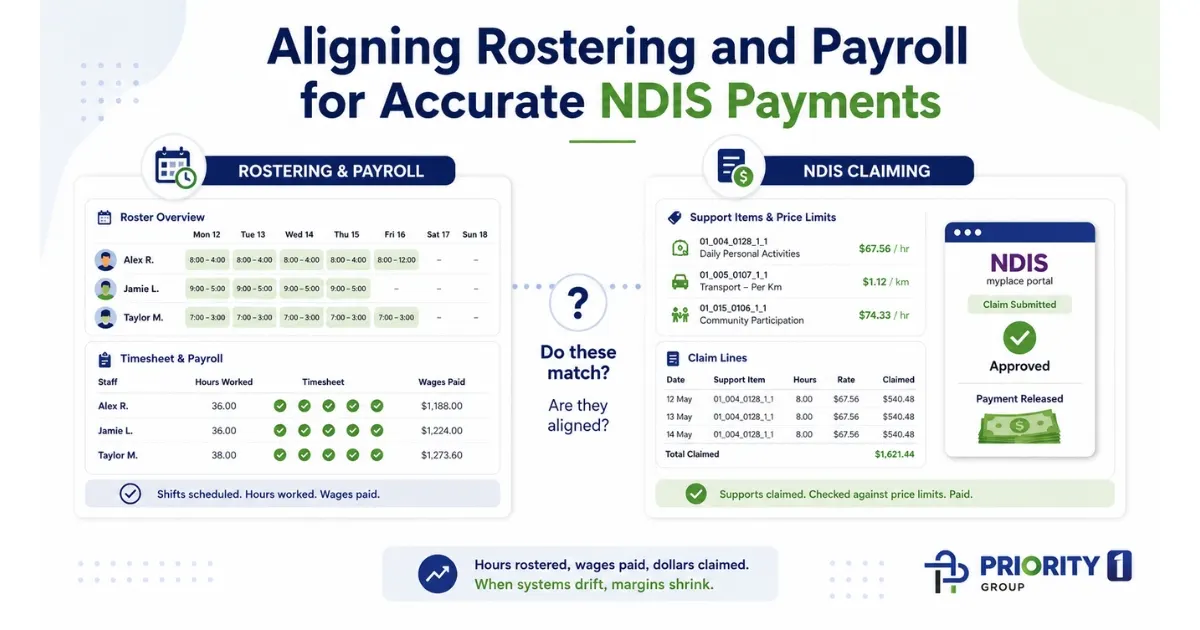
In a typical small business, the money maths is simple: one rate comes in, one rate goes out, and the difference is your margin. NDIS providers don’t get that luxury. You’re working from two separate rulebooks that move on their own schedules and follow their own logic.
On the pay side, you have the SCHADS Award — formally the Social, Community, Home Care and Disability Services Industry Award 2010 (MA000100). It’s widely regarded as one of the most complex modern awards in the country, and for good reason. It carries eight classification levels across several streams, each with its own pay points, and once you layer in penalty rates, overtime, casual loading, broken-shift rules, sleepover provisions, minimum engagements and a list of allowances, you end up with thousands of distinct pay outcomes. From 1 July 2025, SCHADS rates rose by 3.5% following the Fair Work Commission’s Annual Wage Review, so the numbers have moved again. And the stakes for getting it wrong are no longer just commercial — since the start of 2025, intentional underpayment is a criminal offence in Australia.
On the claim side, you have the NDIS Pricing Arrangements and Price Limits (PAPL) — the document the NDIA uses to cap what registered providers can charge for each support. Price limits vary by support item, by the day of the week, by the time of day, and by geographic zone under the Modified Monash Model, with loadings for remote and very remote areas. This document also moves: the 2025-26 PAPL took effect on 1 July 2025 (v1.0) and was updated again on 24 November 2025 (v1.1), with disability support worker price limits lifting by 3.95% — one of the larger core support increases in recent years — partly to reflect the rise in the superannuation guarantee to 12%.
Here’s the trap. These two systems are related but not identical. NDIS price limits for weekend supports are higher precisely because weekend wages are higher under SCHADS — the NDIA even publishes a Disability Support Worker Cost Model that maps award wages through to a “billable hour” price. But that cost model is an industry average built on assumptions. It is not your roster, your staff mix, or your actual cost of delivering a shift. And the two rulebooks update on different dates, for different reasons, through different processes. Treat them as if they automatically line up, and you’ll be wrong in ways you can’t see on the P&L.
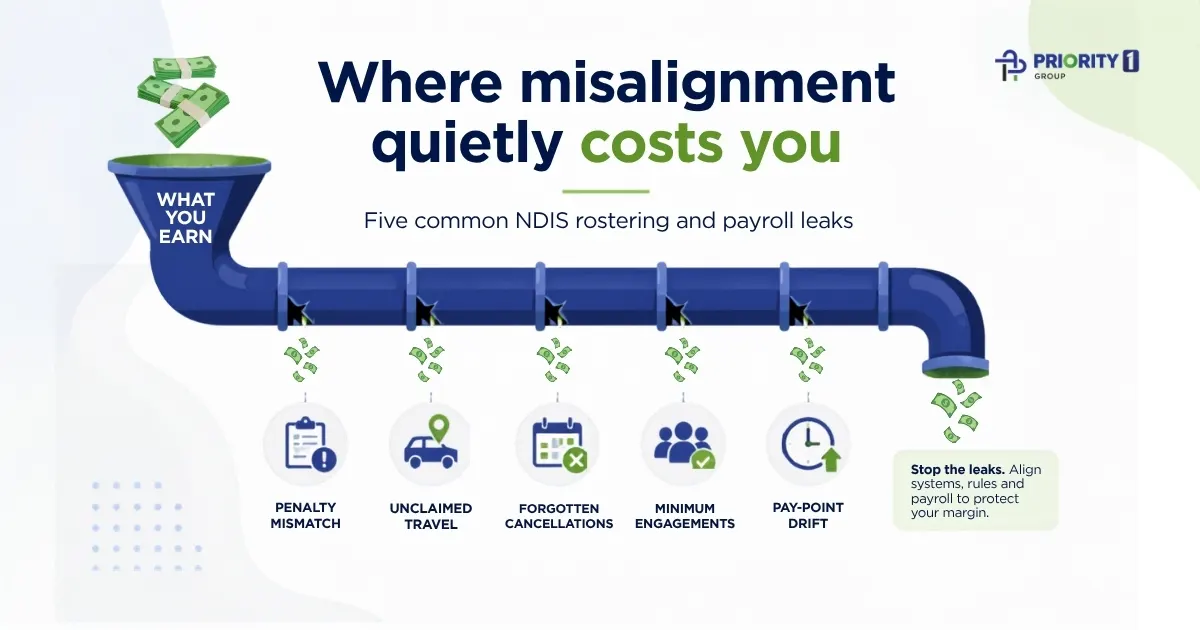
When rostering and payroll fall out of step with claiming, the damage shows up in a handful of predictable places. In our experience reconciling NDIS payrolls, these are the leaks that recur most often.
SCHADS penalty rates climb as the calendar moves away from ordinary weekday hours, Saturday work attracts a 150% loading, with higher rates again on Sundays and higher still on public holidays. The NDIS price limits for those same supports are loaded to match. The problem appears when your rostering pays the correct penalty but your claim doesn’t capture the corresponding weekend or public-holiday support item — or your service agreement quietly assumes a weekday rate. You pay the premium; you claim the base. Repeat that across a weekend-heavy roster and the erosion is significant.
This one catches a lot of providers off guard. Under SCHADS, you generally have to pay workers for time spent travelling between participants, plus a per-kilometre vehicle allowance when they use their own car. But the NDIS rules on what you can claim for travel tightened from 1 July 2025 — provider travel is split into labour and non-labour components, must be agreed in advance in the service agreement, and is subject to time caps based on location. Therapy travel in particular was cut, with providers now able to claim only half of the relevant price limit for travel time. The takeaway: an inefficiently sequenced roster generates travel you’re obligated to pay for and only partially allowed to recover. The fix lives in smarter rostering, not in the claim.
Cancellations are the clearest example of why these systems can’t be run separately — because the whole justification for a cancellation claim is a payroll obligation.
Under the current rules, a cancellation is “short notice” when a participant cancels (or doesn’t show) with less than seven clear days’ notice, unless your service agreement specifies a shorter period. In that situation you can claim up to 100% of the agreed fee — but only if all of the following hold:
That last condition is the entire point. You’re allowed to claim because you’re still paying the wage. So when a roster system marks a shift “cancelled,” the worker remains on the payroll, but the offsetting claim only exists if someone actually lodges it — using the same support item, flagged as a cancellation in the portal. We regularly see providers absorb the wage and simply forget the claim, turning a recoverable cost into a straight loss.
SCHADS includes a stack of structural payments that have no neat one-to-one equivalent on the NDIS side. There’s a broken-shift allowance of roughly $20 to $28 depending on the number of unpaid breaks, paid on top of the hourly rate when a worker’s day is split. There’s a sleepover allowance of close to $60 per night, plus overtime (with a minimum payment) for any work done during the night and a minimum-length shift rostered immediately before or after it. And for part-time and casual home care and disability work, there’s a minimum engagement of two hours per work period — meaning a 45-minute morning visit still costs you two hours of wages.
The NDIS funds the support that’s actually delivered. If your rostering doesn’t account for these floor costs, you can be paying two hours and claiming less than one, and wondering why a busy week didn’t translate into a healthy week.
Finally, there’s the slow leak of paying people at the wrong SCHADS level or pay point. Set it too low and you’ve created a back-pay liability and, potentially, a compliance breach. Set it too high and you’re quietly overspending on every shift that worker does — money that no NDIS support item will ever reimburse, because the price limit doesn’t care what you chose to pay.
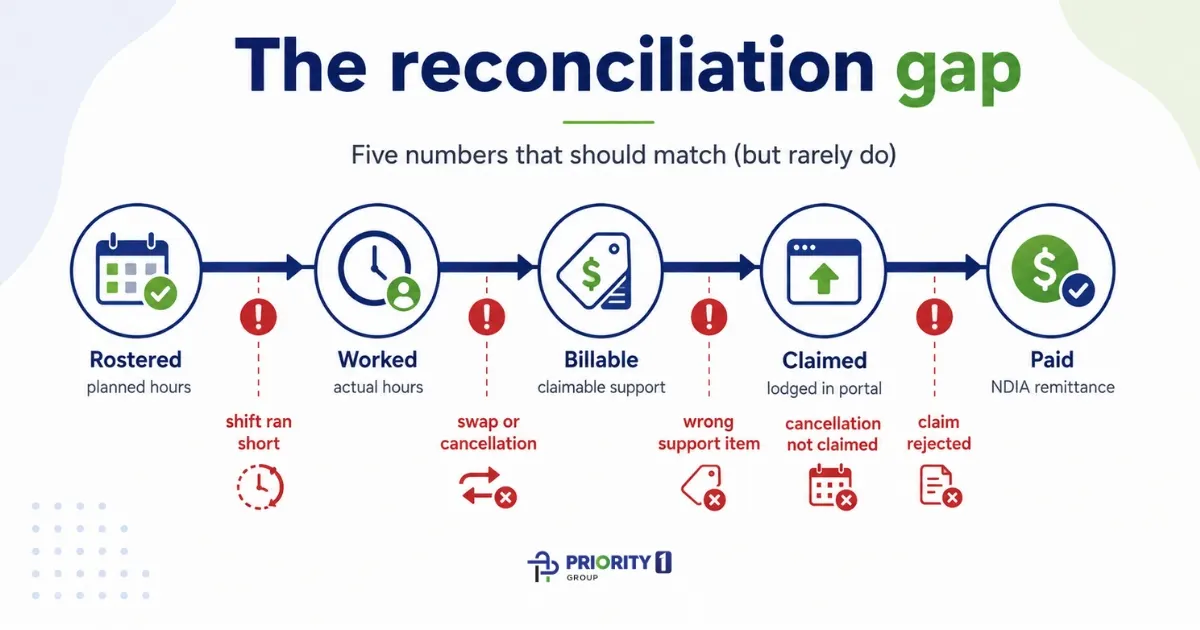
The cleanest way to understand the problem is to follow a single shift through every number it touches. There are five, and most providers only ever check two of them.
Each of these is recorded in a different place, often in a different system, and frequently by a different person. The leak lives in the gaps between them.
Take a concrete example. A worker is rostered for a three-hour Saturday community-access shift. The participant cancels the morning of — short notice. The worker can’t be redeployed, so you pay the full three hours plus the Saturday loading (rostered and worked: ticked). But the support item never gets claimed as a cancellation, so “billable” and “claimed” both read zero. Meanwhile, on a different day that month, a claim you did lodge was rejected for a stale plan reference, so “claimed” and “paid” don’t match either. None of these errors is dramatic on its own. Across a month and a roster of forty staff, they’re the difference between the margin you modelled and the margin you got.
The good news is that closing this gap doesn’t require a finance degree or a six-figure software stack. It requires treating these three systems as one connected money-flow with a single rhythm. Here’s the approach that works.
This is precisely the intersection where Priority1 Group works with Australian NDIS providers. As a bookkeeping service built for SMEs, our role is to sit across both rulebooks at once — getting your payroll and SCHADS award interpretation set up correctly, reconciling your rostering against what’s actually claimed and paid, catching the cancellations and travel that quietly slip through, chasing down rejected claims, and keeping the evidence trail audit-ready. The aim isn’t to add another report to your inbox. It’s to make sure the money you’ve genuinely earned is the money that lands in your account — and that you can prove every dollar of it if anyone asks.
Accurate NDIS payments aren’t really a payroll problem or a claiming problem. They’re an alignment problem. The hours you roster, the wages you pay under SCHADS, and the dollars you claim under the PAPL are three views of the same shift — and when they fall out of step, you don’t usually lose money in one big, obvious hit. You lose it in dozens of small, invisible ones.
Get those three systems speaking the same language, give them a single owner and a weekly rhythm, and reconcile all the way through to what actually hits your bank — and accurate payments stop being something you hope for and start being something you can count on. In a sector this tightly regulated and this finely costed, that alignment is one of the highest-return pieces of admin discipline a provider can build.