
In the world of search engines, the humble blue link has long been the gold standard of SEO success. For over a decade, we built our content strategies around it, optimising for clicks, impressions, and rankings. But now, a seismic shift is underway. The search experience is evolving rapidly, moving from a “Library Index” model, epitomised by Google’s 2010s search engine, to a new paradigm: the “Digital Concierge” powered by generative AI technologies like ChatGPT, Gemini, and others.
As AI continues to improve, it’s no longer about directing users to a website where they can sift through information. Today, it’s about giving users instant, tailored answers directly within the search environment itself. This shift is challenging long-held assumptions about SEO and forcing businesses to rethink how they approach digital content.
The landscape has changed: search engines are no longer simply providing a list of links. They are now delivering curated, actionable insights straight from the AI itself. Whether it’s through a conversational AI like ChatGPT or a predictive model like Gemini, AI systems are designed to offer complete answers to queries without users needing to leave the page. This shift fundamentally alters how brands should think about their content.
For years, businesses relied on traditional SEO metrics like Click-Through Rate (CTR) to gauge the effectiveness of their content. But now, those metrics are on the decline by as much as 60% for informational queries. People are getting their answers directly from AI, not from the links on a page. As a result, businesses need to adapt to this new era of search, where simply driving traffic to a page is no longer enough.
To succeed in 2026, brands must embrace a new kind of optimisation: Generative Engine Optimisation (GEO). Unlike traditional SEO, which focuses on driving users to your site, GEO involves embedding your brand’s expertise and logic directly into the generative AI systems. The AI needs to understand your brand as an authority on specific topics, and your content must be structured in a way that allows it to be ingested, interpreted, and delivered as an answer to the user’s query.
In the world of SEO, search intent has traditionally been divided into three categories: informational, transactional, and navigational. However, as generative AI reshapes the digital landscape, search intent has become more granular and conversational.
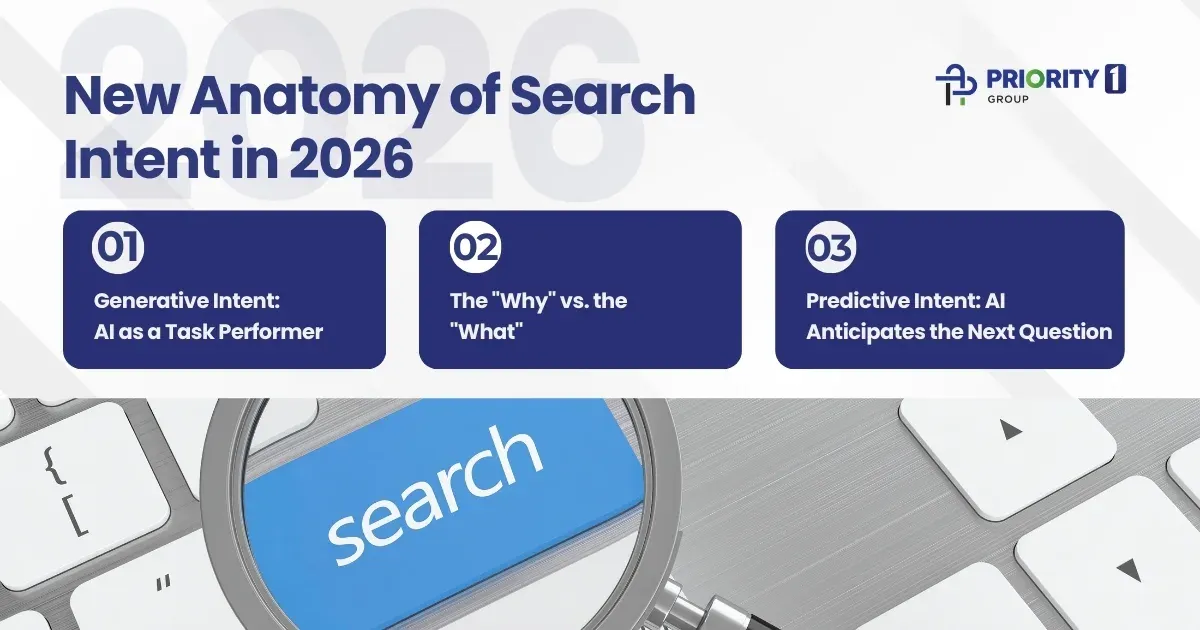
In an AI-driven world, users aren’t simply looking for a link they want the AI to perform a task. For example, instead of typing “best hotels in New York,” users might ask AI to “Create a 3-day itinerary for a trip to New York based on a $1,000 budget.” AI now needs to generate an entire, personalised solution, not just direct users to a resource.
The AI handles the “What” (e.g., “What is SEO?”) instantly. But content strategy now needs to address the “Why” and the “How-to-Contextualise.” Why should the user care about SEO? How do they apply it in their context? The generative AI will look for answers to these deeper questions, which means your content needs to go beyond surface-level definitions and provide real insights.
Predictive intent is one of the most powerful features of AI. AI doesn’t just respond to the immediate query; it anticipates the next question a user might have. For instance, after providing an answer on SEO, the AI might proactively suggest, “Want tips on improving your website‘s SEO ranking?” This predictive feature requires content creators to structure their information in a way that allows AI to deliver helpful, sequential answers.
The SEO playbook of the past focused heavily on keywords. But now, the future lies in entities. It’s no longer about strings of words; it’s about things, concepts, people, places, or brands that the AI recognises and understands.
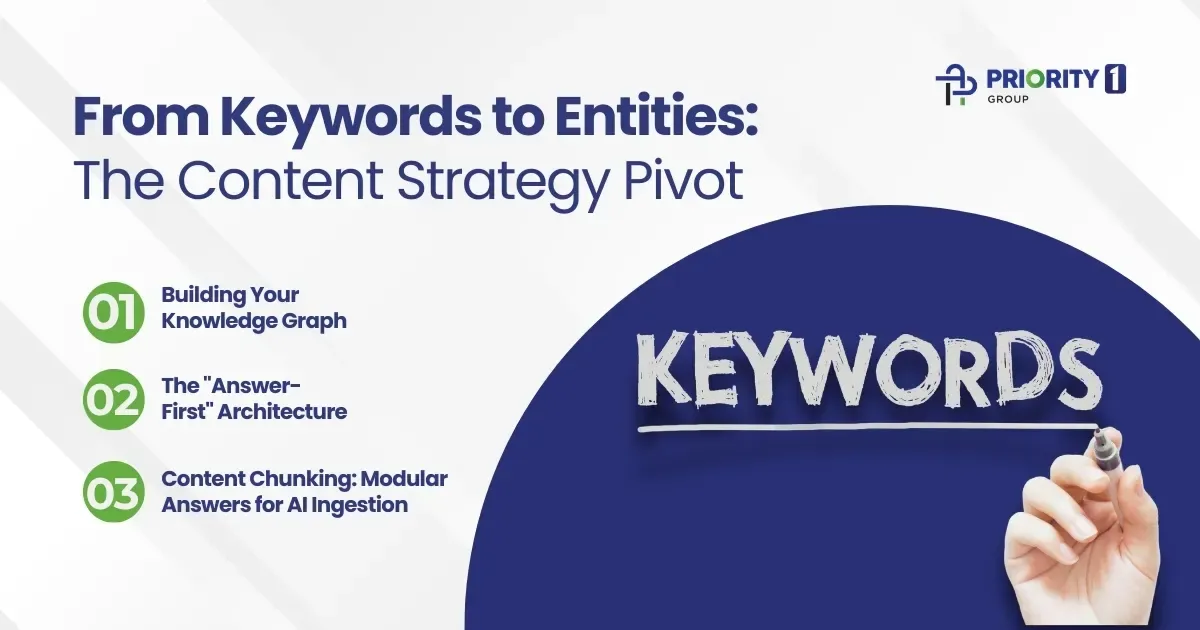
For your brand to be seen as an authority in the AI world, you need to build a knowledge graph. A knowledge graph connects various entities and organises them in a way that AI can interpret and use. By positioning your brand as a “Primary Entity” in your niche, you allow the AI to identify your company as a trusted source for certain topics, whether it’s “enterprise IT solutions” or “sustainable fashion.”
To ensure that your content is consumed by AI, you need to adopt an “answer-first” approach. This means that the most valuable insights should be placed at the top of the page in a format that is ready to be pulled into a snippet. In today’s world, a concise 50-80 word snippet can often serve as the primary piece of content that gets indexed by AI.
To make your content “ingestible” by generative engines, you need to adopt a strategy of modular content. This means breaking down your content into small, standalone sections (H2s, H3s, etc.) that provide answers to specific questions. AI systems thrive on this structure because it enables them to extract relevant pieces of information to build a cohesive response for the user.
With AI summarising common knowledge, it’s the uncommon knowledge that becomes your competitive advantage. How can your brand stand out in this new AI-driven landscape?
“Purely AI-generated content” is becoming a commodity with limited search value. To rise above, you need to integrate human expertise into your content. AI is great at synthesising facts, but it struggles with insights that come from real-world experience. That’s where human content creators, with their deep knowledge and experience, provide value.
AI can’t replicate proprietary data, case studies, and “messy” real-world experiences. These insights provide the nuance and context that AI simply can’t generate on its own. Original research is now a differentiator and a key element in establishing authority.
AI is also starting to recognise authors as “experts.” Including detailed author bios and verified credentials not only adds trust but also becomes a ranking factor in AI systems. For example, if you’re a recognised expert in your field, the AI will value your content more highly, as it can attribute it to an “Expert Entity.”
Just like traditional SEO, there are technical factors that influence how your content is understood by AI systems. But now, these factors are focused on how generative engines parse your content.
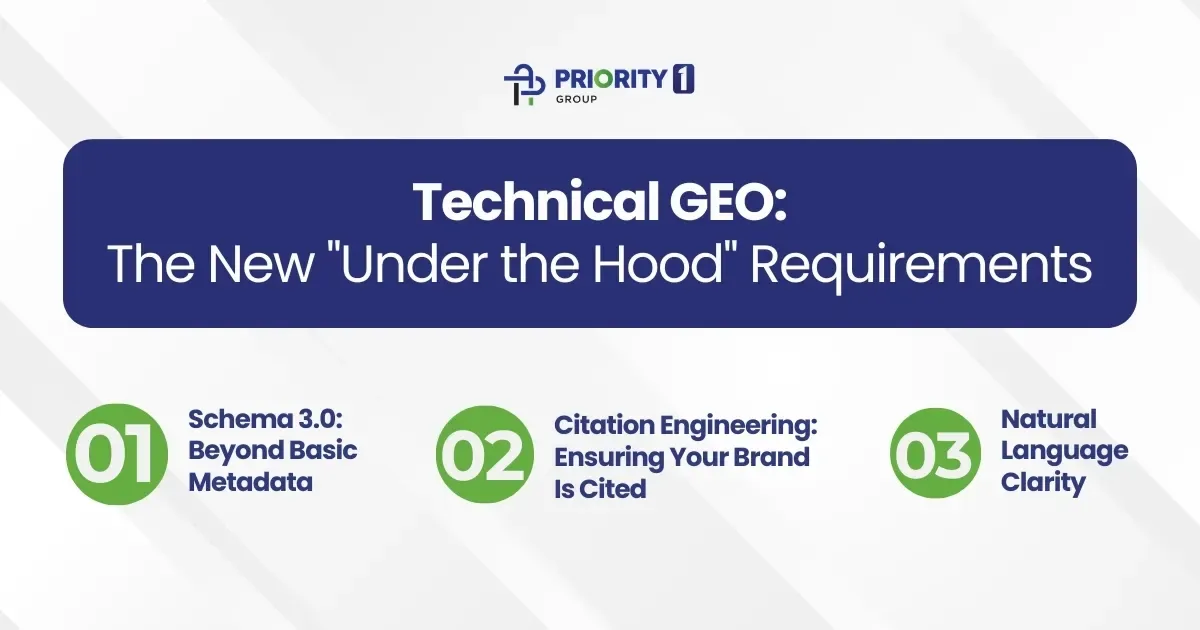
The evolution of Schema markup has given us tools like Speakable, FAQ, and About schemas. These allow you to “hand-feed” context to large language models (LLMs). By providing this structured data, you help AI understand your content on a deeper level, increasing the likelihood of being cited in AI-driven search results.
Citations are still important, but now they are driven by AI. If you want your brand to appear in the footnotes of results from platforms like Gemini, Perplexity, and ChatGPT, you must ensure that your content is well-structured and uses citation strategies that make it easy for AI to credit your brand.
Finally, writing for natural language processing (NLP) is critical. As voice-assisted search becomes more common, your content must be optimised for conversational prompts. This means crafting your copy in a way that feels natural, approachable, and relevant to the way users speak.
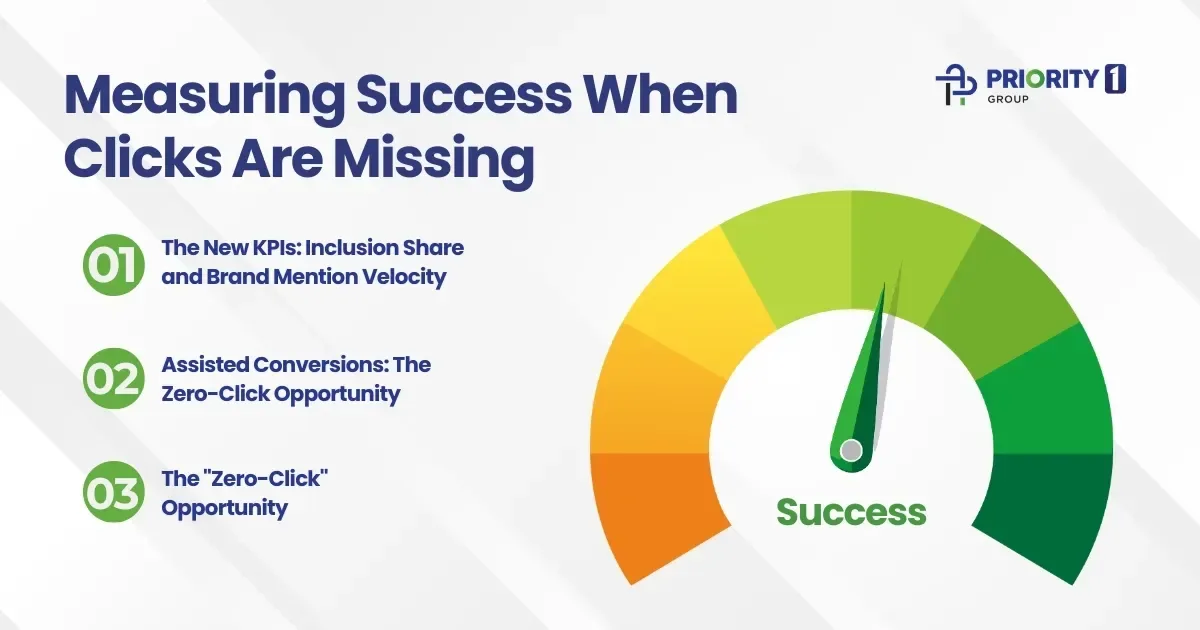
With traditional metrics like CTR becoming less reliable, it’s time to rethink how we measure success in the AI-driven world.
Instead of focusing on rank, focus on Inclusion Share how often your brand is included in AI-driven answers and Brand Mention Velocity, the speed at which your brand is being recognised and discussed across AI platforms.
Assisted conversions refer to the idea that users don’t always need to click through to your website to convert. Being cited in an AI answer is a powerful form of brand influence that affects the buyer’s journey. Even without a direct click, your brand is influencing decisions.
Ultimately, your goal should be to build such authority that users start searching for your brand by name. This is the Zero-Click Opportunity—a point at which your brand’s reputation is so strong that users don’t need to click on anything but your brand when looking for a solution.
The new digital ecosystem isn’t about winning a “popularity contest” with backlinks and click-through rates. It’s about winning a “trust contest” through authority, expertise, and usefulness. As AI continues to dominate search, the brands that thrive will be the ones that create helpful, expert-led content designed not just for human readers, but for the AI systems that interpret and deliver those insights.
AI hasn’t killed SEO; it has finally forced it to evolve into what it should always have been: a tool for delivering helpful, authoritative, and expert-driven communication.