
Outsource Bookkeeping Solutions That Actually Fit Your Business

Outsource Bookkeeping Solutions That Actually Fit Your Business

Most conversations about outsourced bookkeeping start in the wrong place. They begin with a list of services reconciliation, BAS, accounts payable, and end with a price comparison between providers who all look broadly similar on paper. What they skip over entirely is the question that actually matters: which outsourcing model fits the way your business actually operates? 

Because there is no universal answer. A professional services firm billing ten clients per month has fundamentally different bookkeeping needs than a construction company running subcontractor payments, job costing, and variable income streams across dozens of active projects. A business with an internal ops manager who is comfortable in Xero needs something different from one where the owner is the only person who touches the numbers and even then only reluctantly. 

Choosing cheap is easy. Choosing right is the decision that determines whether outsourced bookkeeping reduces your stress or simply relocates it. 

This guide is about how to choose right by understanding the real variables that should drive the decision, the models that exist, and how to match the model to where your business actually is. 

Why the Model Matters More Than the Provider 

Two businesses can engage providers who are equally qualified, equally reputable, and similarly priced, and one will feel like a seamless extension of their operation while the other creates as much friction as it resolves. The difference is almost never the provider’s quality. It is whether the structure of the engagement matches the structure of the business. 

A business owner who values visibility and wants to stay close to the numbers will feel frustrated by a fully managed model that processes everything in the background and delivers a monthly summary. A business owner who wants to hand off the books entirely and never think about them again will feel burdened by a hybrid model that still requires their active input every fortnight. 

Neither preference is wrong. Both are legitimate ways of running a business. The engagement model simply needs to match the preference and the business’s actual operational structure rather than being selected because it was the first result in a Google search or the most attractive package on a pricing page. 

Getting this match right is what separates outsourced bookkeeping that delivers lasting value from outsourced bookkeeping that creates a new set of management problems while solving the old ones. 
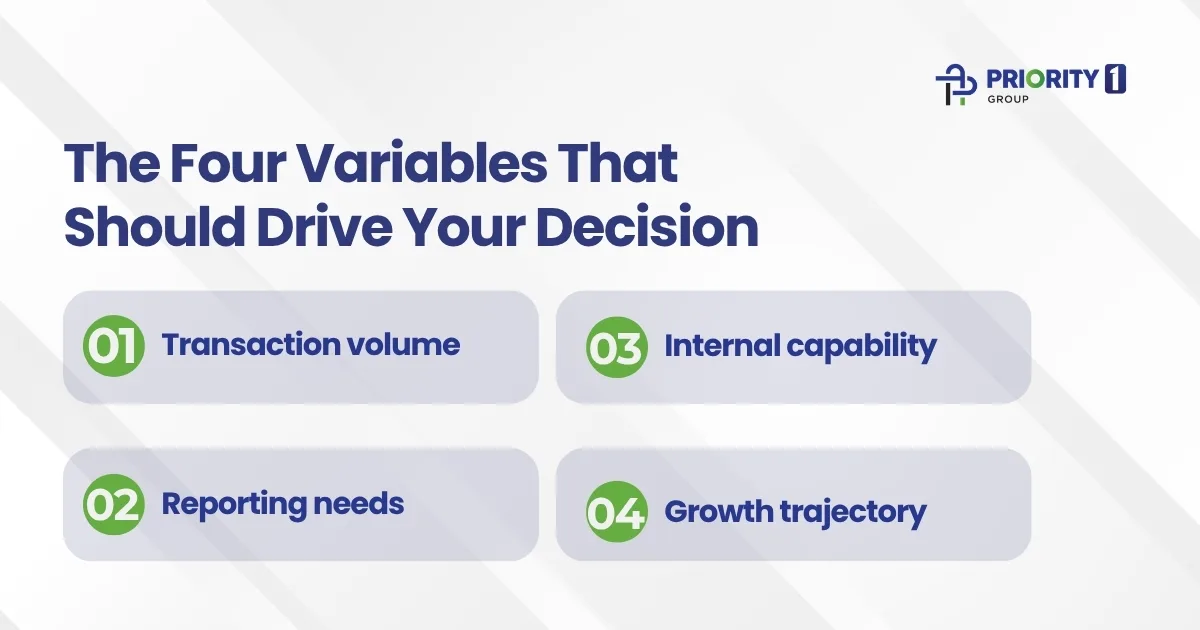
The Four Variables That Should Drive Your Decision

Most conversations about outsourced bookkeeping start in the wrong place. They begin with a list of services reconciliation, BAS, accounts payable and end with a price comparison between providers who all look broadly similar on paper. What they skip over entirely is the question that actually matters: which outsourcing model fits the way your business actually operates? Because there is no universal answer. A professional services firm billing ten clients per month has fundamentally different bookkeeping needs than a construction company running subcontractor payments, job costing, and variable income streams across dozens of active projects. A business with an internal ops manager who is comfortable in Xero needs something different from one where the owner is the only person who touches the numbers and even then only reluctantly. Choosing cheap is easy. Choosing right is the decision that determines whether outsourced bookkeeping reduces your stress or simply relocates it. This guide is about how to choose right by understanding the real variables that should drive the decision, the models that exist, and how to match the model to where your business actually is. Why the Model Matters More Than the Provider Two businesses can engage providers who are equally qualified, equally reputable, and similarly priced and one will feel like a seamless extension of their operation while the other creates as much friction as it resolves. The difference is almost never the provider's quality. It is whether the structure of the engagement matches the structure of the business. A business owner who values visibility and wants to stay close to the numbers will feel frustrated by a fully managed model that processes everything in the background and delivers a monthly summary. A business owner who wants to hand off the books entirely and never think about them again will feel burdened by a hybrid model that still requires their active input every fortnight. Neither preference is wrong. Both are legitimate ways of running a business. The engagement model simply needs to match the preference and the business's actual operational structure rather than being selected because it was the first result in a Google search or the most attractive package on a pricing page. Getting this match right is what separates outsourced bookkeeping that delivers lasting value from outsourced bookkeeping that creates a new set of management problems while solving the old ones. The Four Variables That Should Drive Your Decision Before comparing models, it helps to be clear about the four factors that determine which model will actually work for your business. Transaction volume is the most obvious variable but it is frequently underestimated. Businesses with low transaction volumes (under 100 transactions per month) have very different processing needs than those with 500 or more. Volume affects how much time a bookkeeper needs to spend on your records each month, which in turn affects whether a shared team model is adequate or whether a dedicated resource is necessary. Reporting needs determine how much active involvement your outsourced bookkeeper needs to maintain. A business that needs detailed monthly management reports Profit and Loss, Cash Flow, Budget vs Actuals requires a bookkeeper who understands the business's financial structure deeply enough to produce meaningful analysis, not just process transactions. A business that only needs clean records for year-end tax preparation has a much lower reporting requirement and can be served effectively by a more transactional model. Internal capability is the variable most business owners underestimate about themselves. If someone inside the business is comfortable with the accounting software, can handle basic data entry, and simply needs oversight, review, and compliance support a hybrid model that divides responsibility between internal and external resources may be the most cost-effective option. If nobody internal has any meaningful financial capability or appetite to engage with the numbers, a fully managed arrangement is the only realistic option. Growth trajectory determines whether the model needs to scale. A business planning to double headcount, add a new revenue stream, or enter a new market in the next 12 months needs an outsourcing arrangement that can absorb additional complexity without a complete restructure. A stable business with predictable, consistent activity can optimise for cost and simplicity without worrying as much about headroom. The Main Outsourcing Models What Each One Actually Means These are the four model comparisons that matter most when selecting a bookkeeping outsourcing structure. Each comparison reflects a genuine strategic choice not just a service feature. Fully managed vs hybrid. A fully managed arrangement means the external provider handles the entire bookkeeping function data entry, reconciliation, compliance, reporting, and communication with the accountant with minimal involvement from the business. A hybrid arrangement divides responsibility: the business handles some elements (typically data capture or software entry) while the provider handles review, reconciliation, and compliance. Fully managed suits businesses with no internal financial capability and owners who want complete separation from the day-to-day numbers. Hybrid suits businesses with some internal capability who want professional oversight and compliance without paying for functions they can handle themselves. Offshore vs local. Offshore bookkeeping uses providers or teams based in lower-cost jurisdictions typically the Philippines, India, or Sri Lanka to deliver services at a lower per-hour rate. Local providers are based in Australia, operate within Australian time zones, and typically have deeper familiarity with the ATO compliance environment, Australian accounting standards, and local business contexts. The cost difference is real. So is the communication and oversight difference. Offshore can work well for high-volume, process-heavy work with clearly documented workflows. Local is generally better suited for businesses that need proactive advice, nuanced compliance judgement, and responsive communication. Most businesses benefit from understanding which of these they actually need before optimising for price. Dedicated bookkeeper vs shared team. A dedicated bookkeeper arrangement assigns one professional to your business someone who learns your accounts deeply, understands your patterns, and brings continuity and institutional knowledge to every engagement. A shared team model distributes your work across a pool of bookkeepers, which reduces cost but also reduces the depth of familiarity. Dedicated works best for businesses with complexity, high transaction volumes, or specific reporting requirements that benefit from continuity. Shared team works well for smaller, simpler businesses where the work is largely routine and continuity is less critical. Ongoing support vs project clean-up. Ongoing bookkeeping is a continuous monthly engagement the books are maintained in real time, compliance is current, and reporting is always up to date. Project clean-up is a one-time or periodic engagement to bring disorganised or backlogged books up to date before transitioning to an ongoing arrangement or handing over to an accountant. Most businesses starting with an outsourced provider for the first time need a clean-up phase first. Understanding this upfront prevents the frustration of expecting ongoing pricing before the foundational work has been completed. Matching the Model to Your Business Profile The practical application of these four comparisons is a simple matching exercise but one that most businesses skip because they are not sure which questions to ask before they start shopping. A small service business a sole trader or micro-business with straightforward revenue, minimal accounts payable complexity, and no employees is likely well-served by a shared team, hybrid, ongoing model at a lower transaction volume price point. Their needs are simple; their provider does not need to be deeply embedded in their operation. A growing product-based business with multiple revenue streams, active accounts payable, inventory tracking, and a small team is likely better served by a dedicated bookkeeper in a fully managed ongoing arrangement someone who knows the business well enough to catch irregularities, produce meaningful monthly reports, and communicate proactively when something requires attention. A construction or trade business with job costing, subcontractor management, variable project timelines, and irregular cash flow sits in more complex territory and typically benefits from a local, dedicated, fully managed arrangement with a provider who has specific experience in the construction sector. For industry-specific considerations, Priority1 Group's construction bookkeeping service is built around exactly this profile. Signs You Are in the Wrong Outsourcing Model Many businesses stay in an arrangement that is not working long past the point where the signs were obvious. Here is what misalignment actually looks like: You are not getting reports you can use. If your monthly deliverable is a set of reconciled accounts and nothing more but you need to understand your margins, your cash position, or your cost trends the model is not meeting your reporting needs. Either the scope is too narrow or the provider is not the right fit for the level of output you require. You are spending more time managing the bookkeeper than the arrangement saves. An outsourced bookkeeping arrangement should reduce your administrative burden, not create a new management task. If you are chasing the provider for updates, correcting errors regularly, or spending significant time providing input that should be handled externally the model has friction that should not be there. The cost is low but the value is not visible. Cheap outsourcing that requires constant correction, produces late deliverables, or generates compliance anxiety is not a saving it is a deferred cost. The true cost of a bookkeeping arrangement includes the time you spend managing it, the risk of errors, and the opportunity cost of not having reliable financial information when you need it. For a detailed look at how businesses evaluate the total cost of their bookkeeping arrangement, Priority1 Group's bookkeeping pricing page outlines what different service levels typically include and cost. Your business has grown but the arrangement has not. A model that was right twelve months ago may be structurally inadequate today. If your transaction volume has grown, your reporting needs have increased, or your internal capability has not kept pace with your growth the model needs to be reassessed, not just the provider. You have no real relationship with the person managing your books. In a shared team or offshore arrangement with high staff turnover, there may be no consistent relationship, no institutional knowledge of your business, and no proactive communication. If you cannot answer the question "does my bookkeeper understand my business?" that is a gap that affects quality in ways that are not always immediately visible. How Priority1 Group Structures Outsourced Bookkeeping Priority1 Group is an Australian outsourcing firm delivering bookkeeping services across a range of business sizes, industries, and engagement structures. Rather than applying a generic package to every client, Priority1 Group works with businesses to identify the right model for their specific profile their transaction volume, reporting requirements, internal capability, and growth direction. Their team has specific experience across healthcare, NDIS providers, construction, real estate, and professional services sectors where bookkeeping complexity is higher and the cost of a mismatched arrangement is more significant. Whether a business needs a fully managed ongoing arrangement, a hybrid setup that works alongside an internal resource, or an initial clean-up project before transitioning to ongoing support, Priority1 Group structures engagements around what the business actually needs rather than what fits a standard pricing tier. Conclusion The outsourced bookkeeping market is full of providers. The number of genuinely well-matched arrangements is considerably smaller because matching requires more than comparing service lists and monthly fees. It requires an honest assessment of your transaction volume, your reporting needs, your internal capability, and where your business is heading. It requires understanding the structural differences between outsourcing models and what those differences mean in practice not just in cost, but in the quality of the financial management your business receives every month. Stop picking cheap. Start picking right. The businesses that make this shift consistently find that outsourced bookkeeping becomes one of the highest-value decisions they make not just a cost they manage, but a function that actively supports their ability to grow.

Before comparing models, it helps to be clear about the four factors that determine which model will actually work for your business. 

Transaction volume is the most obvious variable, but it is frequently underestimated. Businesses with low transaction volumes (under 100 transactions per month) have very different processing needs than those with 500 or more. Volume affects how much time a bookkeeper needs to spend on your records each month, which in turn affects whether a shared team model is adequate or whether a dedicated resource is necessary. 

Reporting needs determine how much active involvement your outsourced bookkeeper needs to maintain. A business that needs detailed monthly management reports, Profit and Loss, Cash Flow, and Budget vs Actuals requires a bookkeeper who understands the business’s financial structure deeply enough to produce meaningful analysis, not just process transactions. A business that only needs clean records for year-end tax preparation has a much lower reporting requirement and can be served effectively by a more transactional model. 

Internal capability is the variable most business owners underestimate about themselves. If someone inside the business is comfortable with the accounting software, can handle basic data entry, and simply needs oversight, review, and compliance support, a hybrid model that divides responsibility between internal and external resources may be the most cost-effective option. If nobody internal has any meaningful financial capability or appetite to engage with the numbers, a fully managed arrangement is the only realistic option. 

Growth trajectory determines whether the model needs to scale. A business planning to double headcount, add a new revenue stream, or enter a new market in the next 12 months needs an outsourcing arrangement that can absorb additional complexity without a complete restructure. A stable business with predictable, consistent activity can optimise for cost and simplicity without worrying as much about headroom. 

The Main Outsourcing Models What Each One Actually Means 

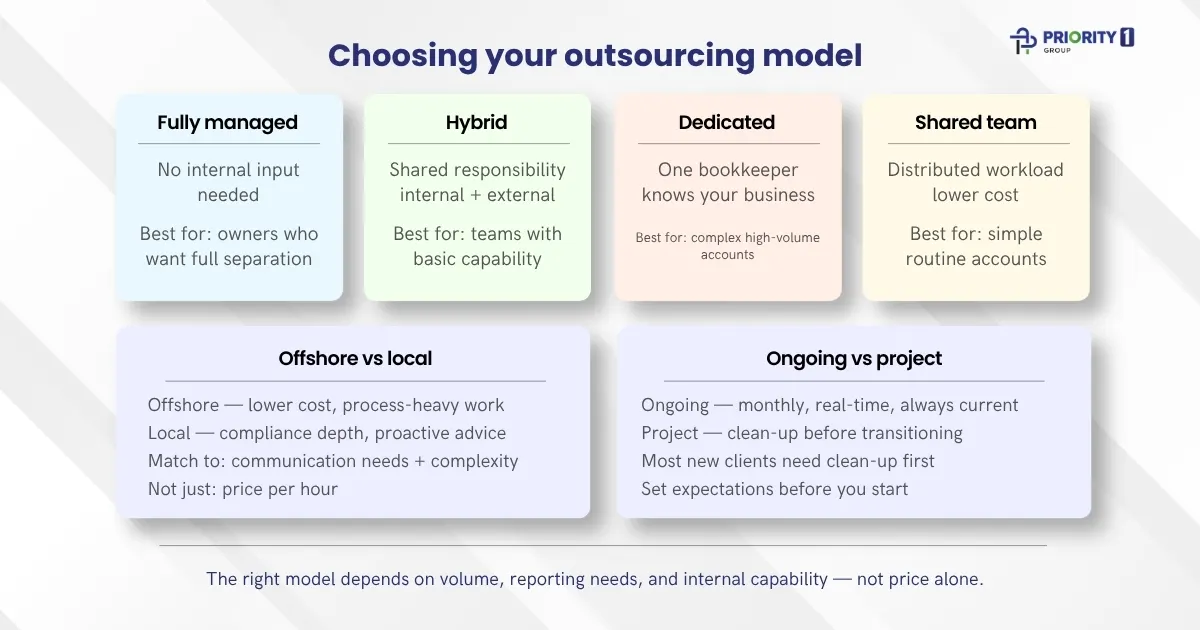
These are the four model comparisons that matter most when selecting a bookkeeping outsourcing structure. Each comparison reflects a genuine strategic choice not just a service feature.
The Main Outsourcing Models What Each One Actually Means

a. Fully managed vs hybrid. A fully managed arrangement means the external provider handles the entire bookkeeping function data entry, reconciliation, compliance, reporting, and communication with the accountant, with minimal involvement from the business. A hybrid arrangement divides responsibility: the business handles some elements (typically data capture or software entry) while the provider handles review, reconciliation, and compliance. Fully managed suits businesses with no internal financial capability and owners who want complete separation from the day-to-day numbers. Hybrid suits businesses with some internal capability who want professional oversight and compliance without paying for functions they can handle themselves.

b. Offshore vs local. Offshore bookkeeping uses providers or teams based in lower-cost jurisdictions typically the Philippines, India, or Sri Lanka to deliver services at a lower per-hour rate. Local providers are based in Australia, operate within Australian time zones, and typically have deeper familiarity with the ATO compliance environment, Australian accounting standards, and local business contexts. The cost difference is real. So is the communication and oversight difference. Offshore can work well for high-volume, process-heavy work with clearly documented workflows. Local is generally better suited for businesses that need proactive advice, nuanced compliance judgment, and responsive communication. Most businesses benefit from understanding which of these they actually need before optimising for price. 

c. Dedicated bookkeeper vs shared team. A dedicated bookkeeper arrangement assigns one professional to your business someone who learns your accounts deeply, understands your patterns, and brings continuity and institutional knowledge to every engagement. A shared team model distributes your work across a pool of bookkeepers, which reduces cost but also reduces the depth of familiarity. Dedicated works best for businesses with complexity, high transaction volumes, or specific reporting requirements that benefit from continuity. Shared team works well for smaller, simpler businesses where the work is largely routine and continuity is less critical. 

d. Ongoing support vs project clean-up. Ongoing bookkeeping is a continuous monthly engagement the books are maintained in real time, compliance is current, and reporting is always up to date. Project clean-up is a one-time or periodic engagement to bring disorganised or backlogged books up to date before transitioning to an ongoing arrangement or handing over to an accountant. Most businesses starting with an outsourced provider for the first time need a clean-up phase first. Understanding this upfront prevents the frustration of expecting ongoing pricing before the foundational work has been completed. 

Matching the Model to Your Business Profile 

The practical application of these four comparisons is a simple matching exercise but one that most businesses skip because they are not sure which questions to ask before they start shopping. 

A small service business, a sole trader, or micro-business with straightforward revenue, minimal accounts payable complexity, and no employees, is likely well-served by a shared team, hybrid, ongoing model at a lower transaction volume price point. Their needs are simple; their provider does not need to be deeply embedded in their operation. 

A growing product-based business with multiple revenue streams, active accounts payable, inventory tracking, and a small team is likely better served by a dedicated bookkeeper in a fully managed ongoing arrangement, someone who knows the business well enough to catch irregularities, produce meaningful monthly reports, and communicate proactively when something requires attention. 

A construction or trade business with job costing, subcontractor management, variable project timelines, and irregular cash flow sits in a more complex territory and typically benefits from a local, dedicated, fully managed arrangement with a provider who has specific experience in the construction sector. For industry-specific considerations, the construction bookkeeping service is built around exactly this profile. 

Signs You Are in the Wrong Outsourcing Model 

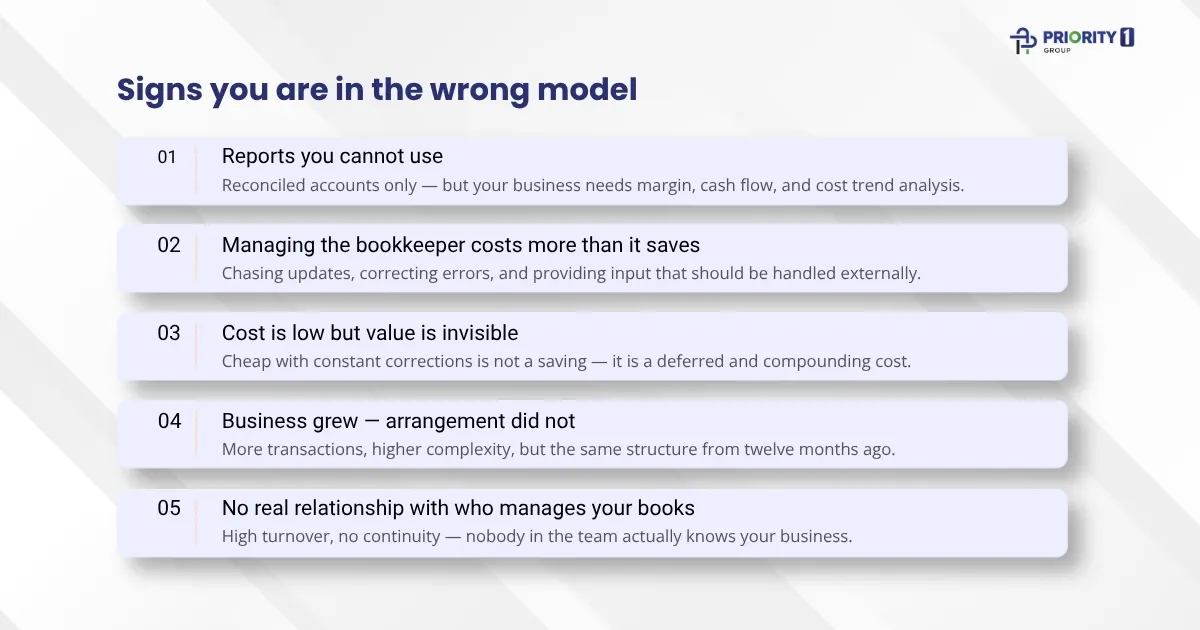
Many businesses stay in an arrangement that is not working long past the point where the signs were obvious. Here is what misalignment actually looks like:
Signs You Are in the Wrong Outsourcing Model

1. You are not getting reports you can use. If your monthly deliverable is a set of reconciled accounts and nothing more but you need to understand your margins, your cash position, or your cost trends the model is not meeting your reporting needs. Either the scope is too narrow or the provider is not the right fit for the level of output you require. 

2. You are spending more time managing the bookkeeper than the arrangement saves. An outsourced bookkeeping arrangement should reduce your administrative burden, not create a new management task. If you are chasing the provider for updates, correcting errors regularly, or spending significant time providing input that should be handled externally the model has friction that should not be there. 

3. The cost is low but the value is not visible. Cheap outsourcing that requires constant correction, produces late deliverables, or generates compliance anxiety is not a saving; it is a deferred cost. The true cost of a bookkeeping arrangement includes the time you spend managing it, the risk of errors, and the opportunity cost of not having reliable financial information when you need it. For a detailed look at how businesses evaluate the total cost of their bookkeeping arrangement, the bookkeeping pricing page outlines what different service levels typically include and cost. 

4. Your business has grown, but the arrangement has not. A model that was right twelve months ago may be structurally inadequate today. If your transaction volume has grown, your reporting needs have increased, or your internal capability has not kept pace with your growth, the model needs to be reassessed, not just the provider. 

5. You have no real relationship with the person managing your books. In a shared team or offshore arrangement with high staff turnover, there may be no consistent relationship, no institutional knowledge of your business, and no proactive communication. If you cannot answer the question “does my bookkeeper understand my business?” that is a gap that affects quality in ways that are not always immediately visible. 

How Priority1 Group Structures Outsourced Bookkeeping 

Priority1 Group is an Australian outsourcing firm delivering bookkeeping services across a range of business sizes, industries, and engagement structures. Rather than applying a generic package to every client, Priority1 Group works with businesses to identify the right model for their specific profile their transaction volume, reporting requirements, internal capability, and growth direction. 

Their team has specific experience across healthcare, NDIS providers, construction, real estate, and professional services sectors where bookkeeping complexity is higher and the cost of a mismatched arrangement is more significant. Whether a business needs a fully managed ongoing arrangement, a hybrid setup that works alongside an internal resource, or an initial clean-up project before transitioning to ongoing support, Priority1 Group structures engagements around what the business actually needs rather than what fits a standard pricing tier. 

Conclusion

The outsourced bookkeeping market is full of providers. The number of genuinely well-matched arrangements is considerably smaller because matching requires more than comparing service lists and monthly fees. 

It requires an honest assessment of your transaction volume, your reporting needs, your internal capability, and where your business is heading. It requires understanding the structural differences between outsourcing models and what those differences mean in practice not just in cost, but in the quality of the financial management your business receives every month. 

Stop picking cheap. Start picking right. The businesses that make this shift consistently find that outsourced bookkeeping becomes one of the highest-value decisions they make not just a cost they manage, but a function that actively supports their ability to grow.

Frequently Asked Questions

The primary factor is complexity and continuity. If your accounts have nuance job costing, multiple revenue streams, detailed reporting requirements, or high transaction volume a dedicated bookkeeper who knows your business deeply will deliver better results. If your accounts are simple and consistent, a shared team is usually adequate and more cost-effective. 

The primary factor is complexity and continuity. If your accounts have nuance job costing, multiple revenue streams, detailed reporting requirements, or high transaction volume a dedicated bookkeeper who knows your business deeply will deliver better results. If your accounts are simple and consistent, a shared team is usually adequate and more cost-effective. 

Not inherently but it requires careful selection and clear workflow documentation. The risk is not the location; it is the depth of knowledge about Australian compliance requirements and the quality of communication and oversight. Businesses considering offshore arrangements should verify the provider's specific knowledge of ATO requirements and establish clear review and escalation processes. 

A hybrid model makes sense when someone internal has basic accounting software capability and the business wants to manage data capture or routine entry in-house while outsourcing review, reconciliation, and compliance to a professional. It is most effective when the internal and external responsibilities are clearly defined from the outset. 

clear assessment of what your current arrangement is delivering and where the gaps are. Engage a prospective new provider for an initial consultation most reputable providers will review your current situation before recommending a model. Factor in a transition period and, if your books are not current, build in a clean-up phase before expecting ongoing service to commence. Contact Priority1 Group to discuss your current situation and wh