
Payroll tax is one of the most misunderstood state-based obligations facing Australian businesses and that misunderstanding has real consequences. Some businesses pay it unnecessarily because they have not understood the exemptions available to them. Others do not realise they have crossed the registration threshold until a state revenue authority contacts them at which point the liability, interest, and potential penalties can be significant.
Unlike income tax or GST, payroll tax is administered entirely at the state and territory level. There is no single national framework, no ATO registration, and no uniform set of rates or thresholds. Each Australian jurisdiction sets its own rules which means a business operating across multiple states may have different payroll tax obligations in each one.
This guide explains what payroll tax is, how wages are treated within that framework, what typically counts as taxable wages, when registration is likely to become necessary, what records a business should maintain, and the most common misconceptions that trip businesses up. It is designed to give business owners a clear, practical understanding of their obligations not as a substitute for professional advice, but as a foundation for better-informed conversations with their advisers.
Payroll tax is a state and territory tax levied on the wages a business pays to its employees above a defined threshold. It is not a tax on employees, it is a tax on the employer, calculated as a percentage of the employer’s total Australian taxable wages above that threshold.
This distinction matters. Payroll tax does not appear on an employee’s payslip, it is not deducted from their wages, and it has no direct impact on what an employee receives. It is a business cost like rent, insurance, or professional fees that arises from the total wages bill crossing a jurisdictional threshold.
The tax is administered by each state and territory’s revenue authority. The thresholds, rates, and grouping provisions vary by jurisdiction. The Australian Government’s Treasury framework for state taxation provides background on how these arrangements operate across the federation, though specific rates and thresholds must always be confirmed with the relevant state revenue authority.
It is also important to understand what payroll tax is not. It is not related to income tax withholding. It is not a superannuation obligation. And it is not the same as the wages reported through Single Touch Payroll though the wages subject to payroll tax and the wages reported through other frameworks often overlap. The obligations are entirely separate.
The payroll tax calculation begins with the concept of Australian taxable wages the total wages paid to employees across all Australian jurisdictions in which the business employs staff. The threshold exemption is then applied based on the rules of the relevant state or territory to determine whether and how much payroll tax is payable.
In most jurisdictions, payroll tax is calculated on a monthly basis, with monthly returns lodged and payments made to the state revenue authority. At the end of the financial year, an annual reconciliation is completed to confirm the total liability for the year and resolve any difference between monthly payments and the actual annual obligation.
One key concept that business owners need to understand is the relationship between total Australian wages and the threshold. In most jurisdictions, the threshold exemption is not applied simply to the wages paid in that state it is reduced proportionally based on the share of total Australian wages that are paid in that jurisdiction. This means businesses with employees in multiple states cannot claim a full exemption in each one.
The South Australian Revenue Office, Revenue NSW, the State Revenue Office of Victoria, and the Queensland Revenue Office each publish detailed guidance on how their specific thresholds and proration calculations work. Checking directly with the relevant authority is always the most reliable approach for jurisdiction-specific calculations.
Understanding what is included in the taxable wages calculation is essential and the definition is broader than many business owners expect. In most Australian jurisdictions, taxable wages include the following:
a. Salaries and wages are the most obvious component gross wages paid to employees, including regular salary, hourly pay, overtime, and shift loadings.
b. Superannuation contributions made by the employer both the Superannuation Guarantee contributions and any voluntary employer contributions are included in taxable wages in most jurisdictions. This is a common surprise for business owners who assume super is treated separately.
c. Allowances and fringe benefits may also be included, depending on the jurisdiction and the specific nature of the benefit. Fringe benefits tax (FBT) grossed-up values are often included as a component of taxable wages for payroll tax purposes, though the precise treatment varies by state.
d. Bonuses, commissions, and incentive payments form part of taxable wages in all jurisdictions. The timing of their inclusion in the payroll tax calculation typically follows when they are paid, not when they are accrued.
e. Director fees and payments to working directors are included as wages in most jurisdictions even where the director does not hold an employment contract in the traditional sense. The nature of the payment, not the title, determines its treatment.
f. Contractor and deemed employee payments can also fall within the taxable wages definition in some circumstances particularly where the contractor is deemed to be an employee under the relevant state legislation’s extended definition. This is one of the areas where professional advice is most valuable, as the rules vary significantly between jurisdictions.
The threshold at which payroll tax registration becomes necessary varies by state and territory, and it changes periodically as governments adjust these thresholds. These are the general triggers that indicate it is time to assess whether registration is required:
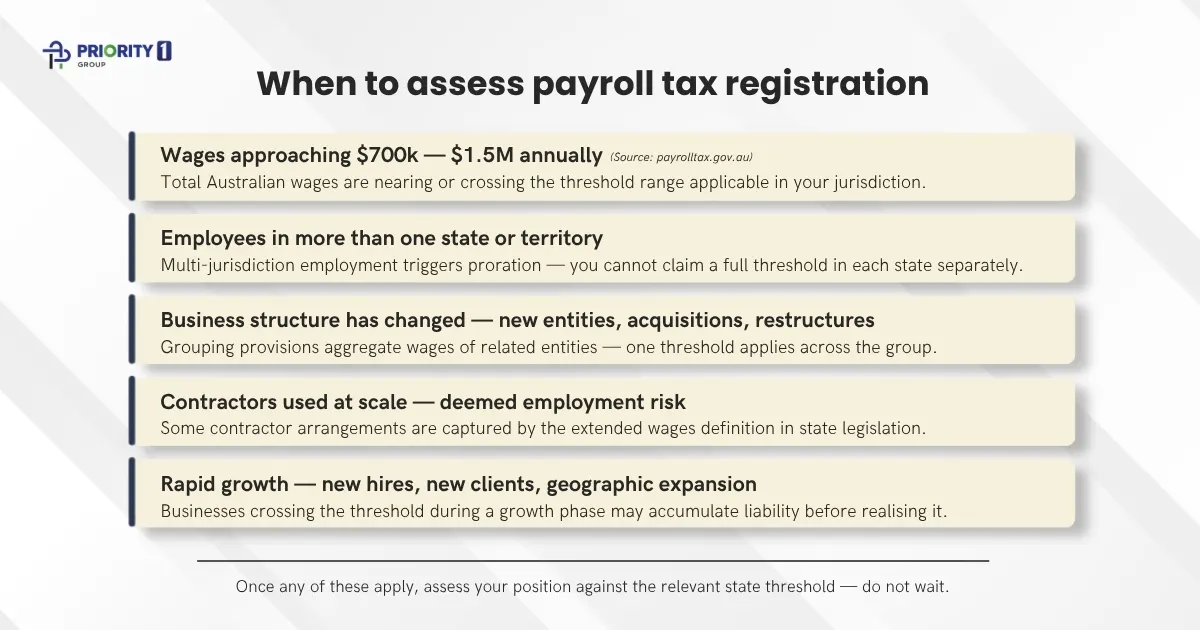
1. Your total Australian wages are approaching or exceeding $1.5 million annually. While exact thresholds vary by jurisdiction and are updated periodically, most Australian states and territories set their annual payroll tax threshold in the range of $700,000 to $1.5 million. As a business’s wage bill grows toward this range, the payroll tax question needs to be actively assessed not left until after the threshold is crossed.
2. You have employees in more than one state or territory. Multi-jurisdictional employment complicates the payroll tax assessment because the threshold exemption is prorated across jurisdictions based on the share of total Australian wages. A business might be below the threshold in any single state but above it when its total Australian wages are considered in the proration calculation. This is one of the most common reasons businesses inadvertently become liable without realising it.
3. Your business structure has changed. Restructures, acquisitions, the addition of related entities, or changes in trading arrangements can affect payroll tax liability sometimes significantly. The grouping provisions in most jurisdictions mean that wages paid by related entities are aggregated for threshold purposes, which can bring entities into liability that would otherwise be below the threshold if assessed individually.
4. You are using contractors at scale. If a significant portion of your workforce consists of contractors, it is worth assessing whether any of those arrangements may be deemed employment for payroll tax purposes. The legislative definitions of wages in most jurisdictions extend beyond traditional employees, and some contractor arrangements are explicitly captured by the taxable wages definition.
5. Your business has grown rapidly. Many businesses cross the payroll tax threshold during a period of rapid growth a new hire cohort, a significant client win, or geographic expansion. Regular review of the total wages bill against the applicable thresholds is the most reliable way to identify when registration is becoming necessary before the liability accumulates.
One of the most significant and least understood features of Australian payroll tax legislation is the grouping provisions. In all Australian jurisdictions, businesses that are related, whether through common ownership, common control, or specific financial or administrative connections, are typically grouped together for payroll tax purposes.
This means the wages of all entities within the group are aggregated to assess whether the threshold is crossed, and only one threshold exemption applies across the entire group. A business owner who operates multiple entities may believe each one is individually below the threshold, but the combined wages of all entities may well exceed it.
The specific tests for grouping vary by jurisdiction, but they broadly cover entities with common directors or shareholders, entities connected through trust arrangements, and entities where common management or business operations create a de facto connection. If your business structure includes multiple entities, even informally connected ones, obtaining professional advice on whether grouping applies to your situation is strongly recommended before concluding that payroll tax does not apply.
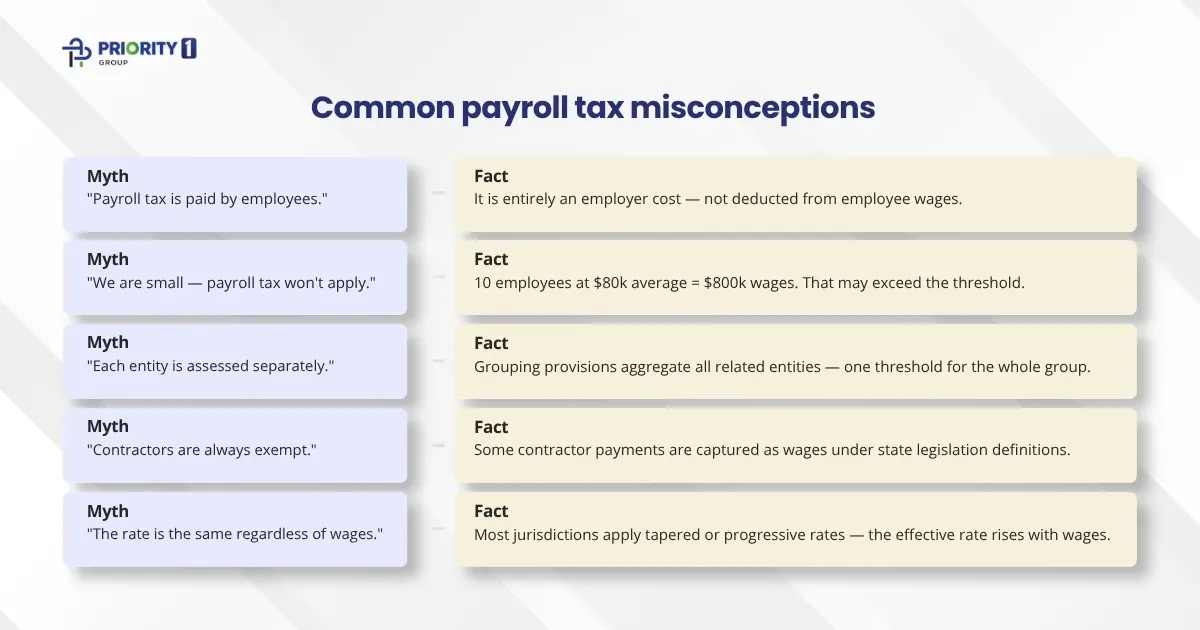
These are the beliefs that most consistently lead Australian businesses into unnecessary liability or unnecessary payment of tax they do not owe.
Accurate, well-maintained payroll records are essential for payroll tax compliance, both for the purpose of completing accurate returns and for substantiating the business’s position if a state revenue authority initiates a review or audit.
At minimum, businesses should maintain comprehensive records of the gross wages paid to every employee in every jurisdiction, the value of any superannuation contributions made on behalf of employees, any allowances, fringe benefits, or bonuses paid during the period, all contractor payments that may be subject to the extended wages definition, and the basis on which any contractor arrangements were assessed as exempt from the taxable wages definition.
Records should be maintained in a form that allows the business to reconstruct its payroll tax calculation for any period within the relevant statute of limitations, which varies by jurisdiction but is typically four to five years in most states. Digital record-keeping through cloud-based accounting and payroll platforms significantly simplifies this task, provided the data captured is complete and categorised consistently.
For guidance on maintaining payroll records that support both compliance obligations and accurate financial reporting, the payroll management service provides structured support for businesses at every stage of their payroll management maturity.
Priority1 Group is an Australian outsourcing firm delivering expert bookkeeping and payroll management services to small and medium-sized businesses across the country. Their payroll management service is designed for businesses that need structured, accurate payroll processing with the compliance rigour and record-keeping discipline that payroll tax obligations require.
While payroll tax assessment and registration are matters for a registered tax adviser or state revenue authority, Priority1 Group’s payroll team ensures that the underlying records the wage data, superannuation contributions, and contractor payment tracking are maintained accurately and consistently, giving businesses and their advisers the reliable foundation they need to assess and meet their payroll tax obligations with confidence.
Payroll tax is not a tax that rewards assumptions. The thresholds change. The grouping provisions catch people off guard. The definition of taxable wages is broader than most business owners realise. And the consequences of getting it wrong in either direction are both financial and operational.
The businesses that manage payroll tax well are the ones that understand the framework early, review their position regularly as their wage bill grows, take professional advice when their structure or circumstances change, and maintain accurate records that can withstand scrutiny.
Understanding when you must register and when you genuinely do not is the starting point. Everything else follows from there.
For businesses looking to strengthen the payroll record-keeping foundation that underpins their compliance obligations, contact Priority1 Group to discuss how structured payroll management support can be put in place.