Imagine spending thousands of dollars on a beautifully designed website, a slick social media campaign, and a polished Google Ads strategy, only to hear crickets in return. No leads. No sales. No traction. For many Australian businesses, this isn’t a worst-case scenario; it’s a familiar one. And nine times out of ten, the culprit isn’t the design, the budget, or the platform. It’s a missing foundation: a clear understanding of who the marketing is actually for.
Before you craft a single ad, write a blog post, or build a landing page, you need to know one thing with absolute clarity, your target audience. Skipping this step is like setting sail without a map. You might move, but you’ll rarely arrive anywhere worthwhile.
In this guide, we’ll walk you through what your target audience really is, why it matters more than ever in 2026, and how to define yours in a way that transforms every marketing dollar you spend.
A target audience is the specific group of people most likely to want, need, and pay for what you offer. They share common traits: age, location, income, interests, problems, online habits, that make them more receptive to your message than the general public.
It’s tempting for business owners to say, “Anyone can be my customer.” Technically true. Practically disastrous. When you market to everyone, you connect with no one. Your message becomes generic, your visuals forgettable, and your offer easily ignored. Strong brands don’t widen the net; they sharpen it.
Think of it this way: a yoga studio in Bondi targeting “anyone interested in fitness” will struggle far more than one targeting “working professionals aged 28–45 in Sydney’s eastern suburbs who want to manage stress and improve flexibility outside office hours.” The second studio knows exactly what to say, where to say it, and how to price it.
A well-defined audience shapes every decision in your marketing funnel. Here’s what changes when you get it right:
Sharper Messaging. You stop writing for “potential customers” and start speaking directly to a real person with a real problem. Your tone, vocabulary, and examples become unmistakably relevant.
Smarter Spending. Paid ads, SEO efforts, and content production all become more efficient. You’re no longer paying to reach the wrong eyeballs.
Better Web Design. A homepage built for tradies in regional Queensland looks and reads very differently from one built for boutique fashion buyers in Melbourne. Knowing your audience drives layout, imagery, calls-to-action, and even loading speeds.
Higher Conversions. When prospects feel understood, they trust faster. When they trust faster, they buy faster.
Stronger Brand Loyalty. Customers stay with brands that “get them.” Audience clarity is the first step toward that emotional connection.
To truly know your audience, you need to look beyond surface-level data. Effective marketers analyse four distinct layers:
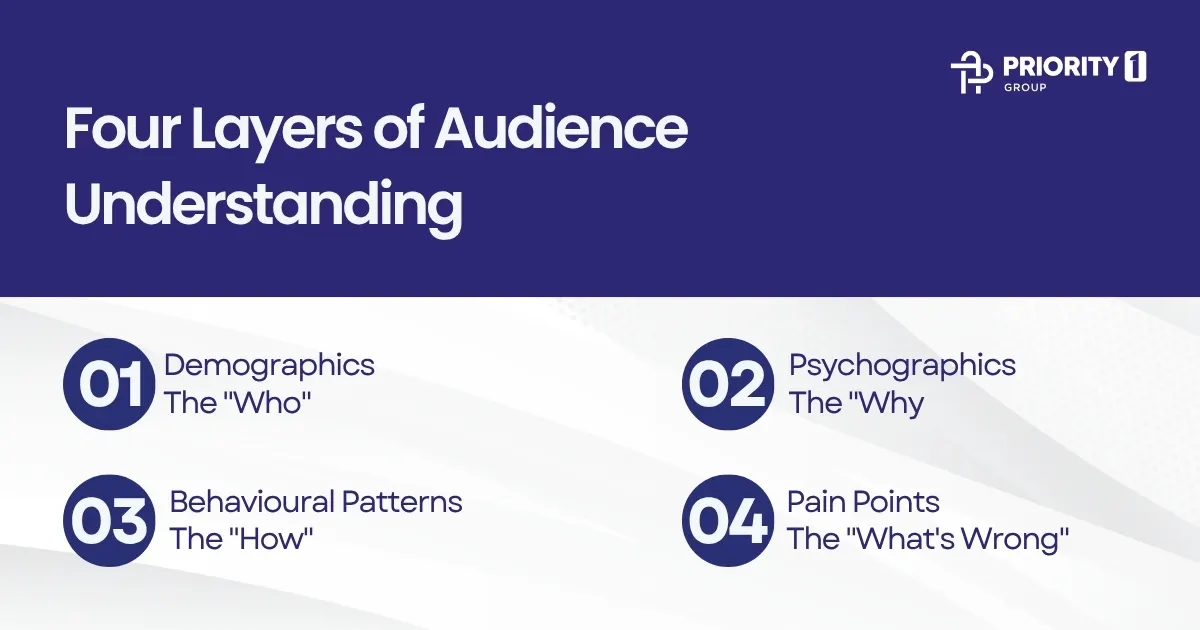
This is the foundational data: age, gender, income level, education, occupation, marital status, and geographic location. For Australian businesses, regional differences matter; a customer in Perth may have different buying patterns than one in regional Tasmania, even within the same demographic bracket.
This layer dives into values, beliefs, lifestyles, attitudes, and aspirations. Two 35-year-old women with identical incomes may make wildly different purchasing decisions because one prioritises sustainability and the other prioritises convenience. Psychographics explain motivation.
How does your audience actually behave online? Which platforms do they use? Do they research extensively before buying or make impulse decisions? Do they prefer reading, watching, or listening? Behavioural data tells you where to show up and in what format.
Every purchase is the solution to a problem, whether stated or unspoken. The more specifically you can articulate the frustrations, fears, and friction points your audience experiences, the more compelling your marketing becomes. People don’t buy products; they buy relief, progress, or transformation.
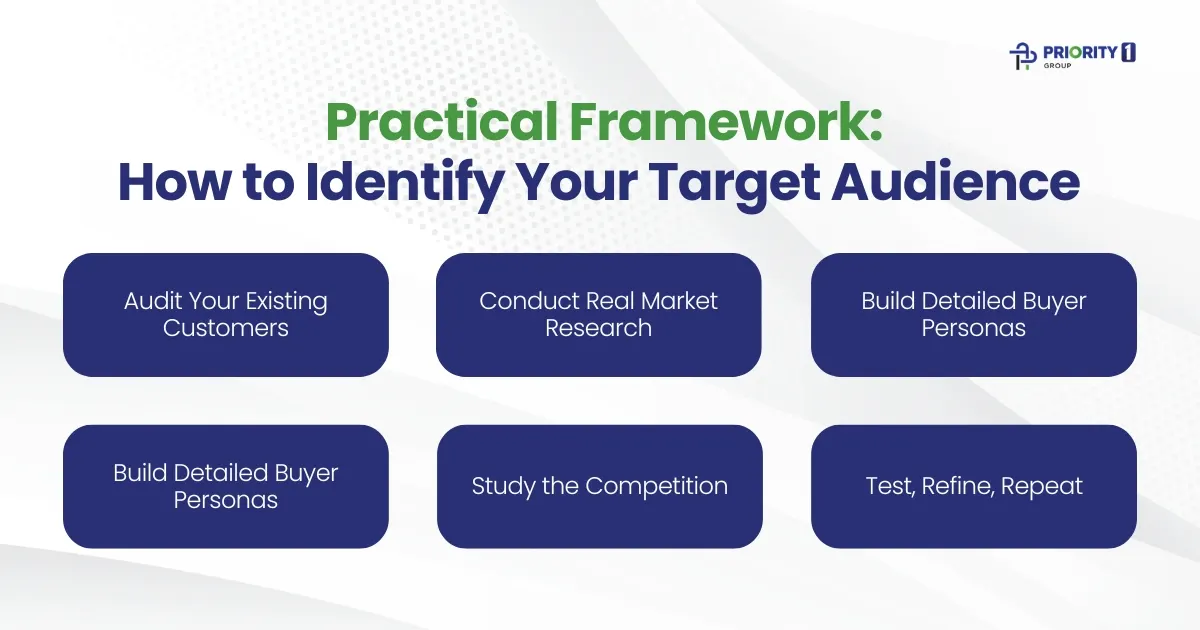
Theory is useful, but execution is what moves the needle. Here’s a practical, step-by-step method any business, small or large can apply:
Your current customer base is the richest data source you have. Pull up your CRM, sales records, or even your inbox. Look for patterns. Who buys most often? Who spends the most? Who refers others? The traits these “best customers” share often reveal your true ideal audience, which may be different from who you assumed it was.
Send short surveys to your email list. Run a few one-on-one interviews with loyal clients. Ask them why they chose you, what almost stopped them, and what problem you solved. Tools like Google Forms or Typeform make this nearly free, and the qualitative insights are gold.
Take everything you’ve learned and condense it into 2–4 fictional but data-backed profiles. Give each persona a name, a job, a daily routine, goals, fears, and preferred online channels. A good persona reads like a character description in a novel, specific enough that you can almost picture them ordering coffee.
Look at the businesses already serving your space. Read their reviews, both five-star and one-star. The complaints reveal unmet needs. The praise reveals what your shared audience values most. Tools like SEMrush or even a simple Google search can show you what content their audience is engaging with.
Google Analytics 4, Meta Audience Insights, and Search Console reveal who is actually finding and engaging with your business right now. Don’t rely on what you think your audience looks like, let the data confirm or correct it. This step alone has reshaped countless marketing strategies for the better.
Audience understanding isn’t a one-time exercise. Markets shift, trends evolve, and your business grows. Build in quarterly reviews to validate that your personas still match reality.
Even well-intentioned businesses stumble when defining their audience. Watch out for these pitfalls:
Casting too wide a net. “Australians aged 18–65” is not an audience, it’s a population. Narrow it down.
Confusing customers with audience. Not everyone who buys from you is your ideal audience. Focus on the segment that’s most profitable and most likely to stay.
Relying on outdated assumptions. The audience that worked for your business in 2020 may not match the one in 2026. Consumer behaviour has shifted dramatically post-pandemic, especially in digital habits.
Ignoring negative personas. Sometimes it’s just as useful to define who you don’t want to attract bargain-hunters, time-wasters, or clients outside your service capacity.
Treating audience research as a one-off. Audiences evolve. So should your understanding of them.
Once your audience is clearly defined, every channel suddenly works harder for less effort:
SEO becomes targeted because you know the exact phrases your audience types into Google, including local search terms relevant to Australian regions.
Social media gains traction because your tone, visuals, and posting times align with where your audience already spends their time.
Web design transforms from a generic template into a tailored experience that speaks directly to visitor intent, which improves both conversions and Core Web Vitals.
Email marketing stops feeling like spam and starts feeling like a useful nudge, because the content matches the reader’s actual stage in the buying journey.
Paid advertising delivers a far better return on ad spend because you’re no longer paying Google or Meta to show your ad to people who’d never buy.
In short, audience clarity is the multiplier that makes every other marketing investment more profitable.
Australia is a uniquely diverse market. Consumer behaviour in metropolitan Sydney differs from the Sunshine Coast, which differs again from Adelaide or Darwin. Cultural diversity, regional economies, and even seasonal patterns (think tourism towns vs. mining communities) all influence how audiences engage with brands.
For local businesses, this means hyper-local audience research often outperforms broad national targeting. For national brands, it means segmenting your audience by region or city can dramatically improve campaign performance. One-size-fits-all rarely fits anyone well in a market this varied.
Marketing is not magic. It’s clarity, consistency, and connection and all three start with knowing exactly who you’re trying to reach. When you understand your audience deeply, your messaging writes itself, your designs feel right, and your campaigns convert without a fight.
If you’re a business owner trying to grow online, don’t start with the logo, the website redesign, or the next ad campaign. Start with the audience. Everything else follows.
At Priority1 Group, we help Australian businesses cut through the noise with audience-driven digital marketing and web development. From in-depth audience research and SEO to high-converting websites and targeted ad campaigns, our team builds strategies that speak directly to the customers who matter most to your business.
Whether you’re a local startup in Brisbane or Melbourne or an established brand serving customers across Australia, we’d love to help you connect with the right audience and turn that connection into measurable growth.
Get in touch with Priority1 Group today and let’s start building marketing that actually works.