
If you run an NDIS business, chances are you didn’t get into this industry because you love invoicing. You got into it to support people to help participants live more independently, connect with their communities, and get real value from their plans. Yet somewhere between the service agreements, the claim batches, the rostering, the audits, and the endless portal logins, the “business” side of your NDIS business has quietly grown into a second full-time job.
That’s the gap NDIS outsourcing exists to fill. But because the term gets thrown around loosely, sometimes meaning a virtual assistant, sometimes meaning a full back-office team, a lot of providers aren’t quite sure what it actually involves, how it works in practice, or whether it’s even allowed under the NDIS rules.
Let’s clear all of that up. In this guide, we’ll walk through what NDIS outsourcing really means, which parts of your business can (and can’t) be handed over, how the process works from day one, and what a well-run outsourcing arrangement looks like on the ground. Along the way, we’ll share the kind of practical details we’ve learned at Priority1 Group from working alongside Australian NDIS providers every day.
NDIS outsourcing is the practice of engaging an external partner to handle specific non-care functions of your NDIS business, things like claims processing, bookkeeping, rostering support, documentation, compliance administration, and even your marketing and website so your internal team can concentrate on service delivery.
The key phrase there is non-care functions. Outsourcing doesn’t mean someone else supports your participants. It means someone else handles the machinery around that support: the paperwork, the numbers, the systems, and the digital presence that keeps enquiries coming in.
Think of it like this. A hospital doesn’t ask its surgeons to run payroll, and it doesn’t hire payroll officers to perform surgery. Each role goes to the people best equipped to do it. NDIS outsourcing applies that same logic to disability service providers most of whom started as care experts, not administrators, and shouldn’t have to become both.
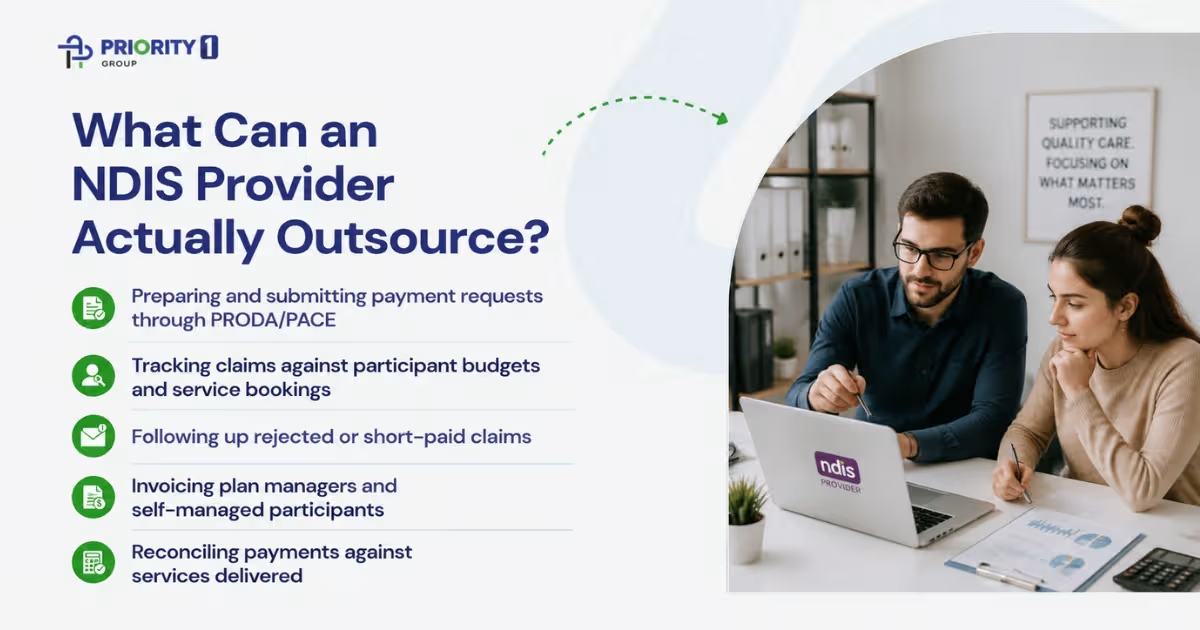
Here’s where it gets practical. The functions most commonly outsourced by Australian NDIS providers fall into four broad buckets.
This is usually the first thing providers hand over, and for good reason: it’s repetitive, deadline-driven, and unforgiving of errors. An outsourced team can manage:
Small errors here compound quickly. A claim coded to the wrong support item doesn’t just delay payment; it distorts your revenue picture and can create headaches at audit time. A dedicated team that processes NDIS claims all day, every day, simply makes fewer of those mistakes than a stretched office manager juggling ten other tasks.
NDIS finances have quirks that generic bookkeeping often misses SCHADS Award interpretation, superannuation on complex rosters, GST treatment of NDIS supports, and cash flow that hinges on claim turnaround. Outsourced finance support typically covers day-to-day bookkeeping, payroll runs, accounts payable and receivable, BAS preparation support, and clean monthly reporting so you always know where you stand.
This bucket covers the connective tissue of your business: maintaining participant files, keeping service agreements current, preparing documentation for audits, tracking worker screening and training compliance, managing intake paperwork, and keeping your CRM or client management system tidy. None of it is glamorous. All of it is what auditors look at first.
Here’s the bucket many providers overlook. Your website, your Google presence, and your enquiry pipeline are business functions too, and in a market where support coordinators and families research providers online before ever picking up the phone, they’re increasingly the difference between a full caseload and an empty one. Outsourcing this means professionals handle your website design and development, SEO, content, and campaigns, while you handle the care those new participants receive.
Direct participant support, clinical decisions, safeguarding responsibilities, and your obligations as a registered provider stay with you always. A trustworthy outsourcing partner will be upfront about that line and will structure everything to keep you in control. You remain the provider; they remain your engine room.
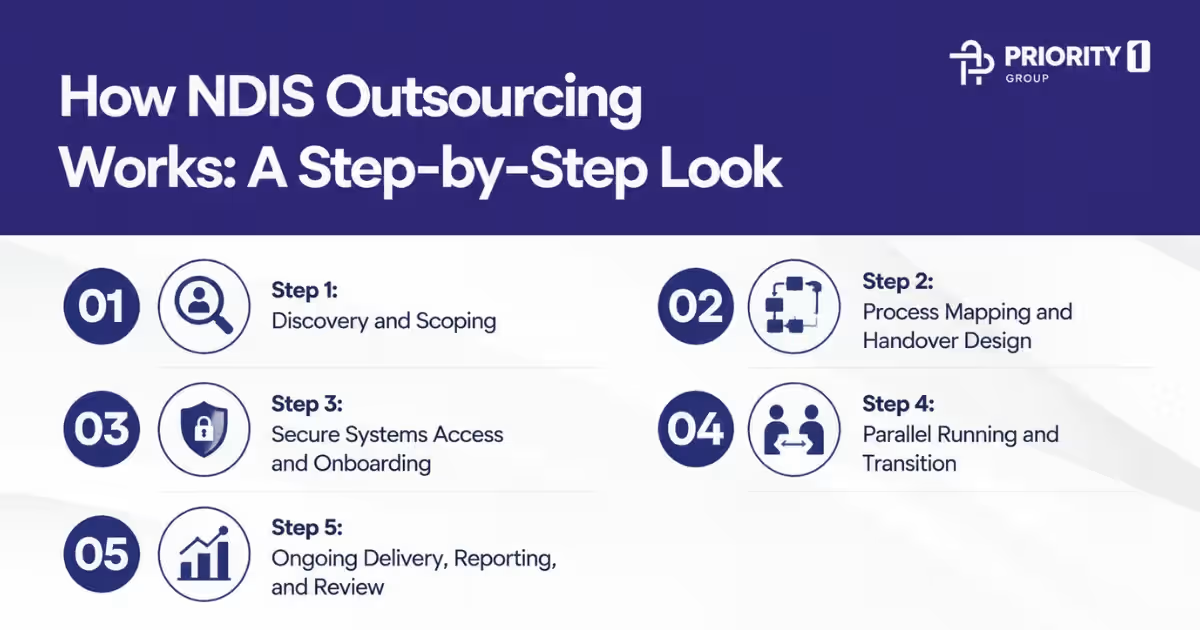
Every partner runs their own version of this, but a well-managed engagement generally moves through five stages.
It starts with a conversation, not a contract. A good partner will want to understand your service types, participant numbers, current software (SupportAbility, ShiftCare, Xero, whatever you use), where the bottlenecks are, and what “success” looks like for you. From that, they’ll recommend a scope that functions to hand over, in what order, and with what expected outcomes.
Before anything transfers, your existing workflows get documented: how a shift becomes a claim, how an enquiry becomes an intake, how an invoice gets approved. This stage matters more than most providers realise. If your current process is messy, a capable partner won’t just replicate the mess offshore they’ll tidy it as part of the transition.
The outsourced team is set up with role-based, auditable access to only the systems they need never blanket access to everything. Confidentiality agreements, privacy protocols aligned with Australian requirements, and clear data-handling rules are locked in before a single participant record is touched.
Sensible partners don’t flip a switch. For the first few weeks, the outsourced team typically runs alongside your existing process, claims are double-checked, reports are compared, and discrepancies are ironed out before responsibility fully transfers. This is where trust is earned.
Once live, the arrangement settles into a rhythm: agreed turnaround times, regular reporting, a named point of contact, and scheduled reviews. You should always be able to see what was processed, what’s pending, and what needs your attention without having to chase anyone for it.
To make this concrete, consider a hypothetical (but very familiar) provider we’ll call Horizon Community Supports, a registered provider in Brisbane delivering community access and in-home supports to around 60 participants.
Horizon’s founder, Daniel, is a former support worker who built the business on reputation. But by the time Horizon hit 25 staff, the cracks were showing. Claims were being submitted in a Sunday-night rush, roughly one in twelve was bouncing back for corrections, and cash flow was so unpredictable that Daniel once delayed his own pay to cover a payroll run. Meanwhile, the website built by a friend in 2021 hadn’t generated a single enquiry in months.
Here’s how outsourcing changed the picture over one quarter:
Nothing about Daniel’s care model changed. What changed was that the business around the care finally worked as hard as the people inside it.
“Will I lose control of my business?” No, and if a partner’s model requires you to, walk away. In a properly structured arrangement, you approve the processes, you own the systems and data, and you receive reporting that gives you more visibility than you had before, not less. Outsourcing delegates the doing, not the deciding.
“Is participant data safe?” It should be safer. Ask any prospective partner about their privacy framework, access controls, and confidentiality agreements. A professional outfit will have documented answers ready; a vague answer is your cue to keep looking.
“Is outsourcing even allowed for NDIS providers?” Yes. Outsourcing administrative and business functions is standard commercial practice. Your registration obligations, quality and safeguarding responsibilities, and duty of care remain yours, which is exactly why the right partner builds their processes to support your compliance rather than complicate it.
“What does it cost?” Less than the alternative, in most cases. A full-time in-house admin or finance hire costs a salary, super, leave, training, and management time, and still leaves you exposed when they resign or take holidays. Outsourcing converts that into a predictable monthly cost with built-in continuity, and it scales up or down as your participant numbers change. The less visible saving is revenue you stop losing: claims that get paid the first time, invoices that go out on schedule, and enquiries your website finally captures.
If you take one thing from this guide, make it this: the value of outsourcing depends almost entirely on who you outsource to. When you’re comparing partners, look for:
1. Genuine NDIS specialisation — they should speak fluently about PACE, support catalogues, SCHADS, and audit evidence without you explaining any of it.
2. A structured transition process — parallel running, documentation, and a clear handover plan, not “send us your logins and we’ll figure it out.”
3. Transparent reporting — you should know exactly what’s been done, by when, every week.
4. Local accountability — an Australian point of contact who understands the sector, even when delivery is supported by an offshore team.
5. Breadth that matches your growth — a partner who can handle your back office today and your marketing tomorrow saves you from managing three different vendors.
At Priority1 Group, NDIS outsourcing isn’t a side offering; it’s what we’re built for. We’re an Australian business outsourcing company that combines dedicated NDIS operational support, claims, bookkeeping, payroll, compliance administration, and back-office management with in-house digital marketing, web design, and development. That combination matters because most providers don’t have one problem; they have an admin problem and a growth problem, and solving them together is far more powerful than solving them apart.
Our teams work inside the systems you already use, follow processes you approve, and report in plain English so you always know your business is running properly, even when you’re out delivering the work that actually matters.
NDIS outsourcing isn’t about doing less for your participants. It’s about removing everything that stands between you and doing more for them. When the claims run themselves, the books stay clean, the compliance files are audit-ready, and the enquiries keep arriving, that’s when an NDIS business stops surviving week to week and starts building something that lasts.
Curious whether outsourcing makes sense for your NDIS business? Talk to the team at Priority1 Group we’ll walk you through exactly what it would look like for your setup, with no pressure and no jargon.