Facebook or Instagram which one deserves more of your business’s attention?
It is a common question, particularly for businesses working with limited time, content resources, and advertising budgets. Both platforms can support brand awareness, customer engagement and lead generation, but they do not necessarily play the same role in a marketing strategy.
Instagram is highly visual and built around formats such as Reels, Stories, images and carousels. Facebook offers a broader mix of content formats alongside Groups, Events, business pages and community-based interactions.
The better platform is therefore not simply the one with the biggest audience. It is the one that aligns with your customers, marketing objectives, content capabilities and the actions you want people to take.
For many businesses, the answer may even be to use both, but for different purposes.
This guide breaks down Instagram vs Facebook for business, including audiences, content, organic marketing, advertising and practical considerations for Australian businesses.
Before looking at each platform in detail, here is a simple comparison.
Factor | ||
Best suited for | Communities, local businesses, broad reach and lead generation | Visual discovery, branding and engagement |
Main content | Posts, Groups, Events, videos, Reels | Reels, Stories, carousels, images |
Visual storytelling | Good | Excellent |
Community building | Excellent | Good |
Local business marketing | Excellent | Very good |
E-commerce | Very good | Excellent |
Lead generation | Excellent | Very good |
Short-form video | Strong | Strong |
Advertising | Available through Meta Ads | Available through Meta Ads |
General strength | Community and conversion | Discovery and visual engagement |
There is no universal winner.
A visually driven retail, hospitality, or lifestyle brand may naturally lean towards Instagram. A local service business may find Facebook particularly valuable for community visibility and lead generation. Other businesses may benefit from combining the strengths of both.
The starting point should always be your audience.
If you are not yet clear on who your ideal customers are, read Priority1 Group’s guide to understanding your target audience.
Facebook and Instagram are both part of Meta’s wider ecosystem, but the way people consume and interact with content on each platform differs.
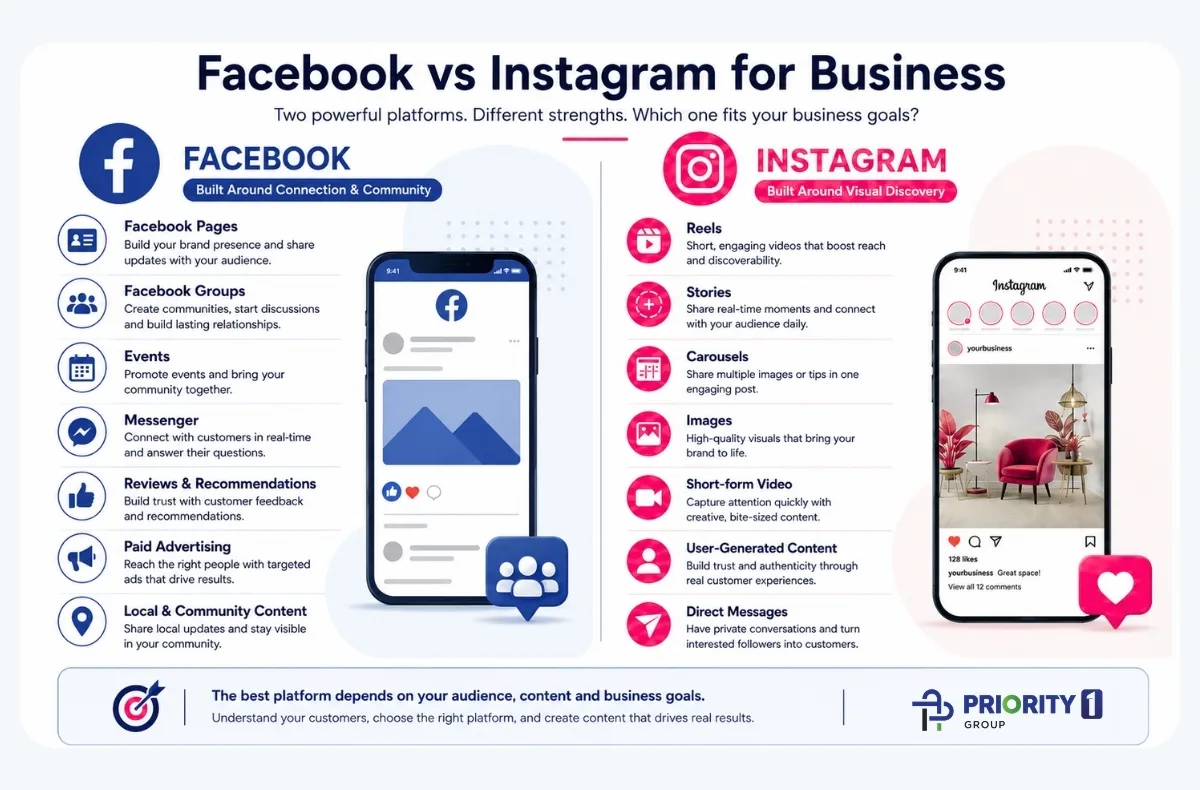
Facebook gives businesses access to several ways of communicating with customers beyond standard social posts.
Businesses can use:
These features can make Facebook useful for businesses that depend on trust, repeat interaction, local audiences or community engagement.
A professional service provider, healthcare business, trade, local retailer or community-based organisation may use Facebook very differently from an e-commerce brand.
Rather than focusing only on how many people see a post, businesses can use Facebook to create conversations, answer questions, distribute useful information and nurture people over time.
Instagram is more visually driven.
Its core content formats include:
This makes it particularly valuable when a product, service, experience or transformation can be communicated visually.
Fashion, beauty, food, fitness, real estate, hospitality, travel and e-commerce businesses are obvious examples, but Instagram can also work effectively for professional and service-based businesses when educational content is presented visually.
A business does not necessarily need a highly photogenic product either.
Advice, case studies, processes, FAQs, staff insights and educational information can all be transformed into short videos and carousels.
Demographics can help guide platform selection, but they should not be treated as fixed rules.
The idea that Facebook is only for older audiences or Instagram is only for younger audiences is overly simplistic.
Both platforms have significant audiences, including in Australia. Current Australian digital data published by DataReportal shows that Meta’s advertising tools provide substantial potential reach across both Facebook and Instagram. It is important to remember that advertising-reach estimates are planning metrics and should not be interpreted as identical to monthly active-user figures.
For a business, the more useful questions are:
Your own business data should ultimately carry more weight than broad demographic assumptions.
Google also recommends creating websites and content primarily for users rather than focusing on search engines alone. The same principle applies to social media: understand your audience first, then build your strategy around what is useful to them.
For Australian businesses, choosing a social platform should involve more than looking at global user numbers.
Local audience behaviour matters.
A Brisbane-based trade business trying to generate local enquiries may require a completely different social media strategy from an Australian fashion retailer shipping nationally.
Facebook can be particularly useful when community, location, recommendations or longer customer journeys play a role.
Instagram may be particularly valuable where visual presentation, lifestyle positioning, product discovery or short-form content are central to the buying process.
Australian businesses should therefore evaluate Facebook and Instagram through four main lenses:
Look at the age, interests, location, and behaviour of the people most likely to buy from you.
Are you trying to:
Different objectives may favour different content and campaign strategies.
A platform can only work effectively if your business can produce content suited to it.
If Instagram is part of your strategy, consider whether you can consistently create strong visual content, videos or carousels.
If Facebook is your priority, consider whether you can provide useful updates, discussions, educational content or community-focused posts.
Think about what someone does after seeing your content.
They may:
Your social media activity should help people move towards a meaningful business outcome.
One of the biggest mistakes businesses make is producing one post and automatically publishing the exact same version everywhere.
Some content can certainly be repurposed, but each platform should be considered separately.
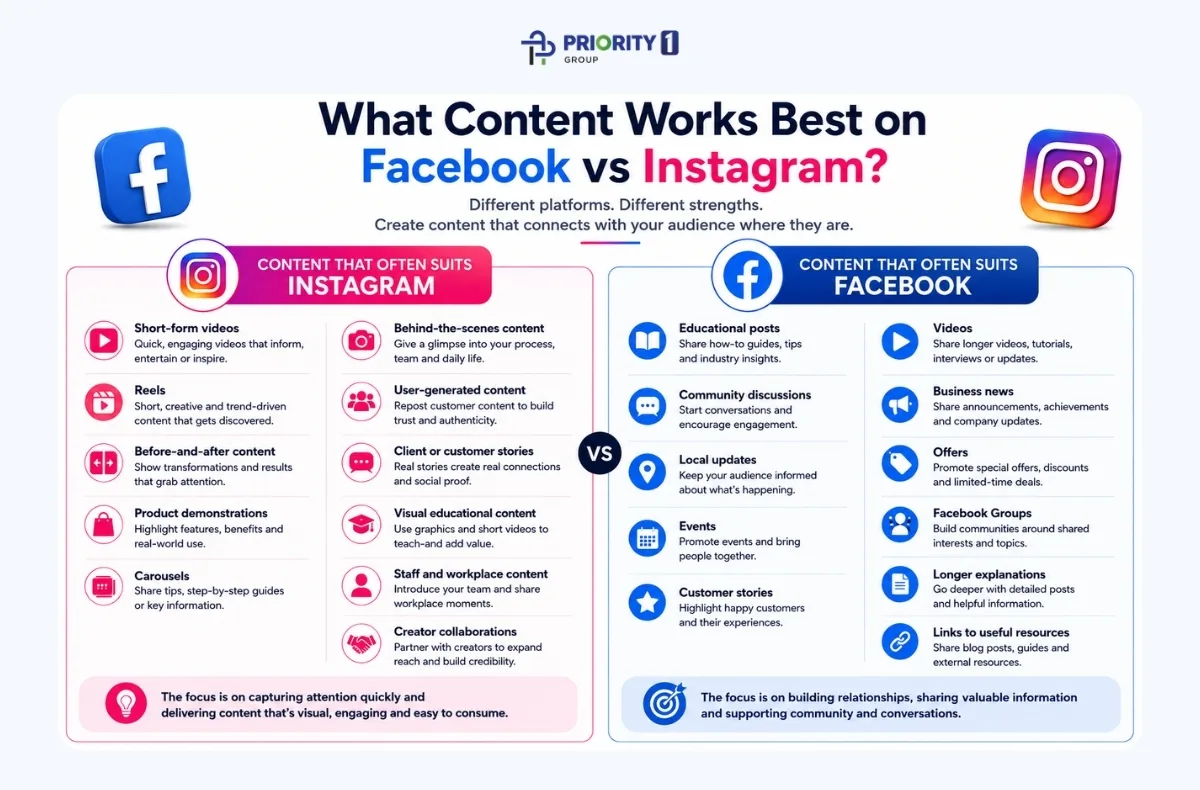
Instagram is particularly well suited to:
The emphasis is often on catching attention quickly and making information easy to consume.
Facebook can be useful for:
The most appropriate format will depend on your audience rather than a universal platform rule.
For broader guidance, Priority1 Group’s guide to social media marketing strategies for small businesses explores how goals, audience, and content strategy work together.
Organic social media refers to content distributed without directly paying to promote it.
Both platforms can support organic marketing, but the approach should be different.
Instagram lends itself well to visual discovery.
Businesses can use:
The biggest advantage is often the ability to make a brand visually recognisable and build repeated exposure through different content formats.
Facebook can work well when businesses use it as more than a noticeboard.
For example, businesses can:
The question should therefore not be:
1. Which platform has better organic reach?
A more useful question is:
2. Which platform gives our business the best opportunity to create relevant content for the people we want to reach?
Organic performance depends heavily on the audience, creative quality, consistency, and usefulness of the content.
Paid advertising is where the Facebook-versus-Instagram comparison becomes more nuanced.
Businesses do not necessarily need to create completely separate advertising ecosystems for each platform.
Facebook and Instagram placements can both be managed through Meta Ads Manager. Meta currently supports advertising placements across a variety of environments, including Facebook and Instagram feeds, Stories, Reels, and other placements.
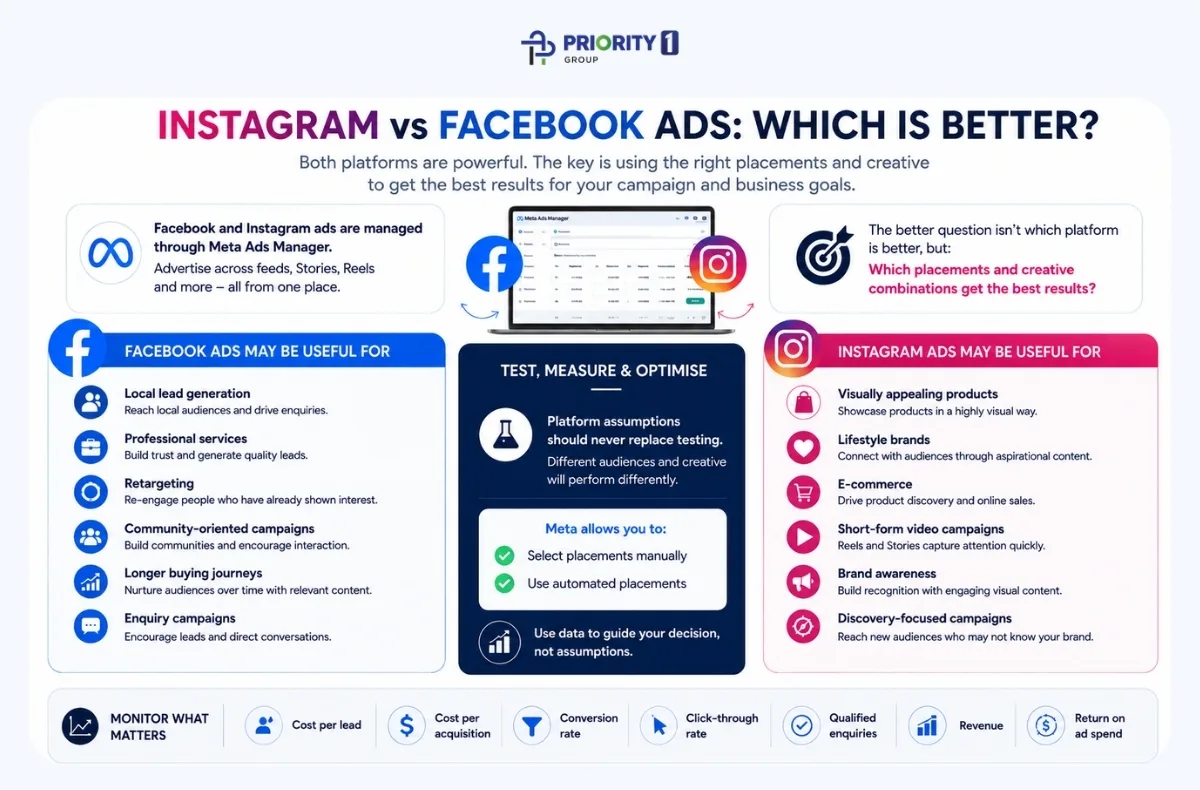
This means the better question is often:
Which placements and creative combinations generate the best results for our campaign?
However, platform assumptions should never replace testing.
A campaign targeting people who primarily use Instagram may naturally perform differently from a campaign targeting another audience segment.
Businesses should monitor metrics such as:
A large number of clicks does not necessarily mean a campaign is successful if those clicks do not produce meaningful business outcomes.
Meta itself allows advertisers to select placements or use automated placement options across its ecosystem.
Businesses wanting to understand competitor activity can also explore Priority1 Group’s guide to using the Facebook Ad Library for competitive research.
For businesses looking beyond organic social content, Priority1 Group also provides paid advertising services across multiple digital channels.
Small businesses usually face one major constraint: resources.
Managing social media properly requires time for:
Trying to be active everywhere can result in inconsistent or low-quality activity.
For a small business, focusing on one primary platform may therefore be more effective if:
Once the business has a reliable content system, expanding across both platforms becomes easier.
The goal should not be to maintain the largest possible number of social profiles.
It should be to build the channels that contribute to your business objectives.
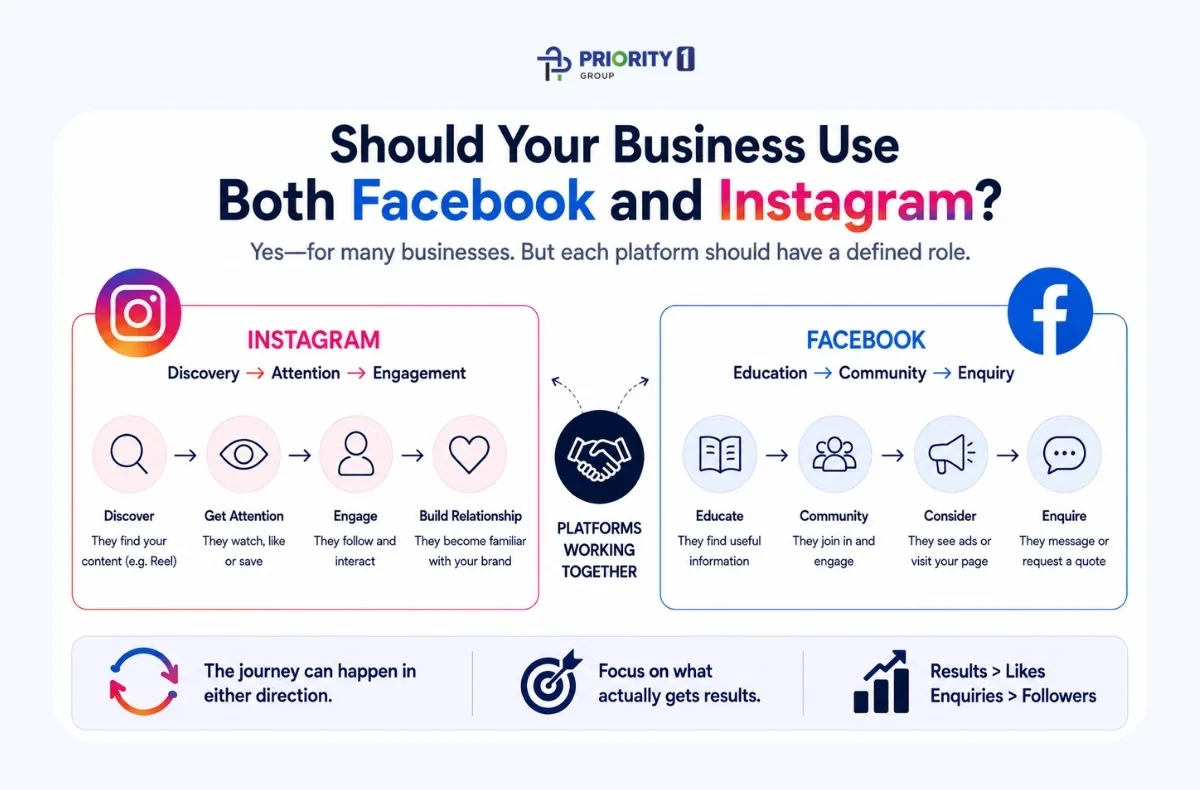
For many businesses, yes, but each should have a defined role.
For example:
Discovery → Attention → Engagement
A customer discovers a Reel, sees several posts, follows the account, and becomes familiar with the brand.
Education → Community → Enquiry
The same customer may later see a targeted ad, read additional information or send an enquiry.
The journey can also happen in the opposite direction.
The important point is that your platforms should work together instead of functioning as disconnected channels.
Businesses should also avoid judging success solely on followers or likes.
A smaller audience that consistently generates enquiries may be more valuable than a large audience that rarely converts.
Instead of guessing which platform is best, use the following decision framework.
Look at your existing analytics, enquiries and customer information.
Avoid choosing a platform because another business is using it successfully.
Your audience may behave differently.
Instagram can require a consistent supply of visual content.
Facebook may give businesses more flexibility to combine videos, articles, updates and community discussions.
Choose a strategy your team can maintain.
Your goal might be:
The platform and content format should support that goal.
Establish measurable KPIs.
For example:
Likes and follower numbers can provide useful context, but they should not be the only measures of success.
Publishing content is only one part of social media marketing.
Someone also needs to:
If you cannot maintain both platforms effectively, prioritise the one most closely aligned with your current objectives.
At Priority1 Group, we do not believe businesses should choose Facebook or Instagram simply because one platform appears more popular.
A better strategy starts with your customers.
Understand:
From there, Facebook and Instagram can be assigned specific roles within the wider marketing strategy.
For some businesses, Instagram may lead brand awareness while Facebook supports lead generation.
For others, both platforms may contribute to paid advertising and remarketing.
The right mix should be guided by data rather than assumptions.
Priority1 Group approaches social media marketing through audience research, strategic planning, content creation, advertising and ongoing performance analysis.
Social media should also not operate in isolation.
SEO, paid search, your website, content and conversion strategy all influence what happens after someone discovers your business.
A broader digital marketing strategy can therefore help connect social media activity with actual business growth.
The Instagram vs Facebook debate does not need a single winner.
Both platforms can play valuable roles in a business marketing strategy.
Instagram may help your business get discovered through visual content, while Facebook can support community interaction, local visibility and lead generation. Paid advertising can also extend across both platforms through Meta’s advertising ecosystem.
The key is to avoid choosing based on popularity alone.
Start with your audience. Define your marketing goals. Build content that suits the platform. Measure what produces meaningful results and adjust your strategy accordingly.
If you are unsure where Facebook and Instagram should fit into your broader digital strategy, Priority1 Group can help you develop a social media approach built around your audience, goals and measurable business outcomes.