

Bookkeeping is the structured process of recording, organising, and maintaining your business’s financial transactions. From tracking daily sales and purchases to managing payroll and receipts, bookkeeping ensures that your financial records are accurate and up to date.
At Priority1 Group, we go beyond just data entry; we provide a clear financial foundation that empowers business owners to make informed decisions with confidence.
Understanding the scope of bookkeeping is essential if you want to manage your bookkeeping costs effectively and avoid surprises. It’s the first step in navigating different bookkeeping pricing models and choosing a service that offers both value and accuracy.
While they often work hand-in-hand, bookkeeping and accounting serve different functions:
In short, bookkeeping lays the groundwork, while accounting builds the strategy.
| Aspect | Bookkeeping | Accounting |
| Purpose | Records daily financial transactions | Interprets financial data for insights and compliance |
| Scope | Sales, purchases, receipts, payments, payroll | Financial reporting, tax planning, forecasting |
| Tasks Involved | Data entry, reconciliations, invoice tracking, payroll | Profit/loss analysis, balance sheet preparation, tax returns |
| Tools Used | Xero, MYOB, QuickBooks, Zoho Books | Accounting software, spreadsheets, and financial modelling tools |
| Goal | Maintain accurate and up-to-date financial records | Help in strategic planning and meeting regulatory requirements |
| Professional Role | Bookkeeper | Accountant or CPA |
With rising bookkeeping fees and increased demand for real-time reporting, it’s more important than ever to understand what services you’re paying for. Whether you’re charged by the hour, per transaction, or through a monthly package, having a clear grasp of bookkeeping rates ensures your costs are justified and your books are compliant.
Additionally, transparent book keeping cost structures and flexible service options allow businesses to scale efficiently while staying on top of tax obligations.
At Priority1, we believe smart businesses don’t just outsource their books—they invest in accurate, strategic, and cost-effective solutions tailored to their operations.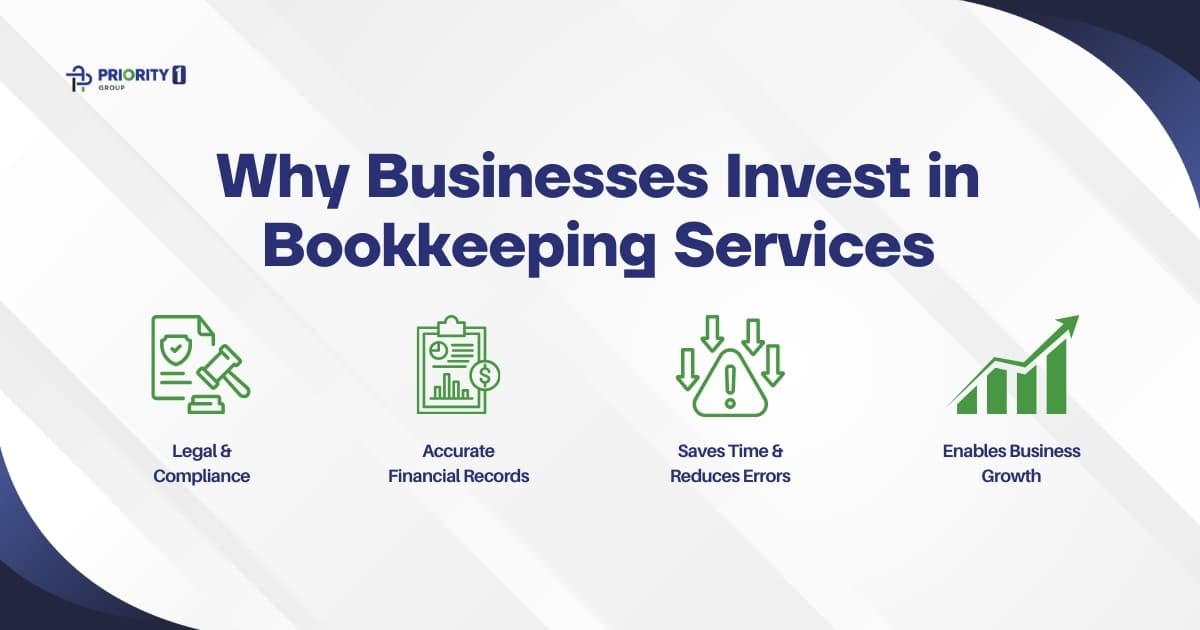
Bookkeepers handle a wide range of tasks that keep your finances accurate, compliant, and organised. At Priority1 Group, we offer both core services and value-added solutions that impact your overall bookkeeping cost.
| Services | What It Involves |
| Data Entry & Categorisation | Recording all income and expenses into software like Xero or MYOB |
| Bank & Credit Card Reconciliation | Matching your bank statements with recorded transactions |
| Accounts Payable (Bills) | Entering and tracking bills to be paid |
| Accounts Receivable (Invoices) | Creating and managing customer invoices |
| Payroll Processing | Running payslips, superannuation, STP submissions |
| GST Compliance | Calculating and recording GST correctly |
| BAS Preparation & Lodgement | Preparing and lodging Business Activity Statements with the ATO |
| Service | How It Helps |
| Financial Reporting | Monthly/Quarterly reports (P&L, Balance Sheet, Cash Flow) |
| Budgeting & Forecasting | Helps you track spending and plan for growth |
| Software Setup & Training | Setting up and training you on Xero, QuickBooks, MYOB etc. |
| Catch-up or Backlog Work | Clearing months/years of overdue entries (often charged at a higher hourly rate) |
| Advisory Services | Strategic advice: cash flow, cost control, profit improvement |
Businesses in Australia can choose from several types of bookkeeping services depending on their needs, resources, and preferred level of involvement. Below is a quick breakdown to help you understand the options available.
Freelancers are independent professionals who manage bookkeeping tasks on a flexible basis. Best suited for simple, low-volume businesses needing basic financial upkeep.
These are employees hired within your business to handle daily financial tasks. Ideal for companies with high transaction volumes and a preference for on-site control.
External service providers like Priority1 Group offer structured, scalable support. Ideal for businesses seeking professional, tech-enabled solutions without the overhead.
Software platforms such as Xero, MYOB, and QuickBooks allow businesses to manage their books in-house. Suitable for tech-savvy owners who prefer a hands-on approach.
Option | Typical Cost | Best For | Trade-offs |
Freelance bookkeeper | $40–$80/hr, or $150–$700/mo | Sole traders, very small businesses | Limited capacity; no backup on leave; may lack BAS/payroll compliance |
Bookkeeping firm | $60–$120/hr, or $350–$2,000+/mo | Growing or complex businesses | Slightly higher monthly cost; some firms feel less personal |
In-house bookkeeper | $60,000–$95,000+/yr + on-costs | High-volume, daily on-site needs | Superannuation, leave, software, office space, recruitment overheads |
A hybrid model — keeping basic data entry in-house while outsourcing payroll, BAS, and reporting — often gives growing businesses the best balance of control and cost.
Priority1 Group combines a firm’s scale, redundancy, and compliance support with the personal service of a dedicated bookkeeper. See our plans.
Red Flag:
“Avoid ‘cheap’ freelancers who don’t understand ATO compliance—errors can cost thousands in penalties.”
One of the most common questions business owners ask is: “How much does a bookkeeper cost?”
The truth is—there’s no one-size-fits-all answer. Bookkeeping costs in Australia vary widely depending on:
Understanding these pricing structures helps you budget effectively and ensures you’re only paying for what your business actually needs.
(Rates are indicative and vary by provider, location, and expertise)
| Bookkeeper Type | Typical Hourly Rate (AUD) | Notes |
| Entry-Level Bookkeeper | $30 – $45/hour | Basic data entry and reconciliation |
| Experienced Bookkeeper | $45 – $70/hour | Handles full-cycle bookkeeping, payroll, BAS |
| Certified/CPA Bookkeeper | $70 – $120/hour | Includes strategic advice, reporting, ATO support |
| Virtual Bookkeeping Firms | Varies by service package | May include bundled services or software access |
Many businesses prefer fixed monthly pricing for predictable budgeting.
| Business Size | Inclusions | Typical Monthly Cost Range |
| Micro/Start-up | Basic data entry, bank reconciliation, BAS | Varies (e.g. $300–$600) |
| Growing Business | Payroll, reporting, invoicing, compliance | Varies (e.g. $600–$1,200) |
| Complex Operations | Multi-entity reporting, budgeting, advisory | Varies (e.g. $1,200+) |
Note: Prices are examples. Exact cost depends on your requirements.
Some services are charged on a one-time or as-needed basis.
At Priority1 Group, we believe that clear, transparent pricing should be the standard not the exception. That’s why we’ve built flexible plans tailored to match the size, complexity, and transaction volume of your business.
Whether you’re just starting out or managing a high-volume operation, we have a solution that fits.
We offer flexible fixed-fee plans built around your transaction volume, payroll size, and reporting needs — from sole traders through to enterprise-level, fully customised support.
See the full inclusions and current pricing on our Bookkeeping Pricing Packages page, or request a personalised quote based on your business size and compliance needs.
What Drives Your Bookkeeping Cost
There’s no fixed price for bookkeeping in Australia — your bill depends on how much work your books require. These are the factors that move the number, from biggest to smallest impact.
Factor | Impact on Cost |
Business size & transaction volume | The single biggest driver. More transactions = more data entry, reconciliation, and reporting. |
Scope of services | Basic data entry costs far less than full-service (payroll, BAS, reporting, advisory). |
Account & industry complexity | Inventory, multiple entities, foreign currency, or sectors like NDIS, hospitality, and construction add time. |
Payroll requirements | More staff and complex pay (STP, super, awards, leave) raise compliance and processing time. |
ATO compliance & lodgements | Monthly vs quarterly BAS, PAYG instalments, and FBT add recurring work. |
Condition of your books | Messy or backlogged records need clean-up first, usually billed at a higher hourly rate. |
Bookkeeper’s experience | Registered BAS Agents and certified bookkeepers charge more than juniors. |
Location | Metro areas (Sydney, Melbourne) typically cost more than regional. |
Software used | Cloud tools (Xero, MYOB, QuickBooks) automate work and can lower ongoing cost vs manual systems. |
Service frequency | Weekly service costs more than monthly but gives better visibility and fewer surprises. |
The takeaway: the more detail you give a bookkeeper upfront — transaction count, employee numbers, software, and the state of your records — the more accurate (and fair) your quote will be. At Priority1 Group, we assess all of these before pricing, so there are no surprise fees.
By understanding the true drivers behind your bookkeeping services pricing, you’ll be able to:
At Priority1 Group, we assess all these factors upfront to provide fair, transparent, and customised pricing that aligns with your goals
Understanding your bookkeeping budget in 2026 starts with clarity, not guesswork. Rather than picking a number blindly, estimating your monthly bookkeeping charges should be a strategic decision based on the complexity and volume of your business operations.
Key Questions to Help You Budget:
More transactions = more time required for data entry and reconciliation.
Payroll complexity increases with more staff, variable pay rates, and award compliance.
Complex business structures require deeper, ongoing bookkeeping involvement.
Monthly P&L, cash flow, custom business insights all add to service scope.
Backlog or disorganised records will raise initial setup costs.
| Business Type | Typical Profile | Estimated Monthly Cost | Inclusions |
| Sole Trader / Micro | < 50 transactions/month, no staff | $150 – $350 | Bank reconciliation, basic reporting, and quarterly BAS |
| Small Business | 1–5 staff, 100–200 transactions/month | $350 – $800 | Payroll, monthly recs, invoicing, BAS, basic debtor/creditor management |
| Growing Business | 5–15 staff, 200–500+ transactions, inventory or complexity involved | $800 – $2,000+ | Advanced payroll, inventory, P&L, cash flow reports, advisory |
Pro Tip: “Ask your bookkeeper for a tiered pricing model; many offer discounts for higher transaction volumes.”
| Scenario | Details | Typical Monthly Spend |
| A. Freelance Designer | Sole trader with ~50 transactions. No employees. Quarterly BAS. | ~$200 (freelancer package) |
| B. Local Cafe | 4 casual staff, ~200 transactions/month. POS integration, weekly payroll, P&L, BAS. | ~$550 (bookkeeping firm) |
| C. Online Retailer | 8 staff, 400–600 transactions/month. Multi-gateway payments, inventory, fortnightly payroll. | ~$1,200 (ecommerce expert) |
You can control costs without sacrificing accuracy: automate bank feeds and invoicing, reconcile regularly to avoid catch-up fees, go paperless with receipt apps, and bundle bookkeeping with BAS and tax under one provider. For the full breakdown, see our guide on DIY vs professional bookkeeping.
Good news—most of the time, bookkeeping service fees are fully tax-deductible in Australia. If you’re running a business, the money you spend on keeping your books accurate and compliant isn’t just an operating cost—it’s also a tax advantage.
Yes. The Australian Taxation Office (ATO) considers bookkeeping costs to be a legitimate business expense, provided they are directly related to earning your business income.
This includes:
| Service Type | Deductible? | Examples |
| Bookkeeping Services |  Yes Yes | Bank reconciliation, expense categorisation, invoicing, A/R & A/P |
| BAS Preparation | Yes | Monthly or quarterly BAS, GST tracking, ATO lodgement |
| Payroll Services | Yes | Superannuation, pay runs, employee onboarding, STP reports |
| Financial Reports | Yes | Profit & Loss, Balance Sheet, Cash Flow reports |
| Bookkeeping Software | Yes | Xero, MYOB, QuickBooks, Zoho Books |
| Advisory/Consulting Support | Yes | Budgeting, forecasting, process improvement advice |
Note: You must retain records (invoices, receipts, contracts) to substantiate your claims.
The ATO generally allows deductions for expenses incurred in managing your business affairs, as long as they are not private or capital in nature.
You can find official guidance under:
For certainty, consult your accountant or tax adviser to ensure you’re claiming correctly and to confirm your specific eligibility.
In short: Bookkeeping fees are not just a business necessity—they’re also tax-smart.
At Priority1 Group, we ensure your books are not only accurate and compliant—but also optimised for end-of-year deductions.
Bookkeeping rates vary by state and city, driven mainly by local demand, labour costs, and industry mix. Metro hubs like Sydney and Melbourne sit at the top end; regional centres are typically 20–40% cheaper for comparable work. The tables below give indicative 2026 ranges. For a firm quote in your city, talk to Priority1 Group.
New South Wales
City | Monthly Cost | Hourly Rate |
$500–$1,800 | $70–$120/hr | |
Newcastle | $400–$1,200 | $60–$100/hr |
Wollongong | $380–$1,100 | $58–$95/hr |
Central Coast | $400–$1,300 | $60–$95/hr |
Coffs Harbour | $350–$1,000 | $55–$85/hr |
Tamworth | $320–$950 | $50–$80/hr |
Victoria
City | Monthly Cost | Hourly Rate |
$450–$1,600 | $65–$110/hr | |
Geelong | $420–$1,250 | $60–$100/hr |
Ballarat | $390–$1,100 | $55–$90/hr |
Bendigo | $380–$1,050 | $55–$88/hr |
Shepparton | $350–$980 | $50–$85/hr |
Mildura | $320–$900 | $48–$80/hr |
Queensland
City | Monthly Cost | Hourly Rate |
Brisbane | $450–$1,700 | $65–$110/hr |
Gold Coast | $450–$1,400 | $60–$100/hr |
Cairns | $370–$1,100 | $55–$88/hr |
Toowoomba | $350–$1,000 | $50–$85/hr |
Townsville | $360–$1,050 | $52–$90/hr |
Rockhampton | $330–$950 | $50–$82/hr |
Western Australia
City | Monthly Cost | Hourly Rate |
Perth | $450–$1,700 | $65–$105/hr |
Bunbury | $370–$1,100 | $52–$88/hr |
Albany | $340–$980 | $50–$85/hr |
Geraldton | $330–$950 | $50–$82/hr |
Kalgoorlie | $350–$1,000 | $52–$88/hr |
South Australia
City | Monthly Cost | Hourly Rate |
Adelaide | $400–$1,500 | $60–$95/hr |
Mount Gambier | $320–$900 | $48–$80/hr |
Whyalla | $310–$880 | $48–$78/hr |
Gawler | $330–$950 | $50–$85/hr |
Port Augusta | $310–$870 | $48–$78/hr |
Port Pirie | $320–$900 | $48–$80/hr |
Tasmania
City | Monthly Cost | Hourly Rate |
Hobart | $400–$1,300 | $55–$85/hr |
Launceston | $320–$950 | $50–$85/hr |
Devonport | $310–$880 | $48–$80/hr |
Burnie | $300–$850 | $48–$78/hr |
Glenorchy | $320–$900 | $50–$82/hr |
Kingston | $310–$870 | $48–$78/hr |
Prices are indicative averages based on 2026 market data and vary with your business’s size, transaction volume, industry, and complexity. Regional rates are generally lower than metro. For an exact figure, request a quote.
When it comes to understanding bookkeeping charges, it’s not just about the number on the invoice—it’s about what drives that cost. In Australia, especially in 2026, several key variables affect bookkeeping service fees and bookkeeping services pricing. Here’s what every business owner should know:
Understanding what drives bookkeeping service fees is essential to budgeting effectively. Whether you’re a sole trader or a growing company, these cost drivers help you assess and plan your expenses more accurately in 2026.
Here’s what typically influences your bookkeeping costs in Australia:
| Factor | Impact on Cost |
| Business Size & Complexity | More transactions and entities = higher cost |
| Scope of Services | Basic entry costs less than full-service (e.g., payroll, BAS) |
| Bookkeeper’s Experience | Qualified BAS agents cost more than juniors |
| Location | Metro areas usually charge more than regional |
| Software Used | Cloud software lowers cost vs. manual systems |
| Condition of Books | Messy books = higher initial clean-up costs |
| Service Frequency | Weekly service costs more than monthly, but provides better visibility |
 Note: Bookkeeping services are not one-size-fits-all. Your exact bookkeeping pricing will depend on these variables—so always provide your bookkeeper with as much detail as possible upfront.
Your choice of accounting software can significantly influence your bookkeeping cost per month. Here’s how:
In 2026, choosing the right accounting software can significantly impact your bookkeeping budget. Many bookkeeping firms like Priority1 Group bundle software into their packages, while others may bill it separately.
Here’s a quick overview of major platforms:
| Software | Plan Examples | 2026 Cost (Estimate) | Included in Packages? |
| Xero | Ignite, Grow, Ultimate | $32–$110/month | Often included |
| MYOB | Lite, Pro | $30–$90/month | Sometimes included |
| QuickBooks | Simple Start, Essentials, Plus | $25–$85/month | Usually optional |
| Reckon | Accounting Plus, Payroll Premium | $29–$99/month | Rarely included |
| Zoho Books | Free, Standard, Premium | $0–$60/month | Often optional |
Tip: Choosing the right bookkeeping software can reduce your bookkeeping service fees over time due to efficiency gains.
Sure, cost matters—but what about the ROI of hiring a professional bookkeeper? Here’s what you actually gain beyond just having clean books:
While costs are important, professional bookkeeping adds value far beyond basic compliance. Here’s how investing in expert services pays off:
| Benefit | Why It Matters |
| Time Savings | Lets you focus on running your business |
| Accuracy & Compliance | Avoid ATO penalties and audits |
| Financial Insights | Make smarter decisions with real-time data |
| Scalability | Service grows with your business needs |
| Peace of Mind | Know your finances are in expert hands |
Spend more time running your business, not reconciling receipts. Bookkeepers handle the admin so you can focus on revenue-generating activities.
Avoid costly ATO penalties and compliance headaches. A good bookkeeper ensures your financials are in order, and your lodgments are timely and correct.
Regular reports (P&L, cash flow, balance sheet) allow you to make informed decisions—whether it’s cutting expenses or planning for growth.
Bookkeeping solutions grow with you. As you hire staff or expand locations, your financial records remain accurate and manageable.
With Priority1 Group, you’re not just hiring a data entry service. You’re gaining a reliable partner committed to your financial clarity and success.
Every business operates differently, and so do its bookkeeping needs. Whether you’re a sole trader managing expenses or a high-volume ecommerce business juggling stock and multi-channel sales, understanding your unique requirements helps you budget realistically. Here’s a breakdown of common business types in Australia and what you can expect from bookkeeping services in 2026:
Sole TradersSole traders typically have a simple business model with fewer transactions and no payroll obligations. They often require basic data entry, bank reconciliations, and quarterly BAS submissions.
Small BusinessesSmall businesses often have employees, manage inventory, and deal with regular invoicing. They need consistent bank reconciliation, payroll support, and monthly reporting.
Tradies and ContractorsTradespeople and independent contractors require job costing, quoting, GST tracking, and mobile invoicing. Their bookkeeping needs vary with project workload and tax obligations.
Online Stores & Ecommerce BusinessesEcommerce businesses manage hundreds of transactions across platforms like Shopify, Amazon, or eBay. They need integrated systems, inventory management, and gateway reconciliation.
Hospitality BusinessesCafes, restaurants, and bars require daily reconciliation, POS integration, complex payroll (often with casual staff), and tip handling.
Healthcare & NDIS ProvidersThese businesses require secure record-keeping, NDIS compliance reporting, and participant-level financial tracking. BAS and payroll are usually mandatory.
Real Estate & Property FirmsReal estate agencies need trust accounting, tenant management, and compliance with state laws. Reporting is often required for licensing and auditing.
Different industries have distinct bookkeeping requirements. Below is an overview of typical costs and service needs by business type:
| Business Type | Key Bookkeeping Needs | Typical Monthly Cost Range (2026) |
| Sole Traders | Basic reconciliation, expense categorisation, quarterly BAS | $150–$350 |
| Small Business | Payroll, monthly reports, BAS lodgement | $350–$800 |
| Tradies & Contractors | Job costing, invoicing, GST tracking | $300–$700 |
| Online Stores & Ecommerce | Inventory management, payment gateway integration | $800–$2,000+ |
| Hospitality | POS integration, complex payroll, weekly reporting | $700–$1,800 |
| Healthcare & NDIS | NDIS compliance, participant reporting, secure data | $650–$1,500+ |
| Real Estate & Property | Trust accounting, tenant invoicing, BAS | $750–$1,600 |
At Priority1 Group, we understand that no two businesses are the same. That’s why we tailor our solutions to match the unique demands of your industry. Whether you’re a small business owner, a busy hospitality operator, or a healthcare or NDIS provider, we specialise in helping you stay compliant, organised, and financially confident.
For Small Businesses: We offer affordable, flexible packages that grow with you, making bookkeeping one less thing to worry about.
For Hospitality Businesses: From POS system integration to award interpretation and casual payroll, our team knows the fast-paced needs of cafes, restaurants, and venues.
For Healthcare & NDIS Providers: Our secure, NDIS-compliant solutions support accurate participant-level reporting and financial tracking—so you can focus on care.
With Priority1, you get expert support, local knowledge, and full transparency in pricing—backed by cloud-based tools and real-time reporting.
Let us simplify your numbers, so you can focus on growing your business.
In addition to standard bookkeeping, many Australian businesses rely on their bookkeepers for payroll processing and ATO compliance services. These can be charged separately or included in a package.
Payroll and compliance services are key cost components in bookkeeping. Here’s what to expect:
| Service | Details | Estimated Cost (2026) |
| Payroll Processing | Per employee per pay run | $4–$10 per payslip |
| Superannuation Lodgement | Monthly or quarterly lodgement | Often included or $30–$100 |
| BAS Statement | Quarterly or monthly, includes GST, PAYG | $120–$300 per lodgement |
| STP Compliance | Single Touch Payroll reporting to ATO | Usually included or $50/month |
Payroll can be charged per employee or per pay run. Complexity increases costs—especially with casuals, shift penalties, or bonuses.
Some bookkeepers charge extra for submitting superannuation, while others bundle it with payroll.
Quarterly or monthly BAS lodgement is mandatory for most GST-registered businesses. Bookkeepers (especially BAS Agents) prepare and lodge these with the ATO.
Required for all employers, STP lodgement ensures payroll is reported to the ATO in real time. Most bookkeepers include this in payroll services.
Choosing between a freelance bookkeeper and a professional bookkeeping firm can significantly impact both the cost and quality of service. Each option has its pros and cons depending on your business’s size, complexity, and expectations.
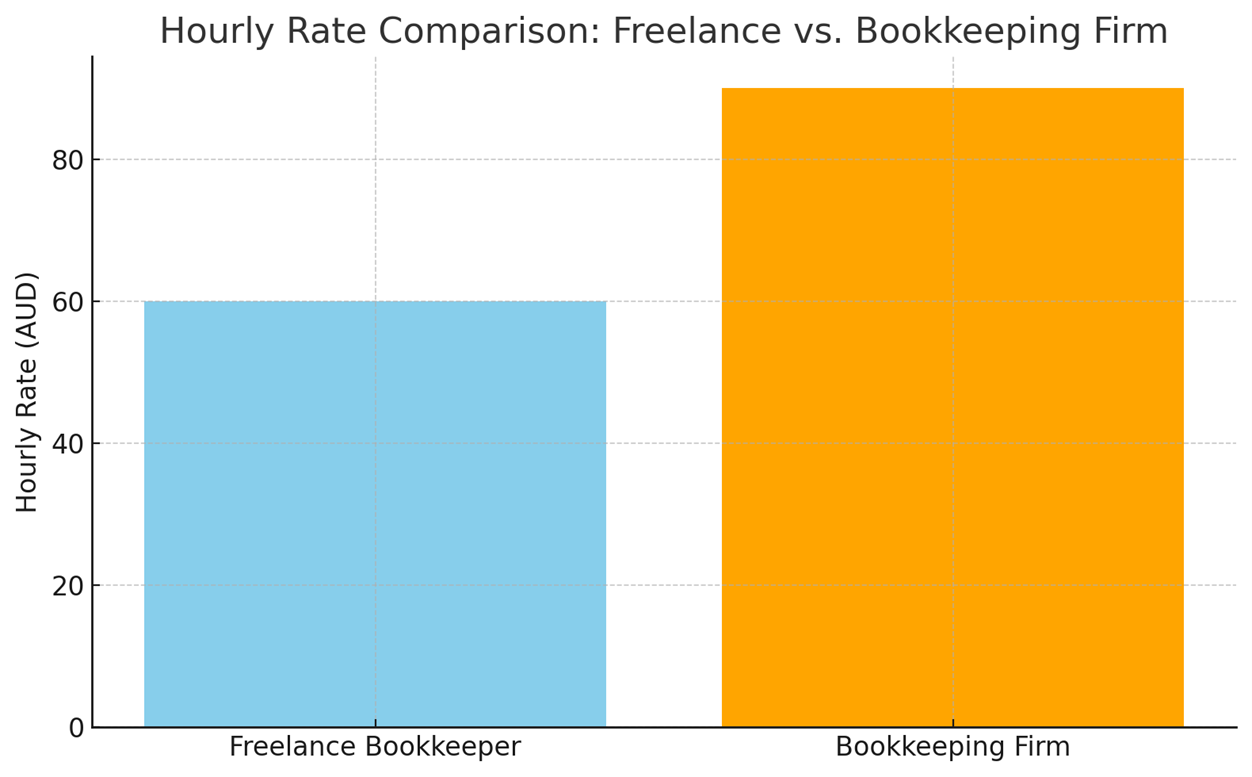
We offer the best of both worlds: personalised service with the capacity and reliability of a full-service firm. Whether you’re after flexibility or full compliance support, we’ve got a plan to match your budget and your business goals.
When deciding whether to hire an in-house bookkeeper or outsource, businesses should consider both the financial and operational impact. Here’s how the two compare:
Many growing businesses choose a hybrid setup—keeping basic invoicing or data entry in-house while outsourcing complex functions like payroll, BAS, or compliance.
This model:
 Tip from Priority1 Group: We help you evaluate whether full outsourcing or a hybrid model is the best fit. If you’re unsure, start with a part-service plan and scale as your needs grow.
Finding the right bookkeeper isn’t just about the lowest quote—it’s about value, accuracy, and long-term financial confidence. In 2026, as pricing models shift and service expectations rise, it’s critical to choose a provider who matches both your budget and your business needs.
Certifications and Experience to Look For
Always check if the bookkeeper is:
At Priority1 Group, all our bookkeepers are qualified, software-certified, and trained to handle both compliance and advisory tasks with precision.
Industry-Specific Knowledge
Look for a bookkeeper who understands your sector. Industry context makes a massive difference in:
 At Priority1, we specialise in small business, hospitality, and NDIS/healthcare providers, giving you niche expertise that generic bookkeepers may lack.
 Red Flags in Undercharging or Overpricing
Too Cheap? You might be dealing with:
Too Expensive? Make sure you’re not overpaying for basic services. Always ask for a breakdown of:
 Questions to Ask Before Hiring
Ask these before signing on:
Hiring the right bookkeeper at the right price saves time, reduces errors, and keeps your financials compliant and investor/lender-ready.
As the bookkeeping industry evolves, a few key trends in 2026 are shaping how services are delivered—and what they cost.
More bookkeepers are leveraging cloud-based tools, automation, and AI to streamline processes. From auto-categorising transactions to AI-driven reconciliation, this shift increases speed and accuracy. While it can lower manual labour costs, it also means that businesses should expect to pay for tech-savvy professionals who understand how to use these tools efficiently.
With the ATO’s ongoing digital transformation and rising expectations around Single Touch Payroll (STP), BAS accuracy, and real-time reporting, bookkeepers must stay up to date. This demand for compliance expertise has raised the baseline skill level required—and, in turn, pricing for qualified bookkeepers.
Many bookkeeping firms are bundling CFO-style services—like forecasting, budgeting, and business strategy—with their bookkeeping packages. These “financial partner” packages offer greater value but also come at a higher premium. For growing businesses, this trend represents a shift in how bookkeeping is positioned—not just record-keeping, but strategic advisory.
As you evaluate bookkeeping options in 2026, it’s essential to understand the true cost vs. value. Here are some key takeaways:
A fair range for bookkeeping services in Australia (based on your business size and complexity) would be:
These figures depend on whether you’re using a freelancer, a full-service firm, or a hybrid model.
Bookkeeping isn’t just a compliance requirement—it’s a foundation for good decision-making. Accurate, timely records help you:
At Priority1 Group, we help transform your numbers into business insights. You’re not just buying time—you’re buying peace of mind and smarter financial decisions.