Running a small business in Melbourne means competing in one of Australia’s busiest and most diverse markets. Whether you operate a professional service in the CBD, a healthcare practice in the eastern suburbs, a trade business servicing multiple areas, a café, an eCommerce brand or a growing B2B company, simply “being online” is no longer enough.
The challenge is not finding digital marketing channels. There are plenty of them.
The real challenge is deciding which channels deserve your time and budget, how long to test them, and what results should determine whether you keep investing.
At Priority1 Group, we approach digital marketing as a measurable business function rather than a collection of disconnected campaigns. Traffic, impressions and followers can be useful indicators, but ultimately your marketing needs to contribute to enquiries, appointments, sales, customer acquisition and long-term growth.
Before investing in any channel, make sure you understand exactly who you are trying to reach. Our guide to understanding your target audience explains why this should come before choosing platforms or advertising budgets.
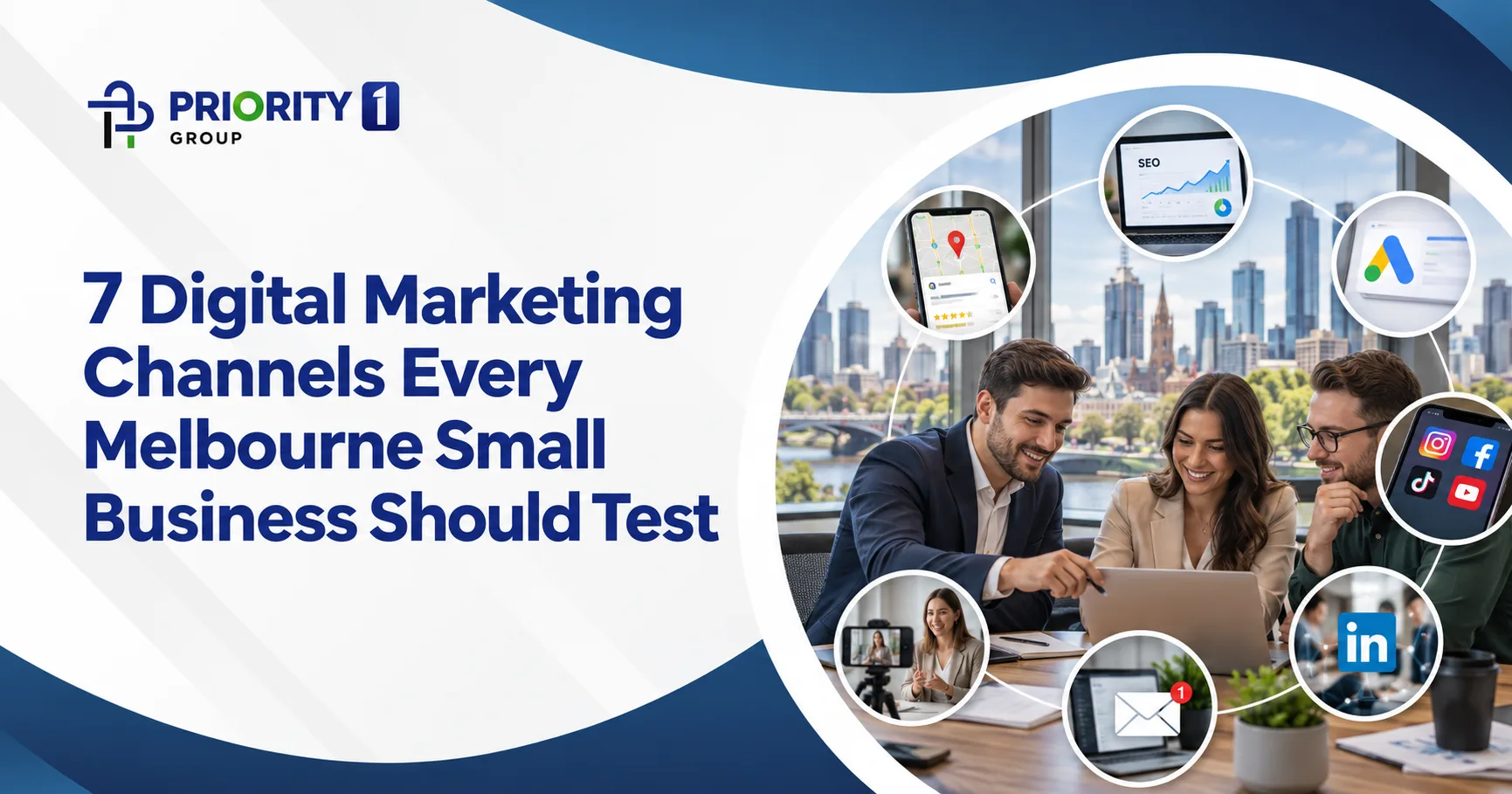
Here are seven channels Melbourne small businesses should consider testing.
For a Melbourne business serving customers within a defined geographic area, local search should often be one of the first channels you examine.
Think about how customers actually search.
Someone looking for an accountant may search within their suburb. A customer with an urgent plumbing problem may look for a nearby provider. A patient may search for a clinic close to home or work. Restaurant and retail searches can be even more location-sensitive.
That means competing for “Melbourne” alone is not always the smartest strategy.
A business servicing areas such as Richmond, South Yarra, Preston, Dandenong, Ringwood, Werribee or Frankston may generate more valuable enquiries by developing visibility around the specific areas it can realistically serve.
Your Google Business Profile becomes particularly important here. Business information, categories, reviews, services, photographs and location signals can all contribute to how effectively people discover and evaluate your business.
Priority1 Group has covered this in more detail in our guide to Google Business Profile optimisation.
Instead of measuring local SEO purely by rankings, monitor whether your local visibility produces business actions: website visits, calls, directions, enquiries and bookings.
For a Melbourne small business, the question is not simply, “Are we visible on Google?”
It is, “Are we visible in the locations where our profitable customers are searching?”
SEO becomes considerably more valuable when it is connected to customer intent.
Ranking for a broad informational phrase may generate hundreds of visitors without a single enquiry. Ranking for a more specific service-and-location search can sometimes generate considerably less traffic but substantially more commercial value.
That distinction matters for small businesses with limited marketing resources.
A strong Melbourne SEO strategy usually needs several layers working together: technically sound website foundations, well-structured service pages, useful content, relevant local pages, internal linking, authority building and ongoing optimisation.
At Priority1 Group, our SEO services focus on connecting organic visibility with qualified traffic and meaningful business outcomes rather than pursuing rankings simply because a keyword has high search volume.
For Melbourne businesses, localisation also deserves careful planning.
Creating dozens of almost-identical suburb pages with only the suburb name changed is not a sustainable local SEO strategy. Each important location page should have a genuine reason to exist and should reflect the services, audience, search intent and geographic relevance of that market.
Track qualified organic enquiries alongside rankings and traffic. Look at which landing pages generate calls, forms, bookings or sales and which pages attract visitors without progressing them towards a commercial action.
SEO is usually a longer-term channel than paid advertising, but the value can compound when your website builds visibility across multiple commercially relevant searches.
SEO builds organic visibility over time. Google Search Ads can help a business appear in front of people already searching for a solution.
That makes search advertising particularly valuable for businesses where the customer has clear intent.
Someone searching for an emergency service, an accountant, a medical appointment, a lawyer, a home service or another specific provider is already much closer to taking action than someone casually scrolling through social media.
But being able to buy traffic does not make every click valuable.
One of the most common problems we see in paid search is an excessive focus on clicks and impressions. Neither tells you whether advertising is profitable.
Priority1 Group’s paid marketing and Google Ads services are structured around measurable performance, including leads, sales and return on advertising investment.
For a Melbourne campaign, location settings deserve particular attention. A business that can efficiently service a 20-kilometre area should question why it is paying for clicks from customers on the opposite side of the metropolitan area.
The same applies to keywords. Broad visibility may look impressive in a report, but high-intent searches normally deserve more attention than traffic that has little chance of becoming revenue.
Measure cost per qualified lead, conversion rate, search terms, lead quality and ultimately the revenue generated from advertising.
Do not declare a campaign successful because cost per click decreased while the number of genuine customers remained unchanged.
Facebook and Instagram can help Melbourne businesses reach customers before those customers actively begin searching.
That makes Meta very different from Google Search.
Google often captures existing demand. Social media can help create, influence or recapture demand.
For visually driven businesses, Instagram can showcase products, people, transformations, locations and customer experiences. Facebook can be valuable for broader audiences, community engagement, lead generation and remarketing.
Service businesses can also use social platforms to demonstrate expertise rather than filling their feeds with repetitive promotional graphics.
Educational videos, customer questions, case studies, behind-the-scenes content, useful tips and genuine team content can give potential customers reasons to remember and trust a business before they are ready to enquire.
If you are unsure where each platform fits, our comparison of Instagram versus Facebook for business marketing explores the different strengths of the two channels.
Priority1 Group also provides dedicated social media marketing services for businesses that need a more structured approach to organic and paid social media.
Separate awareness performance from lead-generation performance.
If your campaign is designed to generate leads, measure actual enquiries and acquisition costs. If its purpose is remarketing, measure whether returning visitors convert at a stronger rate.
Likes can be useful signals. They are not the same thing as revenue.
LinkedIn does not belong in every small business marketing plan.
For the right Melbourne business, however, it can be extremely useful.
Professional services, consultants, software providers, recruiters, commercial suppliers, outsourced service providers and other B2B companies often need to reach a very different audience from consumer-focused businesses.
If your ideal customer is a practice manager, director, operations manager, business owner, finance manager or another professional decision-maker, LinkedIn gives you both organic and paid opportunities to reach them.
The mistake is treating LinkedIn purely as somewhere to post company announcements.
Expert-led content tends to give businesses a stronger reason to be followed. Share what you are learning from your industry. Explain common problems. Challenge inefficient practices. Break down difficult decisions. Show the thinking behind your work.
Over time, this gives prospective clients evidence of your expertise before the first sales conversation occurs.
For organic activity, pay attention to profile visits, relevant engagement, direct enquiries and conversations initiated by the content.
For LinkedIn advertising, lead quality matters more than cheap volume. A campaign producing five conversations with genuine decision-makers may have far more commercial value than one generating 50 poorly matched leads.
Small businesses frequently spend heavily acquiring new customers while underinvesting in people who already know the business.
That is where email marketing becomes valuable.
Your existing database can include previous customers, prospects who enquired but did not purchase, newsletter subscribers and customers who may need another service later.
Instead of treating everyone identically, segment communications according to what the person actually needs.
A Melbourne healthcare business might use email to share service updates and useful information. A professional service firm might distribute practical industry insights. An eCommerce business could communicate new ranges or relevant offers. A service business could reconnect with past customers when another booking may be due.
The strength of email is not simply that messages can be sent cheaply. It is that you are communicating with an audience that has already had some interaction with your brand.
Look beyond open rates.
Measure clicks, enquiries, bookings, repeat purchases and reactivation of previous customers.
Most importantly, protect the value of your database. Sending more emails does not automatically create better results. Relevance and timing matter.
Content should not be treated as an isolated marketing exercise.
One useful piece of content can support several channels.
A detailed article can strengthen SEO. Its main ideas can become LinkedIn posts. Individual questions can become short videos. A useful section can become an email. A case study can support sales conversations. A video can be adapted for Instagram, Facebook, YouTube or a landing page.
This is why we often think about content as the infrastructure connecting marketing channels together.
The key is to create content around genuine customer questions instead of publishing simply because your content calendar says a blog is due.
Listen to your sales calls. Review customer enquiries. Speak with frontline staff. Examine Google search queries. Look at the objections people raise before purchasing.
Those conversations often reveal far stronger content ideas than generic keyword lists.
Content can also strengthen your visibility as search behaviour evolves. Priority1 Group’s guide to staying visible as zero-click search grows explains why businesses increasingly need visibility across multiple search features and platforms rather than relying on traditional organic listings alone.
Measure what happens after people consume the content.
Does a video generate profile visits? Does a blog generate organic enquiries? Does an educational article assist sales conversations? Do people who read multiple pieces of content convert at a stronger rate?
The best content does more than attract an audience. It moves that audience closer to trusting the business.
There is one important element missing from the seven channels above: your website.
That is intentional.
We do not view the website as simply another traffic source. For most businesses, it is the conversion hub connecting the other channels.
Google Ads can bring visitors to your website. SEO can help them discover it. Social media can introduce the brand. Email can bring customers back.
But if the website is slow, confusing, difficult to use on mobile, weak on trust signals or unclear about the next step, additional traffic can simply magnify the problem.
Before aggressively increasing marketing spend, make sure visitors can quickly understand what you offer, who it is for, why they should trust you and what action they should take next.
Our website design and development services are built around this connection between user experience, marketing and conversion.
Usually, no.
Trying to run SEO, Google Ads, Meta, LinkedIn, email, video and local marketing simultaneously with a small budget can spread resources so thin that no channel gets a fair test.
A better approach is to prioritise according to customer intent.
If customers urgently search for your service, Google Search Ads and local search may deserve priority. If you operate in B2B, LinkedIn and search may be stronger starting points. If your product depends heavily on visual discovery, Meta and video may play a larger role. If you already have a substantial customer database, email could produce opportunities faster than constantly chasing new audiences.
There is no universal “best digital marketing channel”.
There is only the channel that produces the right customers at an acceptable acquisition cost for your business.
Good marketing tests start with a business question.
Instead of saying, “We are going to try Facebook Ads,” define what success needs to look like.
For example, decide how many qualified enquiries you need, what you can realistically afford to pay for a lead, how those leads will be tracked, what happens after an enquiry arrives and how long the channel needs to collect meaningful data.
Then change one major variable at a time.
If the audience, creative, landing page, offer and campaign objective all change simultaneously, it becomes difficult to understand what improved performance.
This is where disciplined marketing differs from simply being active online.
Testing generates data.
Data supports decisions.
And better decisions allow businesses to invest more confidently.
Melbourne small businesses do not need to be everywhere.
They need to be present where the right customers discover, evaluate and choose businesses like theirs.
For some businesses, that could mean Google Search, SEO and local search working together. For another, it might be LinkedIn, email and expert content. An eCommerce brand may depend more heavily on paid social, search and remarketing.
The channel mix should follow customer behaviour, not marketing trends.
Priority1 Group works with Australian businesses to develop integrated digital strategies covering SEO, paid advertising, social media, websites, content and conversion-focused marketing. Our approach is built around understanding the audience first, selecting the right channels and continuously improving campaigns based on measurable performance.
Explore our digital marketing services if your Melbourne business needs a clearer, more accountable approach to online growth.
The goal is not to spend more on marketing.
It is to understand which marketing activities deserve more investment and which ones do not.
38B Douglas Street, Milton QLD, 4064 Australia
Monday - Friday 09:30 AM - 05:30 PM
© 2026 All Rights Reserved.