
Running a disability support service under the National Disability Insurance Scheme (NDIS) means navigating a fundamentally different business model than traditional service providers. While most Australian SMEs operate on straightforward revenue-to-profit cycles, NDIS providers face a complex accounting landscape shaped by government regulation, participant funding variability, and stringent financial reporting requirements.
The financial management challenges that NDIS providers face extend far beyond standard bookkeeping. It’s not just about recording transactions correctly; it’s about managing a business model where revenue is unpredictable, expenses must align with individual participant budgets, and regulatory audits can expose financial vulnerabilities that traditional businesses never encounter.
This article explores the core accounting challenges NDIS providers face and provides actionable solutions to strengthen financial management and ensure sustainable business growth.
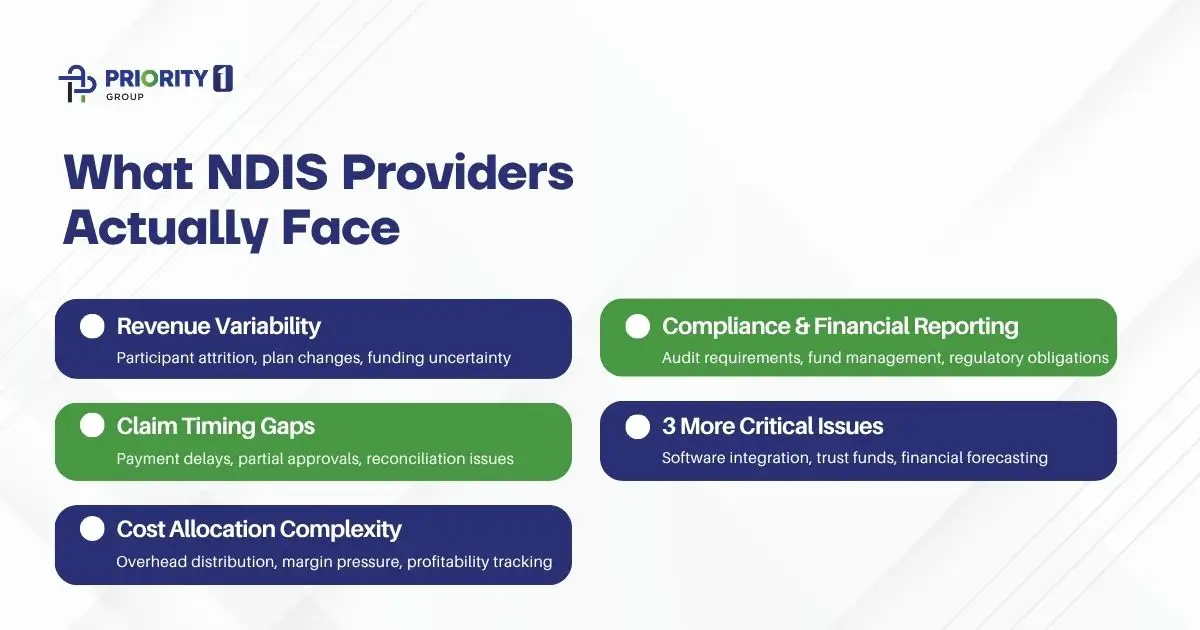 1. Managing Variable and Unpredictable Revenue Streams
Unlike traditional service businesses with predictable monthly revenue, NDIS providers face significant cash flow volatility. Participant funding can fluctuate due to:
This unpredictability makes revenue forecasting exceptionally difficult. A provider might budget for service delivery to 50 participants, only to experience a 15% reduction in active participants mid-year, immediately impacting cash flow and profitability.
Implement conservative revenue forecasting: Build financial projections based on historical turnover rates rather than optimistic scenarios. Most successful NDIS providers work with 10-15% participant attrition built into annual forecasts.
Create participant-level financial tracking: Maintain detailed records of each participant’s funding level, plan period, and service delivery schedule. This enables you to monitor revenue by individual, identify at-risk clients, and forecast more accurately.
Establish cash reserves: Set aside 2-3 months of operating expenses in a separate account specifically for covering the gap between service delivery and payment receipt. This provides a financial buffer during low-revenue periods.
Diversify your participant base: Over-reliance on a single participant or funding source creates vulnerability. Actively work to build a diverse mix of participant profiles and funding levels.
Must Read: The Hidden Complexity of NDIS Bookkeeping: Are You Prepared?
NDIS payment flows are fundamentally different from traditional invoicing. Providers submit claims for services rendered, but payments don’t follow a simple monthly cycle:
For providers with tight cash flow, these delays and disputes create significant accounting headaches. You’ve delivered services and incurred costs, but the corresponding income is uncertain and delayed.
a. Develop a robust claim management system: Don’t just submit claims and wait. Create a tracking dashboard showing claim submission dates, approval dates, expected payment dates, and any status notes. Flag claims older than 30 days for follow-up.
b. Implement stringent documentation practices: Every service delivery must be meticulously documented with participant name, service date, hours delivered, and service type. This reduces claim dispute risk and provides the audit trail needed if payment disputes arise.
c. Use NDIS participant portal systems: Leverage tools like Salesforce or dedicated NDIS management platforms that integrate with participant plans and automatically pull funding details. This reduces manual entry errors and streamlines claim matching.
d. Establish a contingency for claim rejections: Budget conservatively by assuming a small percentage of claims will be disputed or partially approved. If claims process more smoothly than expected, you’ve created a positive variance far better than the reverse.
NDIS pricing is set by the scheme; you don’t negotiate rates with participants or establish premium pricing tiers. This creates unique accounting challenges:
Without precise cost tracking, providers often discover mid-year that their actual costs have exceeded forecasted margins, leaving insufficient profit to reinvest or maintain service quality.
a. Implement participant-level cost accounting: Track not just revenue by participant, but also direct costs (support worker wages, training, consumables). Calculate the actual gross margin delivered by each participant relationship.
b. Use activity-based costing for overhead: Don’t apply a blanket overhead percentage across all participants. Instead, allocate overhead based on actual cost drivers, support hours required, plan complexity, or service intensity. Some participants genuinely require more administrative overhead than others.
c. Conduct quarterly margin analysis: Rather than waiting for annual financial statements, review margin performance quarterly. Identify participants or service lines operating below acceptable thresholds and determine whether service delivery can be optimised or costs reduced.
d. Build pricing flexibility through service mix: While base rates are fixed, explore service bundle variations, group programs, or enhanced support options that participants fund separately. This creates additional margin opportunities without compromising core NDIS service rates.
NDIS providers are subject to multiple layers of financial reporting and compliance obligations:
A provider might have strong operational performance but fail an audit due to inadequate financial documentation or incorrect treatment of participant funds, creating compliance risks and potential funding consequences.
a. Engage specialist NDIS accountants early: Rather than relying on generalist accountants, work with providers who specialise in NDIS services. They understand scheme-specific compliance requirements and can help structure your accounting systems correctly from the start.
b. Maintain segregated financial records: Keep participant trust accounts completely separate from operational accounts. Implement strict controls over who can access these funds and ensure all transactions are clearly documented.
c. Document your accounting policies: Create a comprehensive accounting policy manual covering revenue recognition (when claims become income), expense classification, depreciation methods, and contingency reserves. This demonstrates compliance intent during audits.
d. Prepare for auditor enquiries: Don’t wait until your annual audit to compile documentation. Maintain organised files showing claim-to-payment workflows, cost allocation methods, and compliance decision-making. An auditor’s job is easier, and your audit costs typically decrease.
Must Read: What NDIS Auditors Look for in Payroll Records
NDIS accounting creates a significant timing mismatch between when costs are incurred and when revenue is recognised:
This timing mismatch creates operational stress. Your cash balance might show a deficit while your accrual income statement shows profit a dangerous situation if you’re not prepared.
a. Use accrual accounting properly: Recognise NDIS revenue when the service is delivered (not when payment is received), and match expenses to that revenue. This provides a true picture of profitability separate from cash flow timing.
b. Establish separate cash and accrual dashboards: For daily operations, monitor cash flow rigorously (Is money coming in to pay this week’s wages?). For strategic decisions, rely on accrual financial statements (Is the business actually profitable?). These answer different questions and need different metrics.
c. Negotiate payment terms where possible: Some larger participants or their representatives may allow weekly claim submission rather than monthly. More frequent claim submission accelerates payment cycles and improves cash flow.
d. Use invoice financing or working capital solutions: If cash gaps are unavoidable, establish a line of credit specifically for bridging the gap between service delivery and NDIS payment. This is less expensive than emergency borrowing and provides breathing room.
Must Read: Aligning Rostering and Payroll for Accurate NDIS Payments
NDIS accounting requires integrating multiple software systems:
If these systems don’t integrate seamlessly, data breaks down. A discrepancy between rostering hours and payroll costs is a red flag. Misalignment between actual service delivery and claims submitted creates audit risk.
a. Invest in integrated NDIS management platforms: Systems like Bisk, Lattice, or Salesforce-based solutions are designed to handle NDIS-specific workflows. They connect rostering, payroll, claims, and accounting in one ecosystem, reducing manual data entry and reconciliation errors.
b. Implement daily reconciliation practices: Before claims are submitted or payroll is processed, reconcile key data points. Verify that hours in the rostering system match payroll records and correspond to participant plans.
c. Establish data governance: Assign clear responsibility for data entry and approval at each stage. Document your data validation rules (e.g., a support worker can’t exceed 10 hours per day, or a participant can’t be billed for more hours than their plan allows).
Must Read: The Ultimate Guide to Managing Cash Flow in Small Businesses
NDIS providers often hold funds that don’t belong to them:
These aren’t revenue they’re liabilities. They must be kept separate, accounted for distinctly, and eventually paid out or used for intended purposes. Mixing these funds with operational accounts is a serious compliance violation and audit red flag.
a. Establish dedicated trust accounts: Open separate bank accounts for participant funds, completely separate from operational accounts. Restrict access and implement dual-authorisation for large withdrawals.
b. Maintain detailed trust ledgers: For every participant trust fund, maintain a detailed record showing the opening balance, deposits, withdrawals, and purpose of each transaction. This audit trail is essential.
c. Reconcile trust accounts monthly: Verify that bank statements match your ledger records. Flag any discrepancies immediately.
d. Communicate trust fund status to participants: Provide regular statements showing their trust fund balance and recent transactions. This builds confidence and reduces disputes.
NDIS funding is subject to policy changes, rate adjustments, and regulatory shifts. Providers face ongoing uncertainty:
Without robust financial modeling, providers may not realise they’re heading toward financial distress until it’s too late.
a. Build multi-scenario financial models: Create conservative, realistic, and optimistic scenarios showing how your business performs under different conditions. What if participant numbers drop 20%? What if wage costs increase 8% but NDIS rates increase only 3%?
b. Monitor key performance indicators monthly: Track metrics like cost per service hour, margin per participant, cash conversion cycle, and cash balance. Establish thresholds where you’ll take action (e.g., if cash balance drops below 2 months’ operating expenses, activate contingency plans).
c. Create contingency plans: Identify specific actions you’ll take if financial performance deteriorates, reducing overhead, adjusting service mix, seeking additional funding, or scaling back operations. Having a plan reduces panic and improves decision-making under pressure.
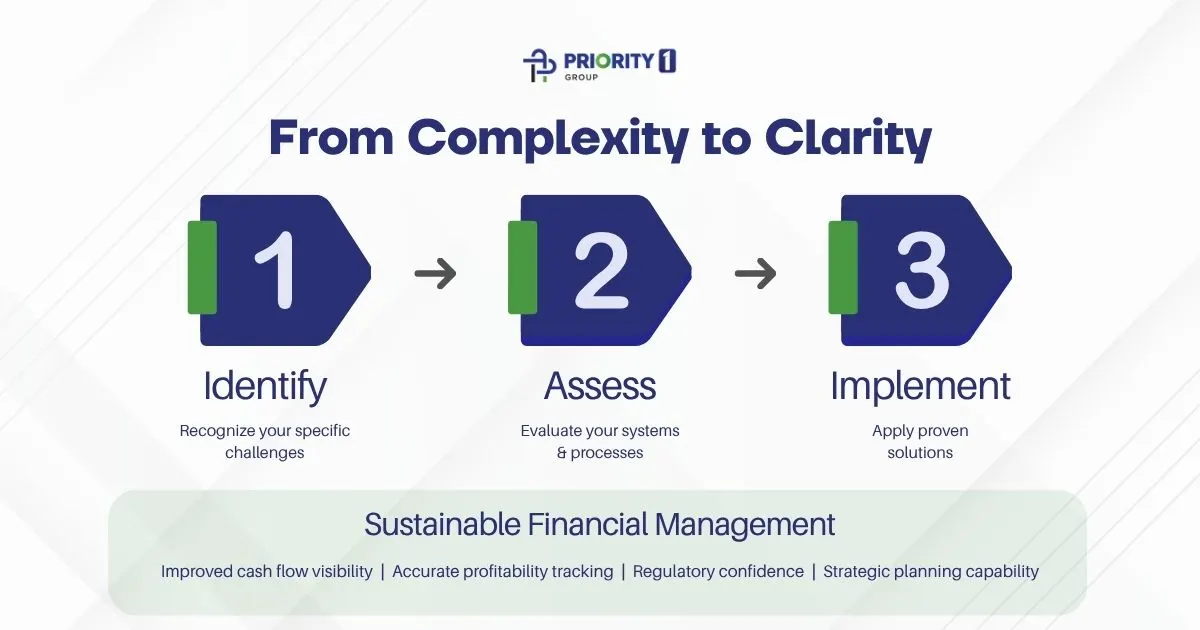
NDIS accounting challenges are real, but they’re not insurmountable. Providers who invest in specialised financial systems, implement robust documentation practices, and work with accountants who understand the scheme’s complexities build sustainable, profitable businesses.
The key is moving beyond treating accounting as a compliance exercise and instead using financial data as a strategic management tool. When you understand your margins, forecast your cash flows accurately, and monitor key performance indicators, you gain control over your business’s financial destiny, regardless of NDIS scheme changes or market fluctuations.
If your current accounting setup doesn’t provide this level of visibility, or if you’re struggling with any of the challenges outlined above, it’s time to revisit your financial infrastructure. The cost of upgrading your systems and processes is far outweighed by the improved financial performance and reduced compliance risk that follows.
About Priority1 Group: Priority1 Group specialises in helping NDIS providers and other Australian SMEs manage complex financial challenges. We offer dedicated accounting, bookkeeping, and payroll services designed for disability support organisations. Contact us to discuss how we can strengthen your financial management.