

In the early stages of business, bookkeeping rarely feels urgent until it becomes painful.
At first, it is just a few receipts in the glovebox, a couple of supplier invoices buried in email, and a promise to “sort it out later.” Then later turns into end of month, quarter-end, or BAS time, and suddenly the books are behind, transactions do not match, and cash flow feels harder to understand than it should.
That is the reality for many small businesses. Time is limited. Cash flow can be inconsistent. Admin gets pushed behind sales, service delivery, and day-to-day problem-solving. The issue is not that owners do not care about their numbers. It is that they are doing too much at once.
This is why many owners choose to outsource bookkeeping earlier than they first planned. Not to hand over control, but to create consistency. When the right tasks are handled by the right people, your books stay cleaner, your reconciliations stay manageable, and your business runs with far less stress.
The goal isn’t perfect books. The goal is books clean enough that you always know where you stand and a partner who keeps them that way.
Most bookkeeping advice is written for businesses that already have a rhythm. It assumes consistent monthly revenue, organised records, and a dedicated hour or two each week to review finances. Early-stage Australian businesses rarely have any of these things.
What you actually have is inconsistent cashflow that makes it genuinely unclear whether a good month covers a slow one. You have receipts across email, a wallet, your phone’s photo roll, and a drawer you have quietly been avoiding. You have a contractor paid via bank transfer, a client who paid two invoices in a single payment, and a stack of BAS obligations building quietly in the background.
Messy early-stage records don’t just create stress; they cost real money. Missed expense deductions, BAS errors, late ATO filing penalties, and the time spent reconstructing months-old transactions can easily outpace the cost of professional bookkeeping. The messier the start, the more expensive the clean-up. Priority1 Group’s bookkeepers are trained to handle exactly this and to set you up so it never happens again.
The problem compounds over time. A week of unrecorded transactions becomes a month. A month becomes a quarter. By the time you sit down to reconcile, you are not doing bookkeeping; you are doing archaeology.
The solution is not to become more disciplined about spreadsheets. It is to build a system early that does not depend on willpower to function.
 The first instinct many founders have is to keep bookkeeping in-house to save money. This is understandable. It is also, in most cases, a false economy. The question is not whether you can do your own books. It is whether doing them yourself is the best use of the hours you have.
For most early-stage business owners, those hours are worth far more spent on sales, client delivery, and operations than on reconciling bank statements. Priority1 Group’s outsourced bookkeeping service is designed precisely to take that weight off your desk permanently.
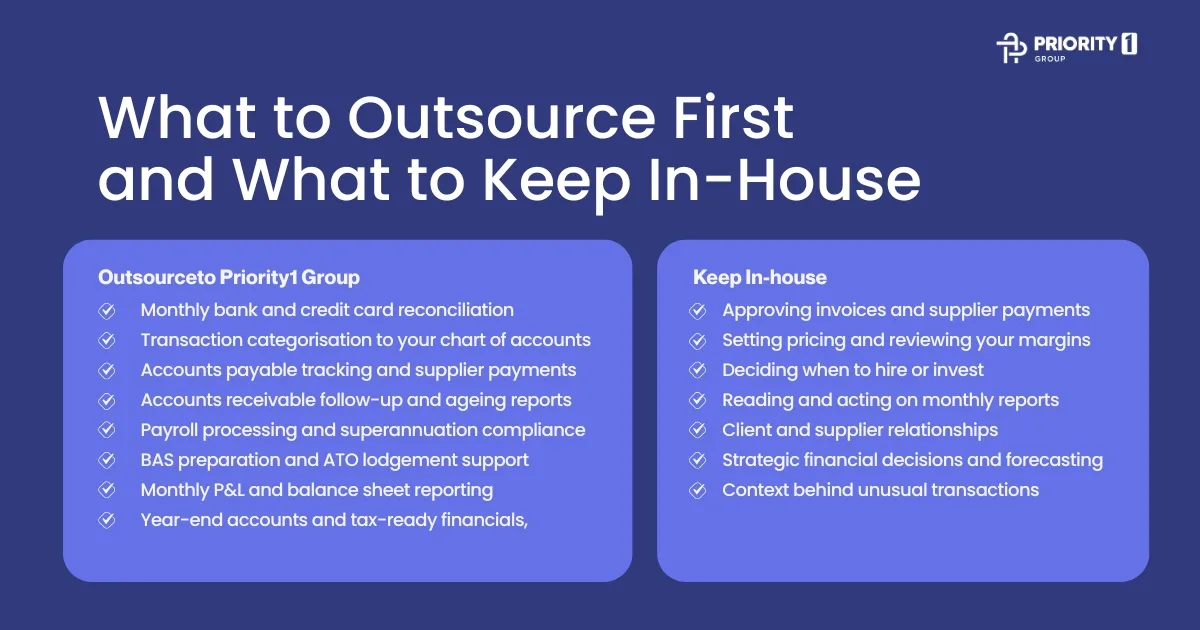
→ Monthly bank and credit card reconciliation
→ Transaction categorisation to your chart of accounts
→ Accounts payable tracking and supplier payments
→ Accounts receivable follow-up and ageing reports
→ Payroll processing and superannuation compliance
→ BAS preparation and ATO lodgement support
→ Monthly P&L and balance sheet reporting
→ Year-end accounts and tax-ready financials,
→ Approving invoices and supplier payments
→ Setting pricing and reviewing your margins
→ Deciding when to hire or invest
→ Reading and acting on monthly reports
→ Client and supplier relationships
→ Strategic financial decisions and forecasting
→ Context behind unusual transactions
Priority1 Group assigns you a dedicated bookkeeper as your single point of contact. They learn your business, your chart of accounts, your suppliers, and your patterns. What you keep in-house is interpretation and decision-making. What you hand to Priority1 Group is the data entry, compliance, and reporting done accurately, on time, every month.
 The biggest friction in any outsourced bookkeeping arrangement is not cost; it is getting information to your bookkeeper in a form they can use. A receipt photographed and sent immediately takes ten seconds. The same receipt reconstructed six weeks later takes twenty minutes and may still be wrong.
Priority1 Group works with Xero, QuickBooks Online, and MYOB. So, your records live on a platform, both you and your dedicated bookkeeper can access in real time. The habits below are designed to make that connection as frictionless as possible.
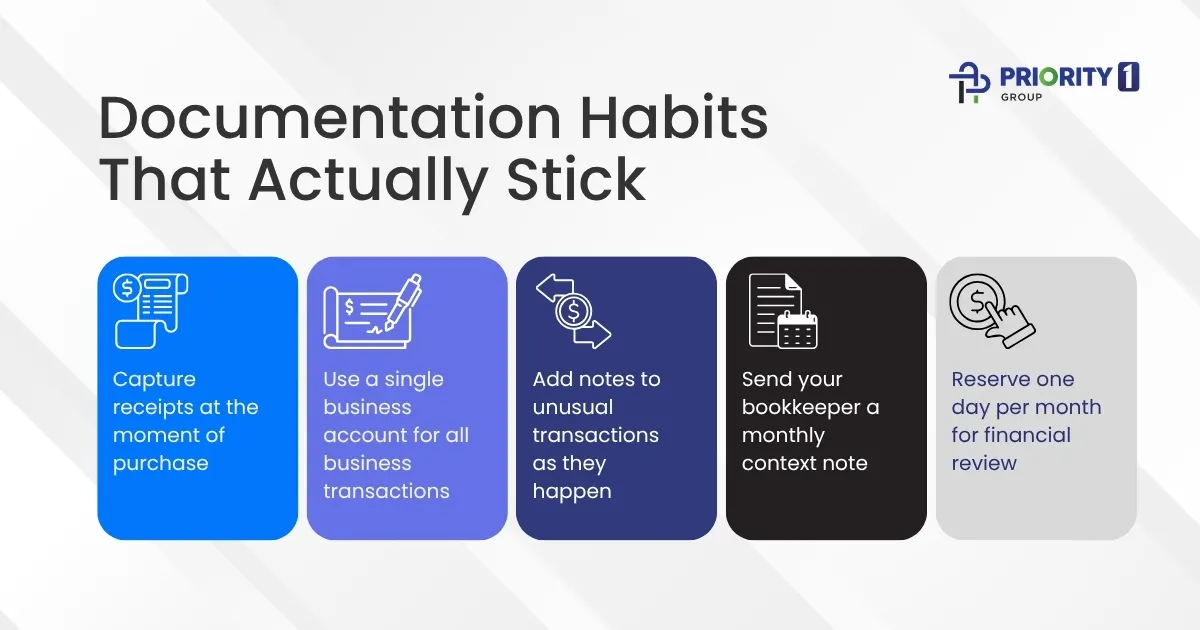
Use your accounting platform’s mobile app (Xero, QuickBooks, or MYOB) to photograph and upload receipts on the spot. Your Priority1 Group bookkeeper receives them directly no email chains, no lost paperwork.
A dedicated business bank account connected directly to your accounting software is the single most effective thing you can do. Priority1 Group sets up this bank feed as part of your onboarding; transactions arrive automatically, removing the biggest lag in the process.
When you pay something that doesn’t explain itself a cash purchase, a payment to a new supplier, a reimbursement; add a brief note immediately. Your Priority1 Group bookkeeper will see it and categorise correctly, avoiding a back-and-forth that delays your monthly close.
A short message at the start of each month ‘new contractor started, cancelled that subscription, one cash purchase at the trade fair’, gives your dedicated bookkeeper the context they need to close your books accurately without chasing you for explanations mid-month.
Not data entry, Priority1 Group handles that. This is your hour or two to read the P&L your bookkeeper has prepared, flag anything unexpected, and approve what needs approving. That is the full extent of your monthly bookkeeping commitment.
Reconciliation is where bookkeeping breaks down for most small businesses. The information exists, it is just scattered, delayed, and out of sequence. By the time you sit down to reconcile, there are transactions you do not remember, supplier invoices that never arrived, and a client payment sitting in the wrong period.
A reconciliation that happens monthly takes an hour. The same reconciliation at year-end takes a week and still misses things.
Priority1 Group builds these into every new client’s setup from day one:
When your bookkeeper at Priority1 Group reconciles your accounts each month, they need two things: the bank feed (already connected) and the supporting documentation (already uploaded via your accounting app). With those two inputs in place, monthly reconciliation becomes a routine process rather than a quarterly crisis.
The months where you will feel the difference most are the ones where something irregular happens an insurance payout, a refunded expense, a client who pays two invoices in one transfer. Your Priority1 Group bookkeeper knows how to handle these correctly. Left to reconstruct them yourself weeks later, you would have spent an afternoon guessing.
The businesses with clean books are almost never the ones with the most disciplined founders. They are the ones with the best systems. A good monthly rhythm removes the need for willpower by making the right behaviour automatic.
Here is the sustainable financial rhythm Priority1 Group establishes with every small business client:
☐ During the month: capture receipts via your accounting app; note unusual transactions as they occur
☐ By the 5th: send any remaining documents not yet in the system plus your brief monthly context note to your Priority1 Group bookkeeper
☐ By the 10th: Priority1 Group completes reconciliation and delivers your monthly P&L, balance sheet, and cashflow summary
☐ By the 15th: you review the reports, flag any questions, approve payments that require sign-off
☐ End of month: pay any outstanding invoices; issue any invoices not yet sent; clear any loose receipts
☐ Quarterly: Priority1 Group prepares and lodges your BAS; reviews cashflow against prior quarter
☐ Annually: Priority1 Group produces tax-ready financial statements and liaises with your accountant for year-end filing
This rhythm works because it distributes effort across the month rather than concentrating it at year-end. Priority1 Group’s team handles the processing and compliance; you handle the reading and decision-making. Neither of you is chasing the other.
Irregular income is one of the most common early-stage realities and one of the most disruptive to financial clarity. A good month followed by two slow months can make it genuinely difficult to know whether you are growing, treading water, or heading towards a problem.
This is where consistent monthly reporting becomes particularly valuable. When every month is reconciled and reported, you can see patterns that are invisible in the moment: that March is always slow, that your biggest clients pay 45 days late despite 30-day terms, that your software subscriptions have crept up 40% with no corresponding revenue lift.
None of these insights emerge from a year-end scramble. They come from the clean monthly reports Priority1 Group delivers every single month on time, in plain English, actionable.
There is a version of the outsourcing conversation that is about saving time. That is true but incomplete. The more important version is about what becomes possible when your books are clean and current.
When you know your numbers genuinely, month by month, you can make decisions confidently. You can see whether you can afford to hire. You can tell a prospect your day rate knowing it covers your costs. You can approach a bank or investor with financial statements you actually understand and trust.
Outsourcing bookkeeping early is not a sign that you can’t handle your finances. It is a sign that you understand what your time is actually worth and what a reliable partner is worth too.
Priority1 Group’s Smart Sourcing model is built to scale with you. As your business grows, the complexity of your bookkeeping grows with it more employees, more invoices, more payment terms, more payroll obligations, more BAS complexity. Priority1 Group scales its service to match, without you needing to onboard a new provider at every stage.
A bookkeeper who has been working with you since your early days already understands your business. They know your chart of accounts, your key suppliers, your payment patterns, and the context behind your unusual transactions. That institutional knowledge is genuinely valuable and it only exists if you built the relationship early.
Priority1 Group serves businesses across healthcare, NDIS, real estate, hospitality, construction, manufacturing, and beyond. Whatever your industry, the outcome is the same: clean records, accurate reporting, and financial clarity that lets you run your business rather than chase your books.
You do not need perfect records from day one. You need a decision, a system, and a team who can carry the load you should not be carrying alone.
The best time to outsource your bookkeeping was when you started. The second-best time is now.
Priority1 Group makes it easy to begin. Your first month is free. There are no lock-in contracts. Your dedicated bookkeeper sets up your accounts, cleans up any backlog, connects your bank feed, and delivers your first monthly report so you can finally see exactly where your business stands.
Priority1 Group offers your first month of bookkeeping free no lock-in contracts, no hidden fees. Let our dedicated bookkeeping team set up your accounts, reconcile your records, and hand you a monthly report you can actually read.